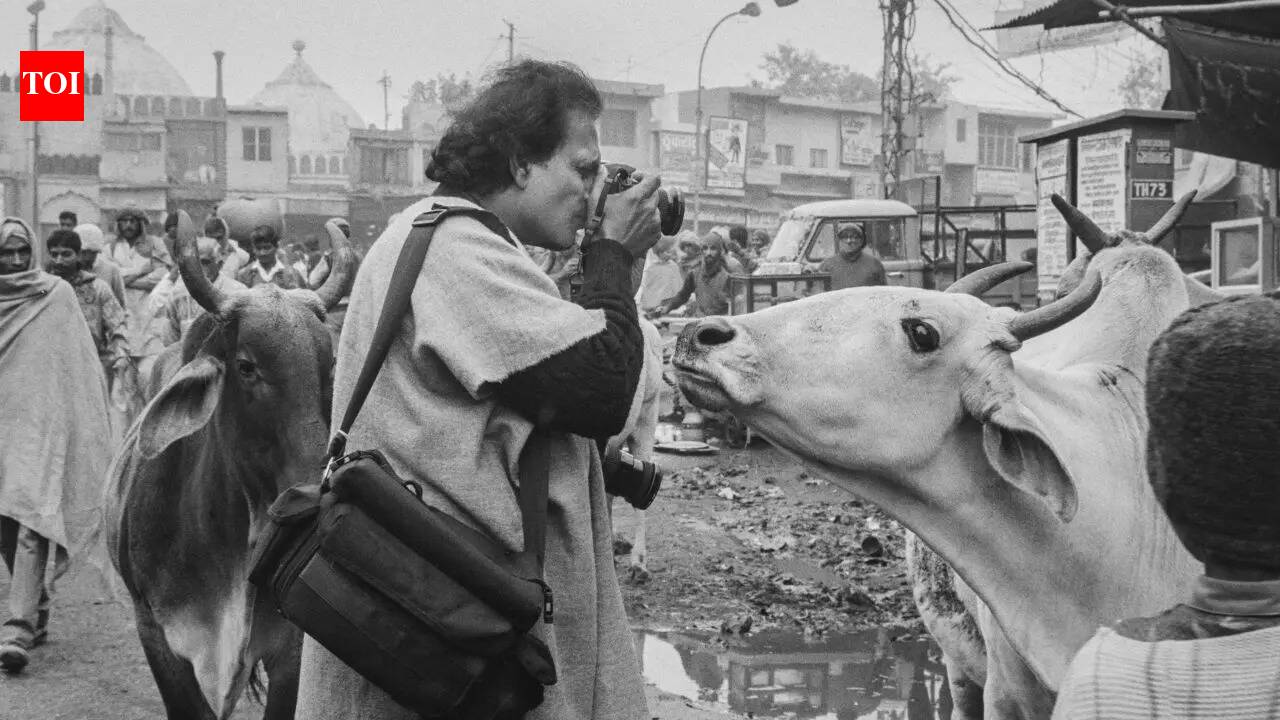

In one of Raghu Rai’s most haunting photographs from the Bhopal Gas tragedy, a grieving father cradles his dead child — the stark black and white image titled ‘Burial of an Unknown Child’ came to define not just one of the worst industrial disasters the world had seen, but the power of photojournalism itself.Rai, the legendary photographer who shaped India’s visual memory for over five decades, passed away on Sunday. From the Bangladesh War to the Bhopal Gas disaster, from portraits of Indira Gandhi and Mother Teresa to everyday life on Indian streets, Rai’s work did not merely document events, it gave them permanence. “Visual history is more important than making pretty and fine art photography. History is always written and is even being rewritten. But photo history cannot be rewritten,” Rai told TOI in an earlier interview.Born in 1942, Rai came into photography almost by chance but quickly rose to international prominence. By his late twenties, he was exhibiting in Paris, where his work caught the attention of Henri Cartier-Bresson, who would later nominate him to Magnum Photos in 1977. “I had my first exhibition in Paris in 1972, with 50 pictures of my work in India and 25 pictures of Bangladeshi refugees and the crisis there. Bresson was the first visitor. I wasn’t his student; he related to me as an equal because I had got great reviews from the French press, saying, ‘Great times for photography in Paris because Raghu Rai is showing here’,” Rai said of his association with the French master.At the core of his practice was an insistence on closeness — to people, to moments, to truth. “In photography, they say if you are not close enough, your photograph is not good enough,” he said. He described the act of photographing as deeply immersive: “If your energy is concentrated, then your mind, body and spirit get into a rhythm, and at that moment, you receive all that is there in front of you through your viewfinder.”Rai began his career in the analog era, whose permanence he deeply valued. “Silver gelatin prints have become very expensive, but their life is 150 years and more,” he noted, though he did do a lot of work with digital in his later years.He also reflected on how much the profession had changed. “The kind of freedom we enjoyed as photojournalists and the access we had in any given situation, even to a prime minister, is unthinkable now,” he said.Over nearly four decades in active journalism, including his tenure at The Statesman, Rai remained conscious of the fleeting nature of news. “In a newspaper, stories die daily,” he said. “So, I was mindful about my photographs living beyond dated stories.” In the hours after his death, social media filled with some of his most unforgettable frames — among them the 1982 Baroda photo essay capturing the wordless companionship between a blind Muslim beggar and a mentally challenged Hindu girl.In later years, he was sharply critical of the direction photography had taken. “The bulk of photography today is happy, snappy, colourful pictures that don’t come into the category of fine art,” he said.“Democratisation is good. But what exactly are these people doing? Selfies, self-love, making stupid faces? The worst thing is that even inside temples and churches, people are standing together and making faces. It’s become unbearable now,” he added.For Rai, the role of the photographer remained a serious one. “A serious photographer, a serious writer will use his pen, his lens for a meaningful expression that touches society, not to please himself,” he said.Even in his eighties, Rai remained engaged with the world, though age slowed him down. Even during the pandemic, he ventured out to take photos of the CAA and farmers’ protests. In an age flooded with images, his work reminds us that photography is not about capturing moments but keeping them alive. Go to Source