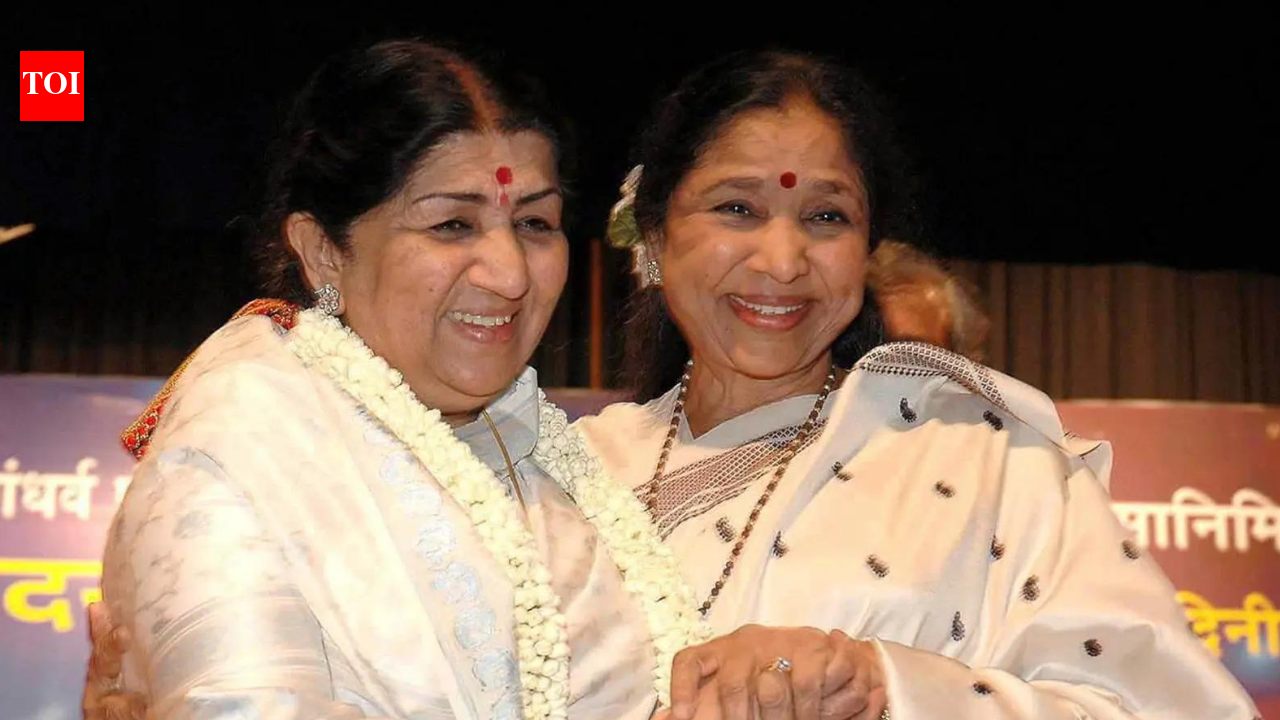

PTI file photo
Societies clinging to the past while dreaming of the future are often trapped between two mental states. India, just out of the clutches of colonialism, too experienced this duality in social order. In this general backdrop of ambiguity, the nation’s attitude to the female playback voice, too, was complicated. After all, voices are secret catalogues of social history. The voice we prefer at a certain moment in time tells something about ourselves.Around Independence, several singers such as Zohrabai Ambalewali, Rajkumari, Amirbai Karnataki, Shamshad Begum, Geeta Dutt, to name a few, jostled for space and ascendancy in Hindi film music. But within a few years, Lata Mangeshkar’s voice encapsulating purity and propriety became the gold standard for leading ladies and emerged decisively dominant.Asha Bhosle, almost four years younger, began her career under the shadow of her elder sister Lata. Keen to find her own voice, the Sangli-born singer listened to a farrago of foreign artistes: samba singer Carmen Miranda, the joyous Caterina Valente, even the breathless Elvis Presley, while trying to incorporate their styles in her rendition. “Slowly,” Asha revealed in an interview to composer Salil Chowdhury on DD Bangla in 1993, “I carved out a different style from my sister.”In time, the two voices became antonyms to each other. If Lata was the voice of the times, Asha was its hidden desire. Lata’s voice personified sincerity, virtuousness, consent — preferred and revered attributes of the time while Asha’s embodied wanting, abandon, dissent — traits frowned upon at the time. Lata’s voice conveyed the innocence of a morning hymn, the sanctity of a temple. Asha’s carried the sizzle of cabaret, the rush of a French kiss. Lata’s voice was the canon of the times, Asha’s a forecast of future freedoms.“Lata didi and I are like Mahatma Gandhi and Nehru. Gandhi was great; Nehru wasn’t bad either,” Asha told Outlook magazine in April, 2006.The sisters were fundamentally apart, not only in their voices, but also with their choices and in their personalities. She thinks with her “head”, me with my “heart”, Asha once said. Perhaps, circumstances played a role. Lata started singing for films at 13 after their father singer-actor Deenanath Mangeshkar’s untimely demise. She never married. Lata disapproved when Asha eloped. The younger sister had three children from a difficult first marriage. Interestingly, Asha’s early hits were children’s songs filmed on pre-teen boys like ‘De di hamey aazadi bina khadag bina dhal’, film: Jagriti, 1954), Chandamama door ke (film: Vachan, 1955).In the 1950s and 60s, Asha wasn’t the preferred singer of most A-list music directors, barring OP Nayyar, with whom she shared a close relationship. She was rarely the playback for major heroines. Nayyar – as well as composer Ravi — nourished her voice. She once credited BR Chopra for giving her the chance to sing for a big movie, Dilip Kumar’s ‘Naya Daur’ (music: OP Nayyar, 1957).By mid-60s, Asha had carved out her distinctiveness. Her range expanded. And her voice was richer in tone, more nuanced in texture. Three songs exemplify this. ‘Aagey bhi jaane na tu’ (Waqt, composer: Ravi, 1965) underlined a growing felicity for maximizing a tune by aligning each note with the lyrics’ emotional intent.In ‘Teesri Manzil’ (1966), young composer RD Burman rewrote Hindi film music’s grammar capturing the new musical zeitgeist. Singing for the film was like a dare for Asha, especially the breathless ‘Aaja aaja’, where her voice needed to pirouette, shake and shiver as if caught in the middle of a mating game. In ‘Teesri Kasam’, set in hinterland Bihar and released the same year, her rendition of ‘Pan khaye saiyan hamaaro’ was flawless flavouring the film with a folksy authenticity.The three songs belonged to three different musical worlds, but Asha seemed to be an honorary native to each of them.Music director RD Burman, whom she would marry in 1980, was an enabler. “…it was Pancham (RD Burman) who really exploited the full potential of my voice and challenged me to greater heights,” she told journalist Kavita Chhibber in a long 2003 interview. She added, “When he offered me Aaja aaja, I was petrified…but didi said you are a Mangeshkar and you can do it.” The remark reveals how Lata was also a mentor, though there are accounts to suggest differences, even a feature film, “Saaz”, which seemed to partly borrow from their lives, suggesting rivalry.Broadly speaking, RD preferred Lata for his more classical compositions. But the nightclubs with cigarette smoke and the grungy hippy joints were Asha’s fiefdom. These settings were home to some of the most furious and distinctive 70s rhythms. ‘Mera naam hai Shabnam’ (film: Kati Patang, 1970), ‘Piya tu ab to aaja’ (film: Caravan, 1971), ‘Dum maaro dum’ (film: Hare Rama Hare Krishna, 1972) and many more.In 1981, ‘Umrao Jaan’ (music: Khayyam) became to Asha what films like ‘Anarkali’ and ‘Pakeezah’ were to Lata. Her voice became an extension of the courtesan’s melancholic life. “Through her voice, you reach Umrao Jaan’s soul,” Khayyam told this reporter in 2008. The song, ‘Dil cheez kya hai,’ fetched her a national award. So did ‘Mera kuchh saamaan’ for Ijaazat (1987).Compared to Lata, Asha was more eager to embrace and adapt to shifting music trends. Hers was the deviant voice that the more conservative India sought to consign to the background. But as the country changed and evolved, she found wings. To Asha’s credit, she never stopped soaring.That’s what made her durable and relevant even when she stepped into her 90s. In 1980s, when disco was the celluloid favourite and ghazals the flavor of private albums, she sang ‘Disco Station’ for Bappi Lahiri (film: Hathkadi, 1982) and outshone Pakistani singer, Ghulam Ali, in Meraj-e-Ghazal (1983).When Indi-Pop took centre stage in the 1990s, she delivered one of its most memorable tracks, “Jaanam samjha karo. (1997)” Cutting tracks with personalities as divergent as Boy George and Brett Lee was part of an unrelenting journey to not only move with the times, but stay a beat ahead. Even in 2026, when 92, she hooked up with Gorillaz, a virtual British band, for “The Shadow of Light”!Much before the two sisters reached the autumn of their careers, Asha had become the preferred voice for a new generation of singers. She was their lighthouse and lodestar.Whether we like Asha or Lata has more to do with the person we are rather than the songs they sang. We see in their voices our own reflections. For true lovers of music, it is never Lata or Asha; it is always both. Go to Source