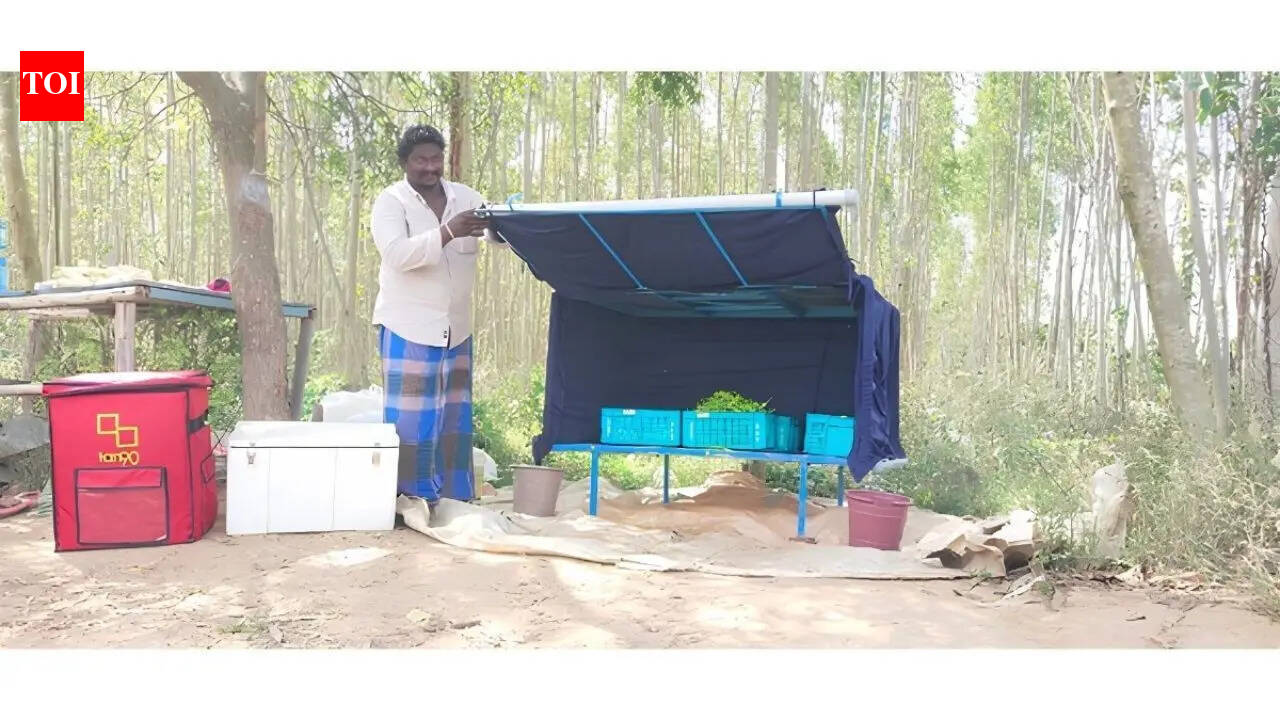

Every harvest season, the outcomes are dreaded. Tomatoes get mushy, leafy vegetables go limp within hours of being cut. In Northeast India, most agricultural yields never make it to urban markets, the reason isn’t a lack of produce or demand, but because refrigerated vehicles are the only option, and their fuel and transit costs make the economics impossible before the journey begins.India does have cold storage infrastructure, but most of it exists near mandis, highways, and cities. For a small farmer from rural Andhra Pradesh or a fisherman returning to a coastal landing site, it might as well not. India loses nearly ₹92,000 crore in food spoilage every year, much of it before it even reaches consumers.On the coastline, fishermen have to purchase ice for every single trip, which degrades in quality, takes up space that could carry catch, and costs money with no subsidy for operating expenses. The burden of preservation falls entirely on the producer. Phase Change Materials (PCM) have changed that by enabling freezing them overnight and using them in an insulated box, which replaces ice in totality. The Result? 50% deduction in expenses and volume utilisation of the shipper box.Expanding this access is where Tan90’sCooling-as-a-Service (CaaS) model comes in: instead of asking farmers to own this equipment, a hub-and-spoke structureplaces a central PCM charging facility at an FPO warehouse, with micro-entrepreneurs distributing charged panels to rent to farmers and fishermen. Due to this, the cold chain has become accessible, not a capital barrier.The real problemIndia’s standard response to food loss has been to build more cold rooms. Tan90 challenges this directly: without a route to the buyer, storage alone creates no economic value. Most facilities are located near mandis, highways, or urban areas, impractical for small growers. Leafy vegetables are particularly vulnerable, with shorter fresh windows leading to a sharp price drop.The CaaS model has completely changed the game for Cold Chain. A farmer doesn’t have to invest in a freezer; he will pay for what he uses and for how long he uses. The hub-and-spoke model makes this possible; think of the hub as a communal FPO Warehouse, and the spoke as a local entrepreneur who makes this accessible for the last mile- farm gate, ports, or the market.This model is already working in the urban areas; the bigger challenge is rural reach, where proximity to these hubs remains inaccessible.The Northeast makes this apparent; they produce high-value exotic fruits and vegetables, buyers exist, but the only bridge is a reefer vehicle whose costs make small volumes commercially unviable. PCM-based portable cold chain solutions offer a viable pathway, including transportation on rail routes, sea routes for longer duration, without requiring intensive capital.The science behind PCMTan90 Thermal Solutions, founded in 2019 by three IIT Madras scholars, was built on something India’s cold chain largely ignores: PCM- a patented tech that stores and releases thermal energy during melting and solidifying at specific temperatures, without electricity. Charge them in a standard freezer or their blast freezer, place them in insulated bags, and you have a portable cold chain system with you. For the fisherman, this means a 70 Ltr Shipper Box can carry over 60 kgs of catch rather than just 25 kgs in a traditional ice set-up, which is over 50% increase in their direct earnings per trip per box.“Cooling infrastructure must be easily accessible on demand, scalable and sustainable without needing to rely on outdated heavy capital investment or systems,” saysSoumalya Mukherjee, Co-founder.On the groundThe field test came through the Krishi Mangal programme across roughly 30 villages in Andhra Pradesh and Telangana, supported by Social Alpha. Over 5,000 farmers were reached, average incomes rose by approximately 16%, 25 tonnes of produce were saved from spoilage, and 1,300 tonnes were stored.Farmer-Producer Organisations that co-invested reclaimed their costs within months. Others began approaching them unprompted, seeking to replicate the model, the clearest sign of sustainability. This aligns with the national direction: under Prime Minister Modi’s government, cold storage modernisation, including solar-powered infrastructure under Kusum 2.01, has been a stated policy priority.The bigger pictureThe Indian cold chain market, valued at over USD 10 billion in 2024, is rapidly growing. Tan90 now operates a Cooling-as-a-Service (CaaS) model across eight Indian cities, letting businesses access temperature-controlled logistics without owning assets. In 2025, Series A led by NAB Ventures, participation from Blue Ashva, 3i partners, and Capital A is being used to expand into additional cities and scale into Southeast Asia, West Asia, and Africa.What makes them different is their material science foundation, service-led model, and on-the-ground results, but their most distinctive idea is micro-entrepreneurship.Reference/s:https://www.pib.gov.in/FactsheetDetails.aspx?Id=148576®=48&lang=2Disclaimer – The above content is non-editorial, and TIL hereby disclaims any and all warranties, expressed or implied, relating to it, and does not guarantee, vouch for or necessarily endorse any of the content. Go to Source