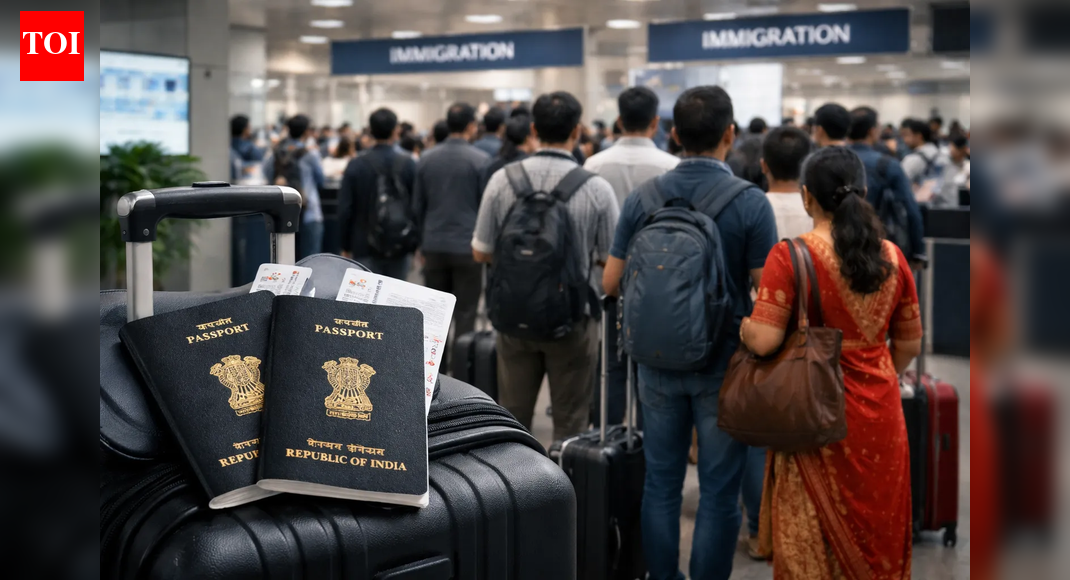

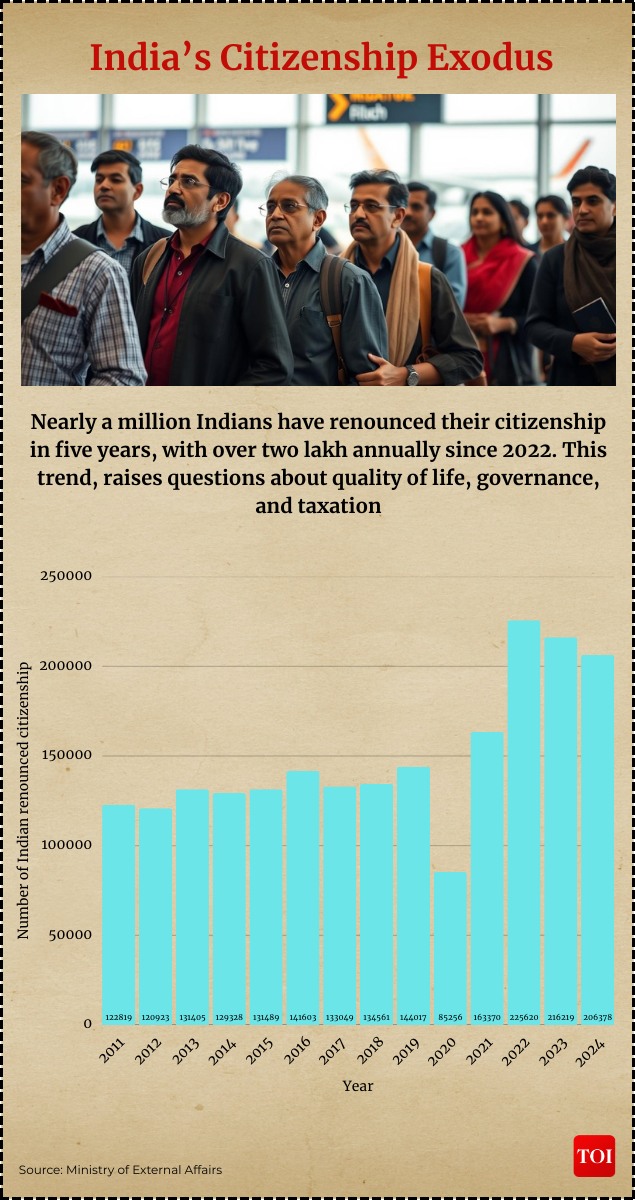
NEW DELHI: Close to one million Indians have renounced their citizenship over the last five years, with annual numbers crossing the two-lakh mark consistently since 2022, according to data presented by the government in Parliament. The trend has reignited a crucial question why a growing number of Indians – particularly the wealthy and highly skilled – are choosing to give up their Indian passports.
Responding to questions raised by Congress MP KC Venugopal in the Lok Sabha, the ministry of external affairs (MEA) said that 2.06 lakh Indians gave up citizenship in 2024, following 2.16 lakh in 2023 and 2.25 lakh in 2022. Earlier, 1.63 lakh renunciations were recorded in 2021, while the figure stood at 85,256 in 2020, the lowest in a decade due to Covid-related disruptions.Between 2011 and 2024, a total of over 20.6 lakh Indians renounced citizenship, with nearly half of them doing so in just the last five years, the government presented data during the ongoing winter session showed.Venugopal sought details on whether the government had studied the reasons behind the rising trend and what steps were being taken to curb citizenship renunciation, particularly among younger Indians. The issue has also been raised by other opposition leaders in recent years, who have flagged what they describe as a growing “exit of the successful” from India.Leading opposition members including TMC MP Mahua Moitra have previously as well questioned the government as to why people are renouncing Indian passports. During a debate on the economy she had asked whether this indicated a “healthy economic environment” or a “healthy tax environment”. Moitra alleged that an “atmosphere of terror” created by the enforcement directorate (ED), with investigations primarily targeting opposition leaders and businessmen, was a contributing factor.Sanjaya Baru, media adviser to former PM Manmohan Singh, in his book ‘Secession of the Successful’, argued that India is witnessing a fourth wave of emigration, marked by the departure of high net worth individuals (HNIs), their families, and elite professionals. Citing Morgan Stanley data, Baru noted that around 23,000 Indian millionaires left the country between 2014 and 2023.Opposition leaders have repeatedly questioned whether rising wealth migration reflects concerns over quality of life, governance, education, taxation and long-term security, especially when compared to developed economies.
MEA: Reasons are ‘personal’, diaspora an asset
In its written reply, minister of state for external affairs Kirti Vardhan Singh said the reasons for renunciation are personal and known only to the individuals concerned.“The Government recognises the potential of the global workplace in an era of knowledge economy,” the MEA said, adding that a successful and influential Indian diaspora is an asset. It added that the government’s focus was on engaging the diaspora and leveraging its expertise and soft power, rather than discouraging overseas citizenship.The MEA also placed on record a list of 135 countries whose citizenship Indians have acquired, underlining the global spread of the trend.
No dual citizenship a key factor
One of the most cited reasons for Indians giving up citizenship is India’s lack of dual citizenship. Under Section 9 of the Citizenship Act, 1955, any Indian who voluntarily acquires foreign citizenship automatically loses Indian citizenship.For Indians abroad, citizenship often decides access to voting rights, social security, permanent residence, public-sector employment and legal protections. While Overseas Citizen of India (OCI) status allows visa-free travel and limited economic rights, it does not give much of political rights.As a result, many long-term migrants – especially those with families – are left with little choice but to formally renounce Indian citizenship.
Post-Covid surge, not just backlog
While the sharp jump in 2022 was partly attributed to pandemic-era backlogs, the continuation of high numbers in 2023 and 2024 suggests a new baseline, analysts say.Before the pandemic, annual renunciations largely remained within a range of 1.2 lakh to 1.45 lakh for nearly a decade.
Who is leaving – and why
Though occupation-wise data is not available, global studies show that Indians form one of the world’s largest skilled migrant populations. According to the UN, India has remained the largest source country of international migrants, with a diaspora of 17.5 million as of 2019.In the US alone, 81 per cent of Indian immigrants aged 25 and above hold at least a bachelor’s degree, significantly higher than both native-born and other immigrant groups, according to the Migration Policy Institute.Migrants often cite better pay, cleaner environments, reliable infrastructure, stronger civic services, education systems and clearer pathways to residency and citizenship abroad. For many, citizenship becomes the final step in a long migration journey that begins with education and employment.
Remittances high, but concerns persist
India remains the world’s top recipient of remittances, receiving an estimated $125 billion in 2023, according to the World Bank. However, opposition leaders argue that the steady outflow of citizens/ brain drain – especially among the affluent and skilled – calls for the need for reforms in urban living conditions, public health, education, social security and income parity.As renunciation numbers moves upwards of two lakh annually, the issue is likely to remain a political and policy flashpoint, particularly amid concerns over talent retention and long-term economic competitiveness. Go to Source