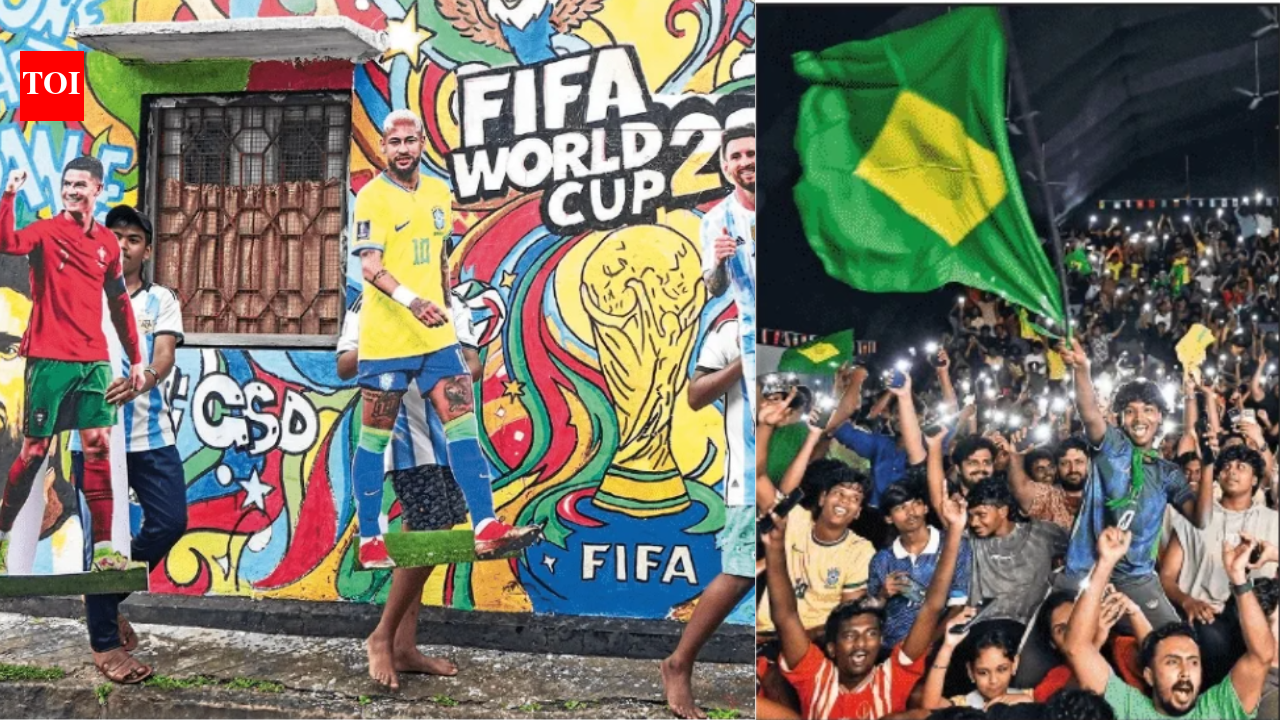

Football fans carry cut-outs of Ronaldo, Neymar and Messi in Kolkata; Kozhikode fans watch Brazil vs Morocco. (PTI and Reuters photo)
Cross. Control. Dribble. Goal! Add the alarm’s snooze to the play and you have World Cup magic in this part of the world.In its opening weekend, the Cup has begun capturing Indian fans’ imagination and viewers are juggling work, family obligations and tricky time difference to catch the action unfolding at unearthly hours in US, Canada and Mexico.The five-week long event is still to witness Mbappe’s prodigious dash, Haaland’s towering presence and the magic of teenaged Yamal. But with the games beginning after midnight and ending at dawn, sometimes even well into the mornings, Indian fans have seemingly stepped into a portal, choosing to live by another continent’s clock. The altered routines include saving leave, setting 3am alarms, negotiating childcare, pushing back office mornings, choosing highlights over live action, and deciding early those fixtures that can’t be missed. The key, as in many things desi, is jugaad.For Indore’s Jomon M George, that habit began years ago. As a teenager, he waited for late-night TV broadcasts, collected bubble gum cards of Baggio and Donadoni, and spent the next day arguing football with friends. “Baggio was our favourite,” he says.Not a 4-week distraction, but a month around which routines are rebuiltJomon said he has watched every World Cup edition since 1994, the last time incidentally that it was played in the US with similar allnighters before the TV sets. He wasn’t going to miss this one either. Despite the many online alerts at hand, the MO is unchanged: fixtures marked in advance, work finished early when possible, power naps before the big games and shrill alarms set for those times when resolve alone cannot be trusted.Few fans may manage that kind of dedication. But everyone recognises the labour — and love — behind it. The World Cup does not enter their lives as a four-week distraction; it becomes the month around which routines are rebuilt.At home, the negotiations can be even more exacting. Kolkata’s Jayitri Sengupta, currently working in Melbourne, has a three-year-old child, so she and her husband began a savings kitty over a year ago. The ‘investment’ would help hire a cook and babysitter for the month, just so taking care of the child would not come at football’s expense. “We were able to make the arrangements,” she says brimming with pride.A long distance away, Mohammed Asif, 41, a businessman in Hyderabad’s Manikonda and a father of four, remembers World Cups through images that stayed with him — Ronaldo’s haircut in 2002, Zidane’s headbutt in 2006, Spain’s tiki-taka in 2010 and Mario Gotze’s extra-time winner in 2014. The Brazil edition tested him the most, he remembers, because it coincided with Ramzan and many matches began around midnight or 3am India time. Then in the corporate sector, he used all the tricks the rule book allowed. “I used every type of leave available — casual leave, sick leave, compensatory offs and even lossof-pay days — to ensure I didn’t miss the key games,” he says, “It also meant plenty of coffee and constant fatigue, but it was worth it.”This time, Asif’s night begins only after his children are tucked into bed. On June 12 -13, he made sure they were in bed by midnight before sitting down to watch the opening games of the current edition. “Fans do find a way,” he offers philosophically.Old-timers measure not only what they watch, but how watching itself has changed. Analendu Roy, 51, an educationist from Visakhapatnam, has followed the World Cup since 1986, when Diego Maradona led Argentina to a famous victory.With telecast entering smartphones, and thus, offering a more private experience, Roy misses the old collective viewing culture. “When we watched football matches — together in packed rooms with 40 or 50 people — the atmosphere was different,” he says, rueing, “Today, people stare into their devices. The excitement is there, but that shared experience is gone.”That packed room Roy misses today has not vanished entirely. It has moved and changed shape. In Shillong, Mangami will watch group-stage matches alone on his laptop but will shift to sports bars or join local watch parties when the a ctions hots up from the Round of 32 onwards.Of course, it’s easier for the young. Shaheen Fathima, 26, from Auroville, a content creator and Germany supporter, says her strongest memory is of the World Cup in Brazil, when games overlapped with sehri. She scoffs at the idea of it being tough to wake up at 3am “Football”, she says, “widened my curiosity about flags and cultures. Watching it expanded my curiosity to learn new things.”What’s bailing out thousands of fans across the country is that peculiar bharta of jugaad, sacrifice and sheer will power. Deepak Arora, a young factory worker in Sonipat, has wrangled from his boss a change in shifts for the next few months.“Millions have made compromises to see the games,” 31-year-old Arora says, “I once thought I’d play for my state. Like many sportspeople in our country, my finances didn’t allow me. Watching the World Cup is the closest I can get to see those who God ordained to play, perhaps like gods themselves.” Go to Source