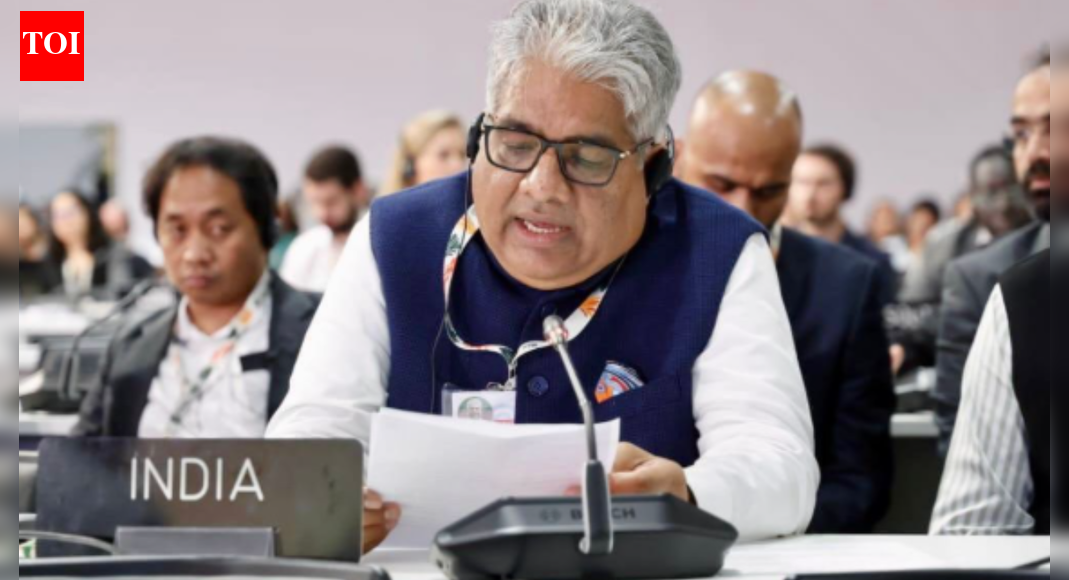

Bhupender Yadav
The 30th session of the UN climate change conference (COP30) concluded in Belem, Brazil on Nov 22, keeping alive the hope of multilateral processes to find answers to global problems. India was led by the country’s environment and climate change minister Bhupender Yadav during the crucial round of negotiations that finally ended with adopting the political outcome – Global Mutirao: Uniting humanity in a global mobilization against climate change – of the annual summit. Consensus on tripling adaptation finance by 2035, establishment of the Just Transition Mechanism, setting up a Global Implementation Accelerator – a two-year process to close the gap between current national climate plans and what is required to keep the global warming within 1.5 degree Celsius – and establishing a two-year work programme for delivery of climate finance are among the key outcomes of COP30. Yadav explained to Vishwa Mohan what these outcomes meant for India and what would be the fate of other critical issues which could not make it to the final decision document. Excerpts:Has the COP30 come up to the expectations of India?COP30 has fully met India’s expectations and stands as a strong affirmation of our leadership and commitment to climate multilateralism. The 29 decisions adopted by consensus clearly reflect India’s priorities across critical areas such as climate finance including adaptation finance, adaptation, unilateral trade measures, technology, and just transition, etc.India played a central role in shaping the ‘Mutirão’ Decision, which reinforces that multilateralism is working and must remain the backbone of global climate action.Driven by PM Narendra Modi’s leadership, India steered the group of like-minded developing countries. We were able to secure a dedicated two-year work programme on Article 9.1 of the Paris Agreement that will bring renewed focus to the legally binding finance obligations of developed countries. Our persistent efforts also ensured that concerns on Unilateral Trade Measures were advanced.India’s expectations on the Global Goal on Adaptation namely flexibility, voluntary nature of indicators, nationally determined indicators, no additional reporting burdens, and continued technical refinement, are all embedded in the COP30 outcome.We also ensured the setting up of Technology Implementation Programme to facilitate implementation of technology needs of developing countries. Importantly, COP 30 has established an institutional arrangement for just transition, reflecting the needs and priorities of developing nations.Overall, India’s core objectives of upholding inclusivity, safeguarding interests of developing countries, and strengthening trust in the multilateral process, have been fully realized at COP30.What more could have been done in Belém?In line with the positions, we advanced throughout COP30. India firmly and confidently articulated its priorities, especially on matters of vital importance to developing countries. We are satisfied with the outcomes, notably the creation of the dedicated work programme on Article 9.1, which places renewed emphasis on the finance obligations of developed nations. COP30 marks an important step forward in strengthening equity and reinforcing climate justice within the multilateral process.What was India’s stand on two critical issues – roadmap on transitioning away from fossil fuels and ending deforestation – during the negotiation? Both these issues could not make it to the final decision text.The COP 30 Presidency’s Belém Roadmaps on ‘Forest and Climate’ and ‘Transitioning Away from Fossil Fuels Roadmap’ have been developed outside the formal UNFCCC processes. The Roadmap on Forest and Climate seeks to bring together Parties and stakeholders to deliberate on strategies to halt and reverse deforestation. The Transitioning Away from Fossil Fuels Roadmap aims to address the fiscal, economic, and social dimensions of the global energy transition, outlining credible pathways for scaling up zero- and low-carbon solutions, while fully recognising national and regional circumstances.India welcomes the Forest and Climate Roadmap. We take note of the Roadmap on Transitioning Away from Fossil Fuels in the context of our national priorities and our long-standing commitment to ensuring energy security for our people.COP30 also witnessed the launch of the Tropical Forests Forever Facility (TFFF), a mechanism designed to provide long-term, results-based payments to tropical forest countries for verified conservation of standing forests. The facility aims to mobilise more than $6.7 billion in its first phase and has received endorsement from 63 countries, thereby establishing a permanent capital base for global forest protection. India is among the countries endorsing the TFFF as an observer.Did India articulate its points on the EU’s unilateral trade measure such as CBAM? Will it still be implemented by the EU from next year as per its plan?With unilateral measures such as the EU’s Carbon Border Adjustment Mechanism (CBAM) already taking effect, and similar initiatives being considered by the United Kingdom and Canada, it was critical for India that this issue be taken up formally on the COP 30 agenda. India, together with the Like-Minded Developing Countries (LMDC), tabled a proposal on “promoting international cooperation and addressing concerns arising from climate-change–related unilateral trade-restrictive measures.” Despite strong and unified opposition from developed countries, India pushed for substantive engagement. Intense negotiations followed, and although the matter did not enter the formal agenda, India secured a meaningful outcome.The COP30 decision reaffirmed that all Parties must cooperate to promote a supportive and open international economic system, one that advances sustainable economic growth and development, especially for developing countries, enabling them to more effectively address climate change. The decision also reiterated that climate-related measures including unilateral actions must not become tools for arbitrary or unjustifiable discrimination, nor serve as disguised restrictions on international trade.Under the adopted decision, Parties will now begin structured dialogues from June 2027 to examine opportunities, challenges, and barriers related to strengthening international cooperation on the role of trade in climate action. A high-level event will be convened in 2028 to exchange experiences and perspectives, with a summary report to be presented later that year.This outcome ensures that the issue of unilateral trade measures such as CBAM is duly highlighted as impediment to an open and fair economic system and as barriers that constrain the ability of developing economies to pursue ambitious climate action. Did the absence of the US make any difference on the overall outcome of COP30?India emphasized that a rules-based multilateral framework remains indispensable for ensuring equity, trust, and predictability in global climate action. Consistent with this approach, Country Parties at COP 30 demonstrated a clear and united commitment to strengthen multilateral climate cooperation, reaffirming that only global collective actions can effectively address the challenge of climate change. The absence of a country did not make any difference on the overall outcome of COP30.Parties at COP30 collectively acknowledged that the Paris Agreement continues to deliver substantive progress towards its temperature goals. Scientific assessments highlighted that, without the Framework Convention and the Paris Agreement architecture, the world would have been on a trajectory toward 3.5 – 4 degree Celsius of warming. Instead, current commitments and cooperative mechanisms have meaningfully bent the curve downward, demonstrating the value and effectiveness of sustained global climate governance. Go to Source