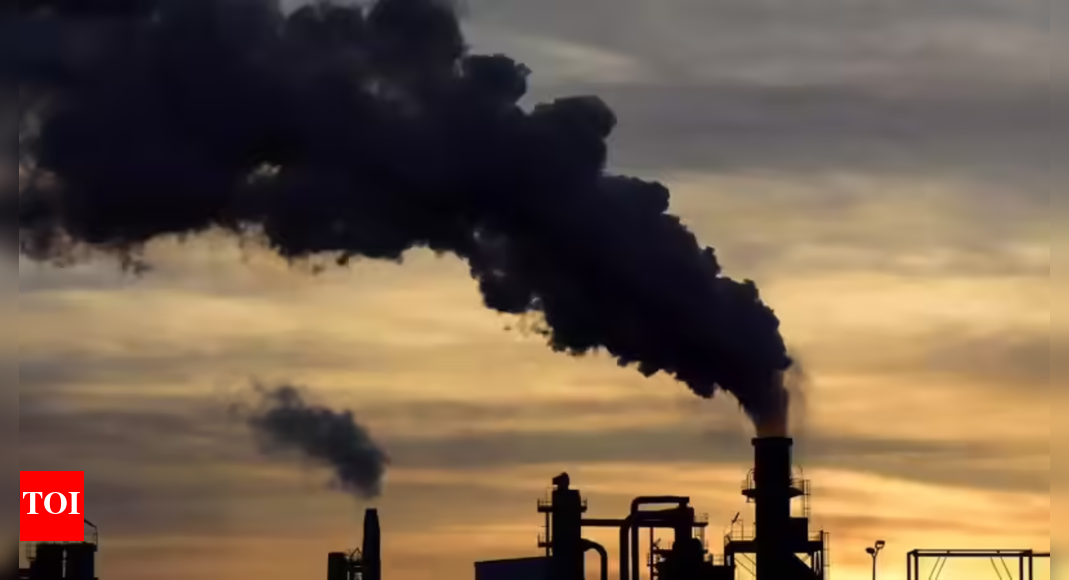

Representative image
BATHINDA: Carbon dioxide (CO2) levels in the atmosphere soared by a record amount to new highs in 2024, committing the planet to more long-term temperature increase, according to a new report from the World Meteorological Organisation (WMO).The WMO Greenhouse Gas Bulletin said continued emissions of CO2 from human activities and an upsurge from wildfires were responsible, as well as reduced CO2 absorption by “sinks” such as land ecosystems and the ocean – in what threatens to be a vicious climate cycle.Growth rates of CO2 have tripled since the 1960s, accelerating from an annual average increase of 0.8 ppm per year to 2.4 ppm per year in the decade from 2011 to 2020. From 2023 to 2024, the global average concentration of CO2 surged by 3.5 ppm, the largest increase since modern measurements started in 1957. “The heat trapped by CO2 and other greenhouse gases is turbo-charging our climate and leading to more extreme weather. Reducing emissions is therefore essential not just for our climate but also for our economic security and community well-being,” said WMO Deputy Secretary-General Ko Barrett. Concentrations of methane and nitrous oxide – the second and third most important long-lived greenhouse gases related to human activities – have also risen to record levels. WMO released the annual greenhouse gas bulletin to provide authoritative scientific information for the UN Climate Change conference in November. The COP 30 meeting in Belém, Brazil, will seek to ramp up climate action.“Sustaining and expanding greenhouse gas monitoring are critical to support such efforts,” said Oksana Tarasova, coordinator of the Greenhouse Gas Bulletin, which is one of WMO’s flagship scientific reports and is now in its 21st issue.Carbon dioxide – continued emissions and less effective carbon sinks When the bulletin was first published in 2004, the annual average level of CO2 measured by WMO’s Global Atmosphere Watch network of monitoring stations was 377.1 ppm. In 2024 it was 423.9 ppm.About half of the total CO2 emitted each year remains in the atmosphere and the rest is absorbed by Earth’s land ecosystems and oceans. However, this storage is not permanent. As global temperature rises, the oceans absorb less CO2 because of decreased solubility at higher temperatures, whilst land sinks are impacted on a number of ways, including the potential for more persistent drought.The likely reason for the record growth between 2023 and 2024 was a large contribution from wildfire emissions and a reduced uptake of CO2 by land and the ocean in 2024 – the warmest year on record, with a strong El Niño.During El Niño years, CO2 levels tend to rise because the efficiency of land carbon sinks is reduced by drier vegetation and forest fires – as was the case with exceptional drought and fires in the Amazon and southern Africa in 2024. “There is concern that terrestrial and ocean CO2 sinks are becoming less effective, which will increase the amount of CO2 that stays in the atmosphere, thereby accelerating global warming. Sustained and strengthened greenhouse gas monitoring is critical to understanding these loops,” said Oksana Tarasova, a WMO senior scientific officer. Today’s CO2 emissions to the atmosphere not only impact global climate today, but will do so for hundreds of years because of its long lifetime in the atmosphere.Methane and Nitrous Oxide Methane accounts for about 16% of the warming effect on our climate by long-lived greenhouse gases and has a lifetime of about nine years. Approximately 40% of methane is emitted into the atmosphere by natural sources (for example, wetlands) which are sensitive to climate as well, and about 60% comes from anthropogenic sources such as cattle, rice farming, fossil fuel exploitation, landfills and biomass burning. The globally averaged methane concentration in 2024 were 1942 parts per billion (ppb) – an increase of 166% above pre-industrial (before 1750) levels. Nitrous oxide is the third most important long-lived greenhouse gas and comes from both natural sources and due to human activities such as biomass burning, fertiliser use and various industrial processes.The globally averaged concentration reached 338.0 ppb in 2024, an increase of 25% over the pre-industrial level. Go to Source