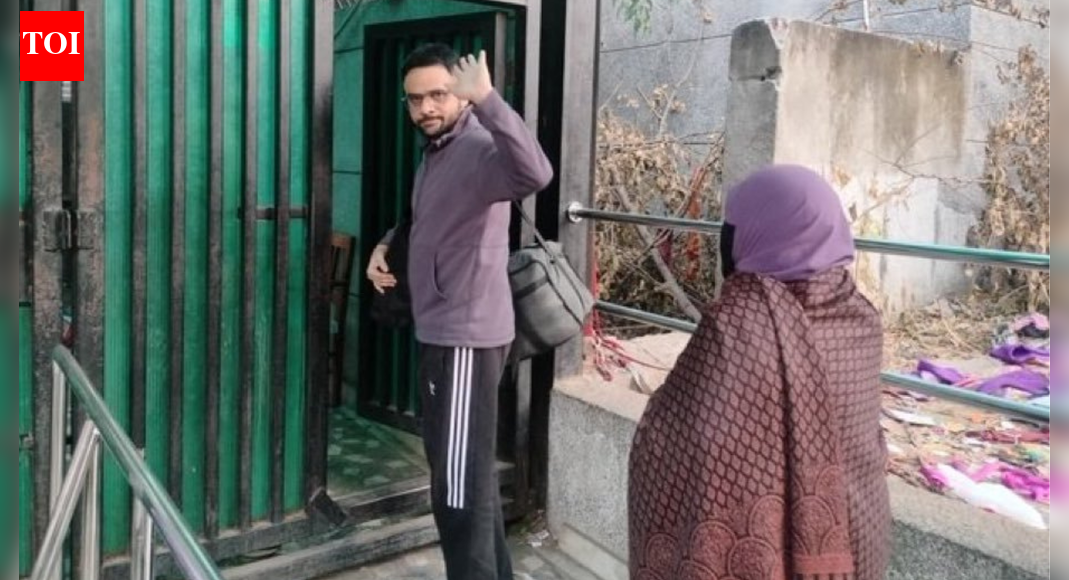

Umar Khalid returned to Delhi’s Tihar Jail on 29 December.
NEW DELHI: The Supreme Court on Monday pronounced its verdict on Umar Khalid, Sharjeel Imam and several others, rejecting their bail plea in the Delhi 2020 riots case.A bench comprising Justices Aravind Kumar and N.V. Anjaria rejected the bail pleas of Umar Khalid and Sharjeel Imam, saying that the two stand on different footing and it can’t be ignored in terms of parity and culpabilty.”Khalid and Imam can pray for bail after one year,” the SC added, saying that that terrorist act under UAPA is not confined to conventional warfare but includes all acts of attacking national integrity and sovereignity.The accused had challenged a Delhi High Court order refusing them bail in a case under the Unlawful Activities (Prevention) Act (UAPA) linked to the alleged larger conspiracy behind the 2020 north-east Delhi riots.The SC however granted bail to Gulfisha Fatima, Meeran Haider, Shifa Ur Rehman, Mohd. Saleem Khan, and Shadab Ahmad.
What the Supreme Court said:
- The court observed that Umar Khalid and Sharjeel Imam stand on a “qualitatively different footing” compared to the other accused, both in terms of the prosecution’s case and the evidence on record.
- The SC said their roles were “central” to the alleged offences.
- The bench noted that although their incarceration has been long and continuous, it does not violate constitutional guarantees nor override the statutory bar on bail under the applicable law.
- The Supreme Court held that the prosecution material discloses a prima facie case against Umar Khalid and Sharjeel Imam.
- It said the statutory threshold for denying bail under the law stands attracted in their case.
- At the present stage of the proceedings, the court ruled that they do not deserve to be released on bail.
- Activists Gulfisha Fatima, Meeran Haider, Shifa Ur Rehman, Mohd. Saleem Khan, and Shadab Ahmad, however, were granted bail by the Supreme Court.
The case so far
Counsel appearing for the accused had argued primarily on the prolonged incarceration of the petitioners and the uncertainty over the commencement of the trial. They had told the court that the accused have been in custody for more than five years despite facing serious charges under the UAPA, and contended that there was no evidence to show that they had instigated violence during the riots even after such a long period. Opposing the pleas, the Delhi Police had maintained that the alleged offences amounted to a deliberate attempt to destabilise the state. It argued that the violence was not the result of spontaneous protests but part of a well-planned “pan-India” conspiracy aimed at “regime change” and “economic strangulation”.The police further submitted that the conspiracy was allegedly timed to coincide with the official visit of the then US President to India, with the objective of attracting international media attention and globalising opposition to the Citizenship Amendment Act (CAA). The CAA, it said, was deliberately chosen as a “radicalising catalyst” under the guise of “peaceful protest”.According to the prosecution, the “deep-rooted, premeditated and pre-planned conspiracy” allegedly orchestrated by the accused led to the deaths of 53 people and extensive damage to public property, resulting in the registration of 753 FIRs in Delhi alone. It also claimed that evidence on record indicated an attempt to replicate the conspiracy on a pan-India scale, citing, among other things, the use of various WhatsApp groups, including the Delhi Protest Support Group (DPSG) and the Jamia Awareness Campaign Team.The Delhi Police argued that delays in the trial were attributable to the accused themselves and submitted that, if they cooperated, the trial could be concluded within two years.On September 2, the Delhi High Court denied bail to Imam, Khalid and seven others — Mohd Saleem Khan, Shifa Ur Rehman, Athar Khan, Meeran Haider, Shadab Ahmed, Abdul Khalid Saifi and Gulfisha Fatima. On the same day, another high court bench rejected the bail plea of co-accused Tasleem Ahmed.In its order, the high court observed that, prima facie, the role attributed to Imam and Khalid in the alleged conspiracy was “grave”, noting that they had delivered inflammatory speeches along communal lines to “instigate mass mobilisation of members of the Muslim community”. Go to Source