


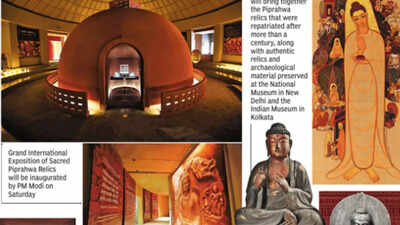
.
NEW DELHI: India will showcase its soft power to the world on Saturday through what is being cited as a first of its kind landmark exposition of Buddha’s Piprahwa relics, reliquaries and gem relics, recently repatriated to India.Set to be inaugurated by Prime Minister Narendra Modi at the iconic Rai Pithora Cultural Complex in Delhi, the repatriated Piprahwa gem relics constitute the most extensive assemblage of authenticated relics attributed to the Buddha thus far documented. The exhibtion featuring over 80 objects spanning the 6th century BCE to the present, includes sculptures, manuscripts, thangkas, and ritual objects.
Titled ‘Light and the Lotus: Relics of the Awakened One’, the display marks the “reunification of the Piprahwa gem relics of Lord Buddha, repatriated after 127 years, with relics, gem relics, and reliquaries from 1898 and then 1971-1975 excavations at the Piprahwa site,” the govt said in a statement. It highlighted that the exhibit “commemorates the ministry of culture’s successful repatriation of the relics in July 2025, achieved through a public-private partnership, halting an auction at Sotheby’s Hong Kong.”
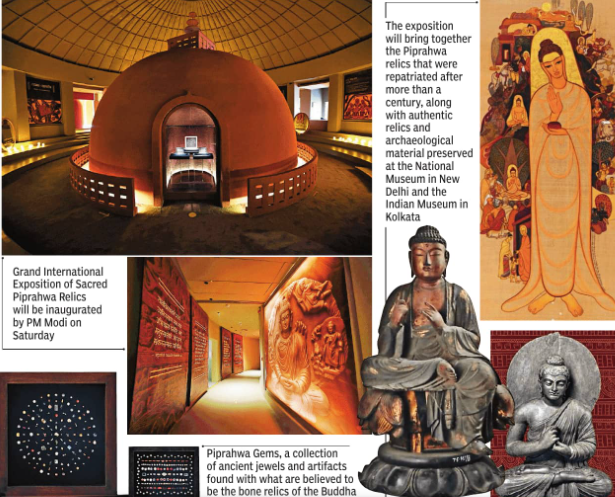
.
PM Modi said in his post that the inauguration of the “grand international exposition” will mark a very special day for those passionate about history, culture and the ideals of Bhagwan Buddha.”“For the first time since the 1898 excavation, the exposition brings together relics from the 1898 Kapilavastu excavation, treasures from the 1972 excavation, reliquaries and jewelled treasures from the Indian Museum, Kolkata, recently repatriated relics from the Peppé family collection and monolithic stone coffer within which the gem relics and reliquaries were originally found,” the minisry said. At the picturesque Rai Pithora Cultural Complex guests will get to enter through a gateway inspired by the earliest southern torana of Sanchi, celebrated for its Ashokan four-lion capital and intricately carved panels portraying scenes from Buddha’s life in aniconic forms.At the heart of the exhibition, a stupa model features three niches displaying key findings from the Piprahwa excavation: the first displays sacred bone fragments from the National Museum, Delhi, alongside gem relics, an inscribed steatite casket, and a crystal casket with a fish handle from the Indian Museum, Kolkata.The sacred Buddha relics were discovered in 1898 by William Claxton Peppé at the ancient stupa of Kapilavastu. Following their discovery, portions were distributed globally, with one part gifted to the King of Siam, another taken to England, and a third preserved at the Indian Museum, Kolkata. Go to Source