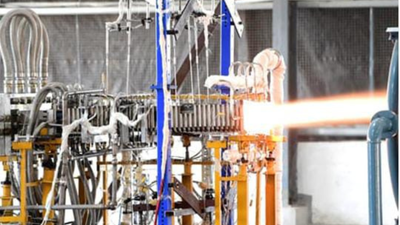
DRDO lab DRDL conducting a long-duration test of its actively-cooled scramjet full-scale combustor for the hypersonic missile at its facility in Hyderabad on Friday
NEW DELHI: In a boost for India, the Hyderabad-based laboratory of Defence Research and Development Organisation (DRDO), Defence Research & Development Laboratory (DRDL), on Friday achieved a milestone in the development of hypersonic missiles as it successfully conducted an extensive long-duration ground test of its actively-cooled scramjet full scale combustor, achieving a run time of over 12 minutes at its state-of-the-art Scramjet Connect Pipe Test (SCPT) facility. The successful test positions India at the forefront of advanced aerospace capabilities.Defence minister Rajnath Singh complimented DRDO, industry partners and academia on the successful ground test of full-scale actively-cooled long-duration scramjet engine. He said the “achievement is a solid foundation for the nation’s hypersonic cruise missile development programme”. DRDO chairman Samir V Kamat, too, congratulated the teams associated with the test for the achievement.The combustor is a core component of the scramjet engine, where fuel is mixed with compressed air to ignite and create thrust. The success of this test shows that India is capable of handling the extreme temperatures and pressures generated during the hypersonic flight.The hypersonic cruise missile is capable of exceeding five times the speed of sound (over 6,100 km/hr) for extended periods. The remarkable feat is achieved through a cutting-edge air-breathing engine, which utilises supersonic combustion to sustain long-duration flight. The ground-tests conducted at SCPT facility have successfully validated the design of advanced scramjet combustor, as well as the capabilities of state-of-art test facility, DRDO said in a release.Unlike traditional jet engines that compress air before combustion, scramjets rely on the high-speed airflow that enters the engine to compress the air in the combustion chamber. The primary advantage of scramjets is that they allow vehicles to travel at extremely high speeds for long distances without carrying large amounts of oxidizer (such as liquid oxygen), which is typical in rocket-based systems.The significant achievement built upon the earlier subscale test conducted on April 25 last year for a long duration, marking a crucial step forward in the hypersonic missile development. The combustor and test facility were designed and developed by the DRDL and realised by industry partners.