

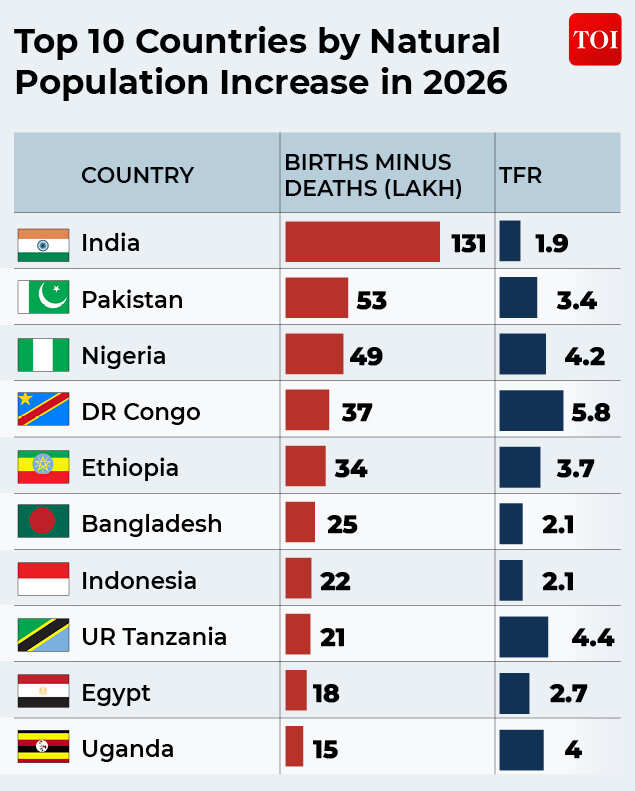
India has crossed a major demographic milestone: for the first time in modern history its fertility rate has slipped below the replacement level.The latest SRS report from India’s Office of the Registrar General and Census Commissioner shows the average Indian woman is now expected to have 1.9 children — under the 2.1 threshold that keeps a population stable — joining more than 130 countries already at sub‑replacement fertility.But here’s the twist: lower fertility hasn’t stopped India’s population from growing.In 2026, India is still set to add roughly 1.3 crore people through natural increase — the largest single‑country gain anywhere.That seeming contradiction comes down to population momentum: decades of higher birth rates have built a huge cohort of young adults now entering their prime childbearing years.Even with smaller families, the sheer number of potential parents keeps births above deaths, delaying the point at which the country’s population begins to stabilise and eventually decline.Before we dive into the charts, it’s important to know a few demographic terms that experts use to measure population change.• Replacement Fertility (Replacement-Level Fertility): The average number of children a woman needs to have to replace herself and her partner in the next generation. In most countries, this level is considered 2.1 children per woman.• Total Fertility Rate (TFR): The average number of children a woman is expected to have over her lifetime based on current fertility patterns. It measures family size, not the number of births in a given year.• Birth Rate (Crude Birth Rate): The number of live births per 1,000 people in a population each year. Unlike TFR, it depends on the population’s age structure as well as fertility.1. Where does India stand?India has entered a significant phase in its demographic transition. In 2026, 131 countries and territories are estimated to have fertility rates below the replacement level of 2.1 children per woman, and India is now among them.Yet, despite its below-replacement fertility rate of 1.9, India is projected to add around 1.3 crore people through natural increase in 2026—the largest population gain of any country. This makes India a demographic outlier: among the 10 countries expected to add the most people, it has the lowest fertility rate. By comparison, countries such as Bangladesh and Indonesia are only just approaching replacement-level fertility, while the Democratic Republic of Congo, with a fertility rate of 5.8 children per woman, is projected to add around 37 lakh people in the same year.The contrast highlights an important reality: India’s population growth is no longer being driven by high fertility, but by its large and youthful population base, which continues to produce more births than deaths despite smaller family sizes.
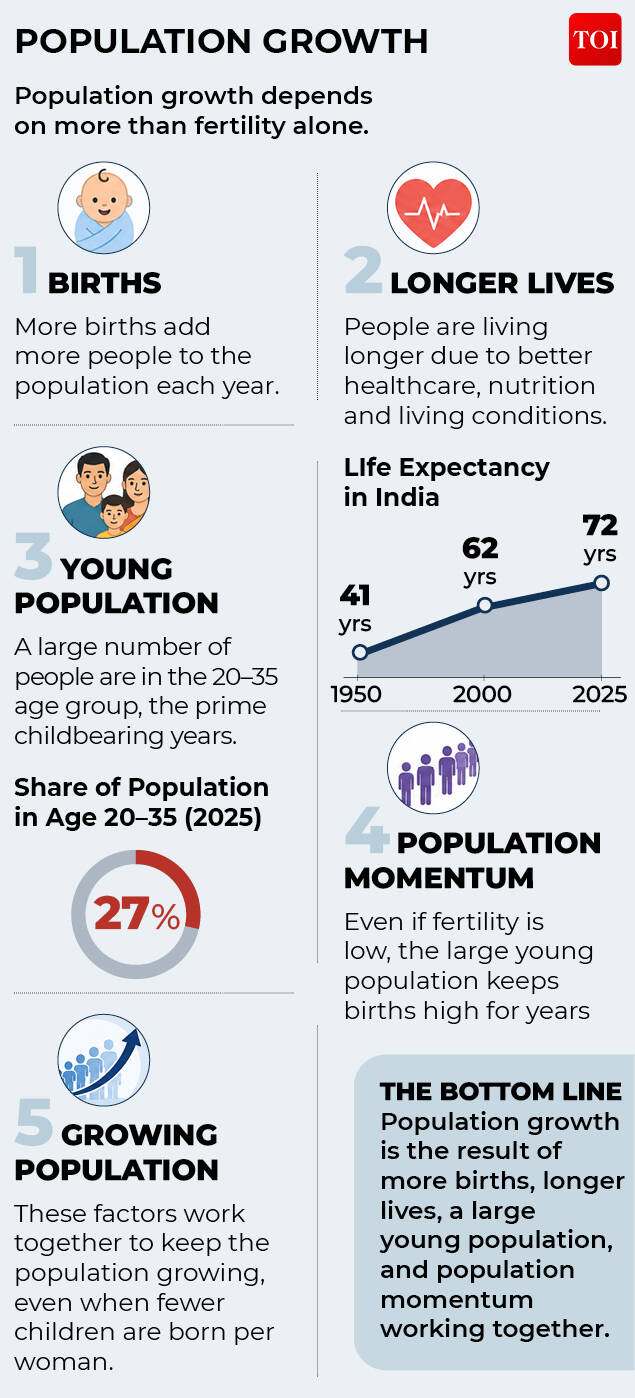
2. What factors drive population growth?Population growth is determined by far more than fertility alone. While the fertility rate indicates how many children women are having, the overall size of a population is also influenced by several demographic factors that affect the balance between births and deaths over time.
- Population momentum (The Biggest Driver)
India’s population exceeds 1.4 billion with one of the world’s youngest populations, with a large share of people currently in their 20s and 30s—the prime childbearing years.Even though the average woman is now having fewer than two children, the sheer number of people entering parenthood each year keeps the total number of births high, allowing the population to continue growing for decades.
- Births still exceed deaths
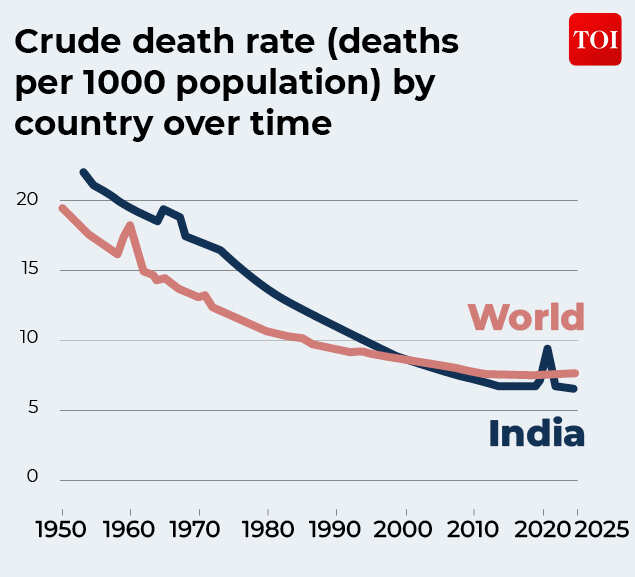
Despite declining fertility, India continues to record significantly more births than deaths every year, resulting in a natural increase in population. This gap between births and deaths is expected to add around 1.3 crore people to India’s population in 2026 alone.India records around 9.5 million deaths annually—the second-highest absolute number in the world after China—but this largely reflects its status as the world’s most populous country.Relative to its population size, India’s Crude Death Rate (CDR) remains lower than the global average and has steadily declined over time.According to Data for India, even as India’s population grew by more than a billion people between 1950 and 2025, annual deaths remained broadly stable at around 8–10 million, allowing births to consistently outpace deaths and sustain population growth.
- Increasing life expectancy
Another key reason India’s population continues to grow is that people are living longer than ever before.In 1950, the average Indian could expect to live just 41 years, compared with 69 years in the United Kingdom.
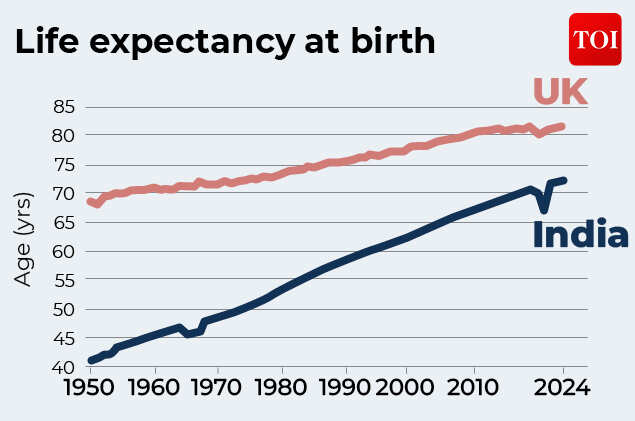
By 2024, India’s life expectancy had risen to around 72 years, significantly narrowing the gap with the UK. Improved healthcare, better nutrition and lower mortality have enabled more people to survive into older age, contributing to continued population growth.
- Declining infant mortality
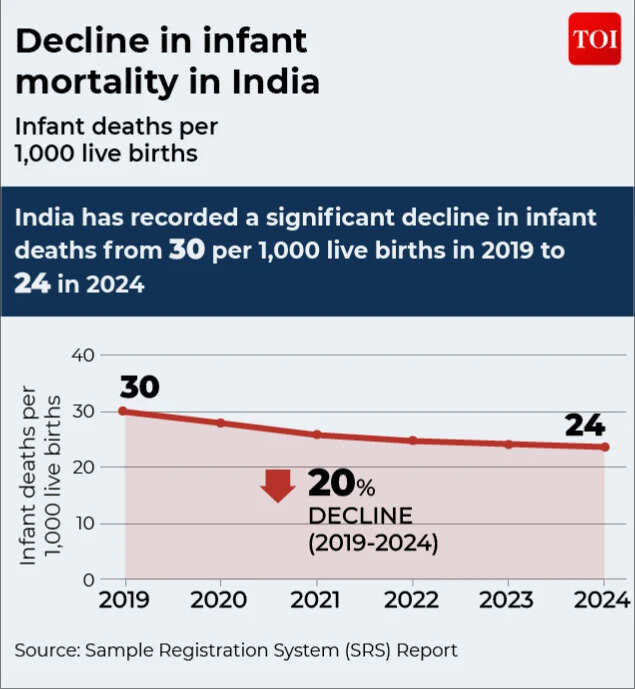
As more children survive into adulthood, the need for larger families declines, contributing to lower fertility while also sustaining population growth in the short term.According to the latest Sample Registration System (SRS) report, India’s Infant Mortality Rate (IMR) fell from 30 deaths per 1,000 live births in 2019 to 24 in 2024. The decline in infant mortality is closely linked to falling fertility across the country, as families become more confident that their children will survive, reducing the need to have more births.
- Regional differences
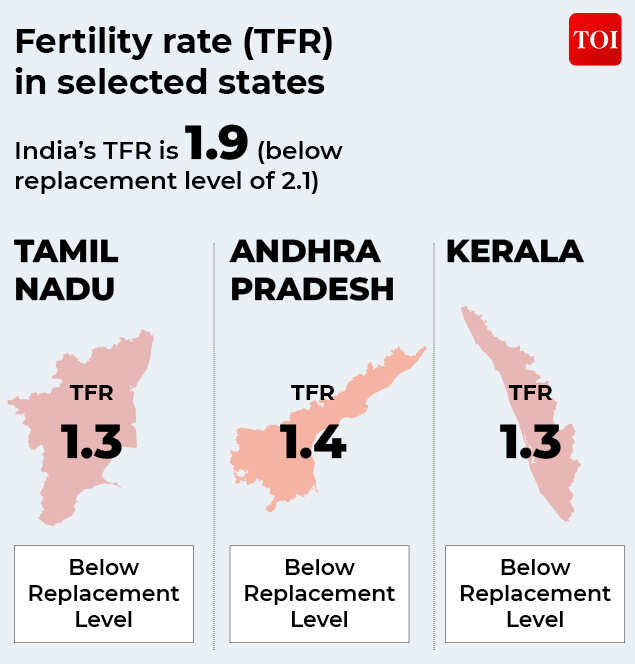
India’s demographic transition is uneven, with fertility rates varying widely across states. Many southern states crossed below replacement fertility years ago.This shift has prompted a policy reversal in some low-fertility states. Andhra Pradesh has scrapped its two-child norm for local body elections, Tamil Nadu is encouraging larger families, and Kerala stands with 1.3.
- Education is driving fertility lower
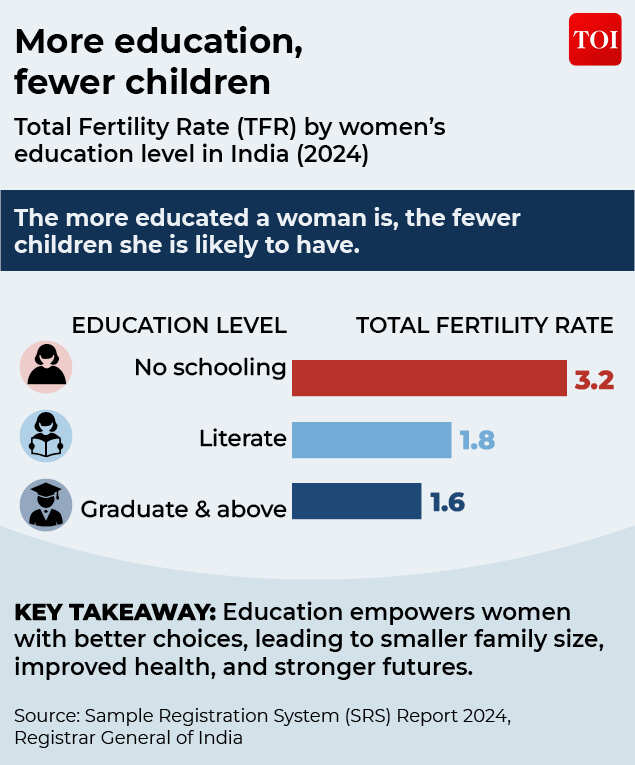
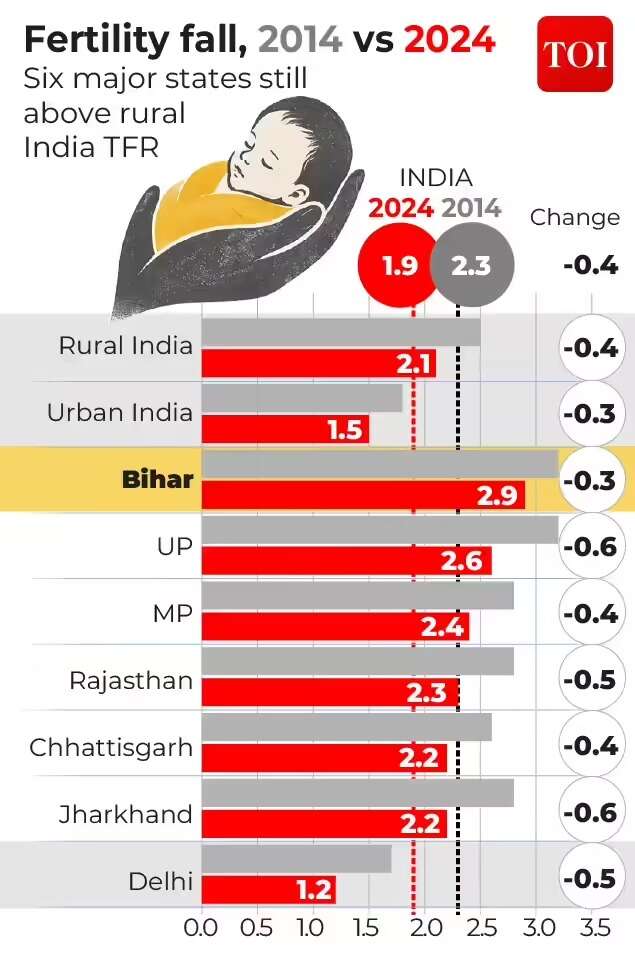
The latest Sample Registration System (SRS) report shows that fertility declines steadily as women’s educational attainment increases. Women with no formal education have an average fertility rate of 3.2 children, compared with 1.8 among literate women and 1.6 among graduates or those with higher education.The report also highlights a clear rural-urban divide. The average rural woman has 2.1 children, compared with 1.5 in urban areas, where fertility is now well below the replacement level. Over the past decade, rural fertility has declined from 2.6 to 2.1, while urban fertility has fallen from 1.8 to 1.5, reflecting changing family preferences, greater educational opportunities and increased urbanisation.
- No children after turning 30
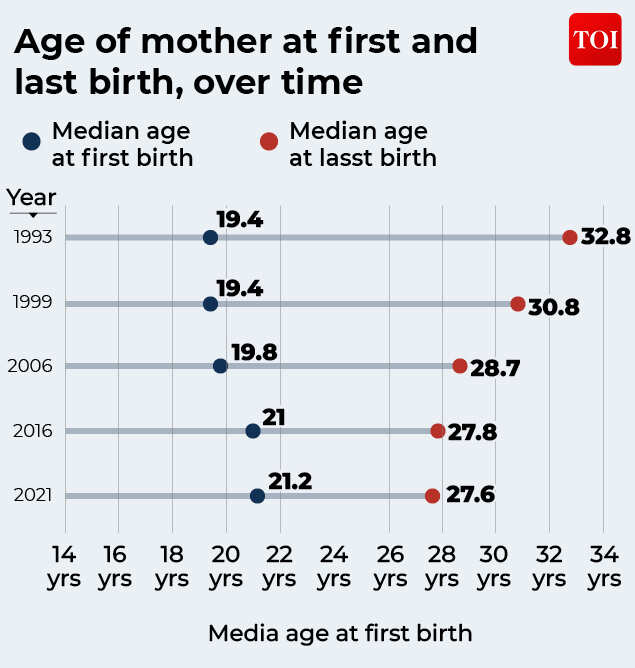
A study published in Nature titled “Changes in Age at Last Birth and Its Determinants in India” found that Indian women are completing their childbearing at younger ages. Researchers Mayank Singh, Chander Shekhar and Neha Shri reported that the median age at last birth has remained below 30 years since National Family Health Survey (NFHS) data-3, reflecting a shift towards smaller families and earlier completion of childbearing.
This trend is another indicator of India’s ongoing demographic transition and declining fertility.
- The birth ladder is thinning
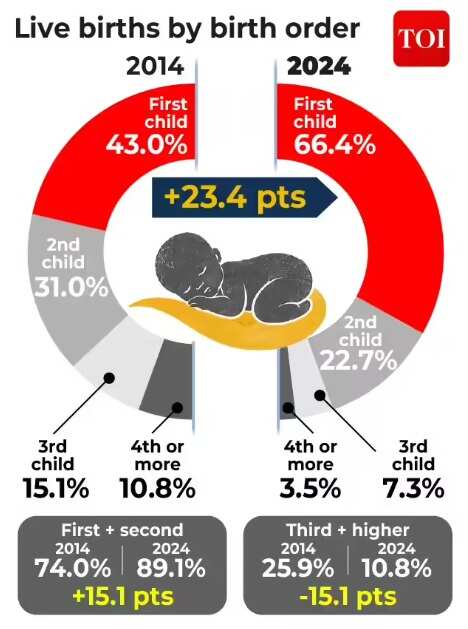
India’s birth pattern has changed dramatically over the past decade, with first and second children now accounting for a much larger share of all births. First-born children made up 43% of live births in 2014, rising to 66.4% by 2024. Meanwhile, third-and-higher-order births declined from 25.9% to 10.8%, while fourth-or-higher births fell sharply from 10.8% to just 3.5%.
The shift does not mean every family is choosing to have only one or two children. Instead, it shows that larger families are becoming far less common, reflecting changing social and economic priorities. Smaller family sizes allow parents to invest more in each child’s education, health and overall well-being, while also signalling a gradual shift away from viewing children primarily as a source of financial support in old age.
3. Northern and central states-wise report Bihar (2.9), Uttar Pradesh (2.6), Madhya Pradesh (2.4), Rajasthan (2.3), Chhattisgarh (2.2) and Jharkhand (2.2) continue to record fertility rates above the national average and account for a large share of India’s population growth.At the other end of the spectrum, Delhi has one of the country’s lowest fertility rates at 1.2, reflecting demographic trends already seen in many developed regions.
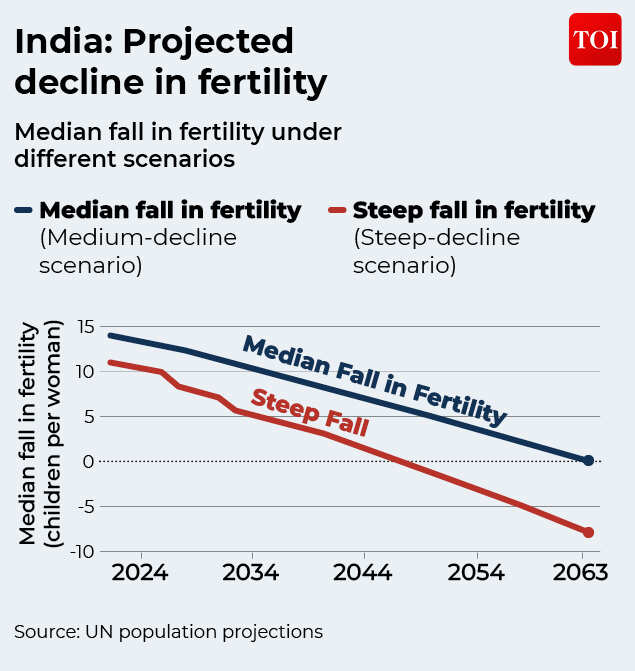
The World Bank has also cautioned that South Asia is not creating enough jobs to keep pace with its expanding working-age population, particularly for young people and women, making balanced regional development increasingly important.4. When will India’s fertility begin to decline?According to UN data, the country’s fertility could begin to decline around 2047 under a steep fertility-decline scenario, or around 2063 under a medium-decline scenario.However, some demographers believe the turning point could arrive even earlier. Rapid declines in fertility across many states, women completing childbearing at younger ages, limited future gains in life expectancy, and the fact that some Indian districts are already witnessing population decline suggest that India’s population peak may occur sooner than the UN’s 2047 estimate.
The big pictureIf numbers tell a story, this one is full of ironies: India is shrinking its family sizes even as an army of young people keeps the country growing.The shift will reshape ordinary life — how young couples plan careers and children, how cities bustle or quieten, how neighbourhoods age — in ways that won’t show up immediately on any chart.More than a demographic milestone, this is a slow-motion cultural turning point: a country remaking its future not by having more people, but by changing what family, work and ageing look like for a generation.What this moment really demands is a rethink of priorities more than panic.India is sliding into a new demographic era where the challenges will be less about sheer numbers and more about quality — jobs for a swelling workforce, health and social care for a graying population, and policies that support choices around family, work and retirement.The window to turn a demographic shift into a long-term advantage is open but narrowing; smart investments in education, female labour participation, and regional job creation will decide whether India cashes in on its remaining demographic dividend or gets caught by its own momentum. Go to Source


