
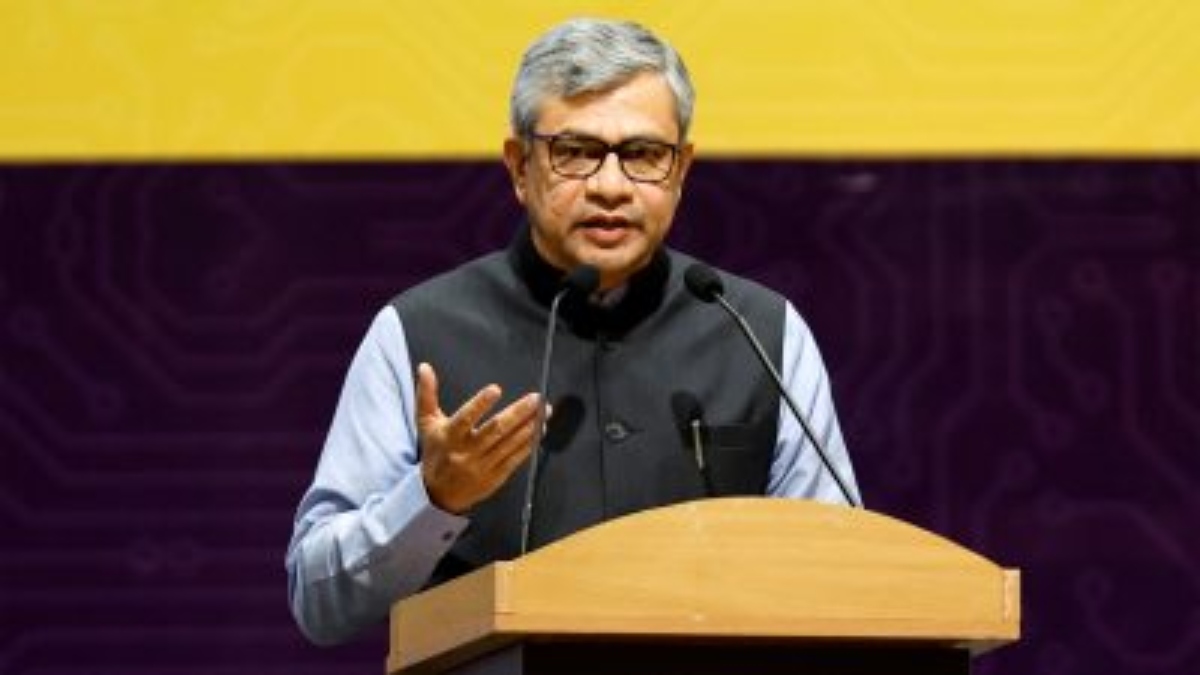
 "Made-in-India chips to power country’s next job engine: Ashwini Vaishnaw")

Union Minister Ashwini Vaishnaw has said that semiconductors will play a pivotal role in driving India’s next wave of job creation and industrial expansion just as steel did in the 20th century.
Speaking to Network 18’s Group Consulting Editor Bodhisatva Ganguli and Moneycontrol’s Deputy Executive Editor Chandra Ranganathan, Vaishnaw said, “Semiconductors are a foundational industry, much like steel was. Once you build that base, it powers growth across a wide range of sectors.”
Drawing a direct comparison, he noted that steel enabled the rise of industries like automobile manufacturing, construction, and infrastructure, in the same way, semiconductors are now central to modern manufacturing, embedded in everything from televisions and refrigerators to electric vehicles and advanced electronics.
“Practically every manufacturing sector today has an element of chips in its design and production processes. Establishing a strong semiconductor base in India will have a multiplier effect across the economy,” he added.
Vaishnaw emphasised that countries that successfully developed semiconductor ecosystems have seen widespread benefits, including high-value employment, innovation, and resilience in critical supply chains.
India currently has 10 ongoing semiconductor projects worth $18 billion, and construction is already underway in five of them, including a facility in Assam. Under the India Semiconductor Mission (ISM), the government aims to develop not just chip fabrication but the entire supporting ecosystem, from specialty chemicals and gases to precision machinery and trained talent.
Vaishnaw said that semiconductors aren’t just about high-tech prestige but they represent a vast employment opportunity, both directly and through their multiplier effect.
“Practically every modern manufacturing sector has semiconductors at its core. Establishing this foundational industry will ripple through every layer of the economy,” he said.
Vaishnaw said India is rapidly advancing in its mission to become a global semiconductor hub, underscoring the government’s long-term vision for the sector.
Echoing Prime Minister Narendra Modi’s recent remark that “while oil was black gold, chips are the new digital diamonds,” Vaishnaw said the country is laying the groundwork for a 25-year roadmap to establish a resilient and globally competitive semiconductor ecosystem.
“We started this journey in January 2022 with the announcement of the India Semiconductor Mission (ISM). Today, five of the ten approved units are already under construction—including one in Assam. The mission spans all critical sectors, from automotive and telecom to power electronics, defence, and strategic applications,” the minister said.
Vaishnaw hsaid that despite growing concerns around renewed US trade protectionism and potential Trump-era tariffs, India continues to attract major investments in the semiconductor and electronics manufacturing sectors.
In particular, he said that there has been no hesitation from global players like Apple, which remains deeply invested in India’s electronics ecosystem.
Speaking about the current investment climate, Vaishnaw emphasised that India’s growing strength in chip design, policy stability, skilled talent base, and global credibility are proving to be decisive factors for companies choosing to expand in the country.
“When we look at Apple’s investments, semiconductor investments, and electronics manufacturing, we have to reconstruct the entire landscape to understand why India continues to attract such strong interest,” he said.
India’s design capabilities have evolved rapidly, he pointed out. A decade ago, much of the country’s tech work was considered back-office support. Today, Indian engineering teams are designing entire products, reflecting a major leap in capability. This, Vaishnaw said, is a critical differentiator that global companies consider when deciding on long-term manufacturing and R&D locations.
Alongside design strength, the minister highlighted the importance of India’s policy stability. At a time when many countries are facing political and regulatory volatility, India offers predictability—a factor increasingly valued by multinational corporations. This stability, he noted, is giving India a competitive edge in attracting sustained capital inflows.
Vaishnaw also credited India’s deep talent pool, both in manufacturing and in scaling up production, for driving investor confidence. But perhaps most importantly, he said, is the global trust India has earned over the past 11 years under Prime Minister Narendra Modi’s leadership.
“India is now seen as a country that respects intellectual property, upholds democratic values, and is committed to long-term growth—not short-term fixes,” he said.
“That trust is visible across sectors, and it’s why company after company wants to set up a base here,” he added.
On the issue of IT services and potential risks to outsourcing, Vaishnaw acknowledged the concerns raised by recent developments in the US and other markets but maintained that the government is closely engaged with all stakeholders.
He said the Centre is in constant dialogue with global tech firms that have their global capability centres in India, as well as with governments in the US, Europe, Japan, and Southeast Asia.
“Our effort is to ensure that this vibrant, fast-growing industry continues to thrive and provide high-quality employment,” he said, calling IT services a vital engine of white-collar jobs in India.
At the same time, Vaishnaw noted the remarkable progress made in domestic electronics manufacturing, calling it a strong counterbalance to any potential risks in services.
“So today, I can say with a level of satisfaction that in last 11 years, our electronics manufacturing has grown six times. Our electronics exports have grown eight times. Our smartphone market share globally has crossed 20 percent and one by one we are getting every component into our country,” he said.
End of Article


&description=Made-in-India+chips+to+power+country%E2%80%99s+next+job+engine%3A+Ashwini+Vaishnaw)