
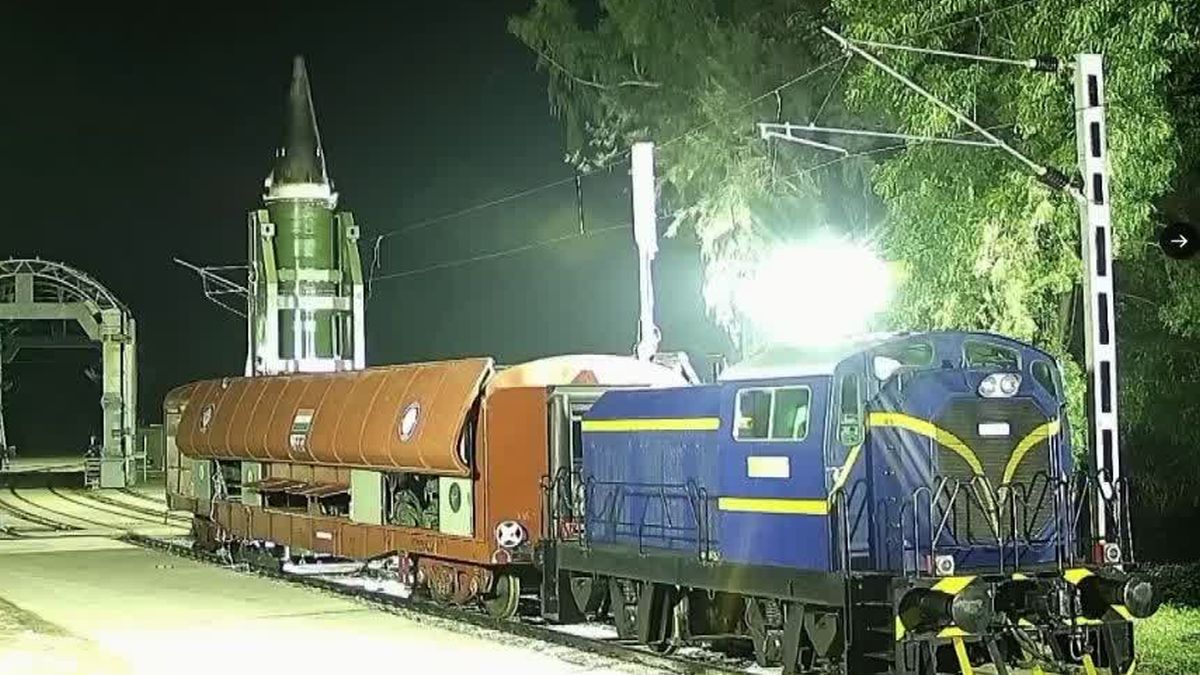
 "It’s a missile train! Why India’s latest Agni-Prime launch is significant")

India’s enemies be warned! The country has tested a new defence technology that strengthens its and enhances the mobility of its missile systems.
On Thursday, for the very first time, India successfully carried out a launch of the Intermediate Range Agni-Prime Missile from a rail-based mobile launcher system.
We take a closer look at why this launch is significant and which other countries possess such technology.
Agni-Prime missile test-fired from rail-based mobile platform
On Thursday (September 25), India successfully conducted a test launch of the Agni-Prime, which is an advanced intermediate-range ballistic missile, from a rail-based mobile launcher system. Simply explained, India test-fired the missile from a train.
India has carried out the successful launch of Intermediate Range Agni-Prime Missile from a Rail based Mobile launcher system. This next generation missile is designed to cover a range up to 2000 km and is equipped with various advanced features.
The first-of-its-kind launch… pic.twitter.com/00GpGSNOeE
— Rajnath Singh (@rajnathsingh) September 25, 2025
Defence Minister Rajnath Singh hailed the exercise as the “first-of-its-kind”, congratulating the nation and the scientists at the Defence Research and Development Organisation (DRDO) for this achievement.
“Congratulations to DRDO, Strategic Forces Command (SFC) and the Armed Forces on successful test of Intermediate Range Agni-Prime missile. This successful flight test has put India in the group of select nations having capabilities that have developed canisterised launch system from on the move rail network,” wrote Singh on social media platform X after the launch.
For those who don’t know, the Agni-Prime missile is a two-stage, solid-propellant intermediate-range ballistic missile, boasting of a range as far as 2,000 km — which covers China and Pakistan. It is the sixth missile in the Agni series and until now could be transported by truck and launched via canister. It also possesses nuclear-capabilities.
With the latest test, India has the capability to launch a nuclear missile from under the sea, surface, air, and now from a railway network.
Significance of rail-based launch
The launch of the Agni-Prime from a railcar is significant. That’s because it enables the user of this technology to have cross-country mobility and launch within a short reaction time with reduced visibility.
Picture this: Currently, most advanced missiles such as the Agni-Prime are large and not easy to move. For this reason, they are traditionally launched from fixed missile silos. Though, some missiles are now being mounted on vehicles, very few countries have been able to mount them on trains.
Defence experts note that by keeping missiles in a fixed silos, they are more vulnerable to a strike. Hence, shifting them to moving objects makes them less vulnerable to a pre-emptive strike.
A rail-based missile is harder to destroy, as they can travel anywhere along a nation’s rail network, and hide from satellite surveillance in tunnels. Furthermore, they can be rapidly mobilised in times of need owing to the country’s existing rail network serves. A rail mobile launcher could also provide better disguise than road launchers.
Countries that possess this technology
With Thursday’s launch, India has joined a very small club of countries that are capable of launching missiles from trains.
In fact, this technology dates back to the Cold War with the then Soviet Union and the United States of America mulling the option of launching missiles from a train. In the 1950s, the United States initiated a study on the feasibility of using the rail-basing mode for its Minuteman inter-continental ballistic missiles (ICBMs), but abandoned this option in 1961. The idea was revisited in the 1980s, when the US planned to deploy Peacekeeper ICBMs on railway mobile launchers. However, this plan was cancelled after the Soviet Union collapsed.
On the other hand, the USSR deployed an ICBM system on rail, which was named the RT-23 Molodets. However, with the collapse of the Soviet Union, the railcar-launched intercontinental ballistic missiles (ICBMs) underwent dismantlement in accordance with the Strategic Arms Reduction Treaty (START).
Russia also planned to reintroduce this launching capability, with a system called Barguzin. However, this project was shelved in order to focus on the development of its hypersonic missile.
In December 2016, several news reports emerged that China launched a test of a new rail-mobile version of its newest intercontinental ballistic missile (ICBM), the DF-41 (CSS-X-20).
Years later, North Korea also reportedly test-fired a new rail-based short-range ballistic missile (SRBM) system and even released pictures of the same. According to state media, the missiles flew 800 km before striking a target in the sea off North Korea’s east coast.
Moreover, Pak Jong Chon, a North Korean marshal and member of the Presidium of the Politburo of the ruling Workers’ Party of Korea, who oversaw the test, was quoted as telling KCNA: “The railway-borne missile system serves as an efficient counter-strike means capable of dealing a harsh multi-concurrent blow to the threat-posing forces.”
Following the test, Adam Mount, a senior fellow at the Federation of American Scientists, wrote on X that rail mobile missiles are a relatively cheap and reliable option for countries seeking to improve the survivability of their nuclear forces. “Russia did it. The US considered it. It makes a tonne of sense for North Korea,” he further wrote on the social media platform.
With inputs from agencies
End of Article


&description=It%E2%80%99s+a+missile+train%21+Why+India%E2%80%99s+latest+Agni-Prime+launch+is+significant)