
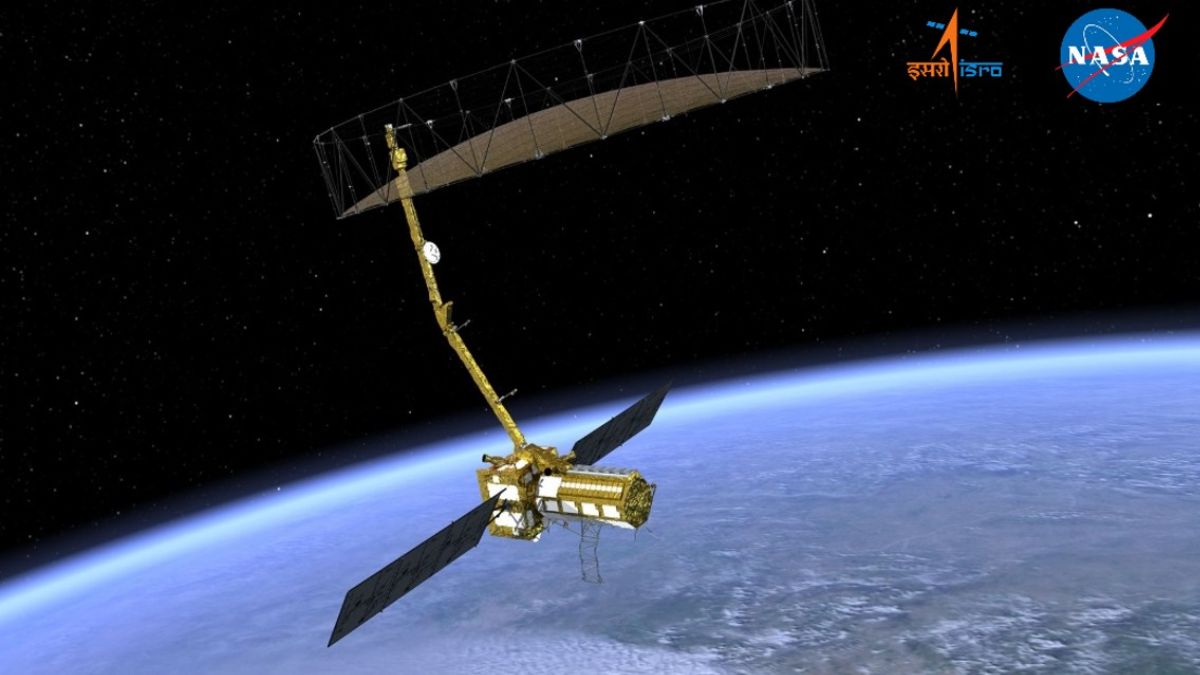
 "India eyes to deploy ‘bodyguard’ satellites to protect spacecraft, counter threats in space: Report")

India is reportedly working on a plan to develop “bodyguard” satellites and advanced tracking systems to protect its spacecraft
India is said to be working on a plan to strengthen its ability to protect satellites from potential attacks following a close encounter in orbit that highlighted growing risks to its national security.
A Bloomberg report cited an incident from mid-2024 when a satellite from a neighbouring country passed within one kilometre of one belonging to the Indian Space Research Organisation (Isro). Firstpost has not independently verified the report.
The Indian satellite was orbiting at an altitude of 500 to 600 kilometres, an increasingly congested band of space that is also home to communications constellations such as Elon Musk’s Starlink.
The sources indicated that although no collision took place, the unusually close approach may have been intentional, perhaps a display of capability by the other nation. The proximity was considered especially alarming because the Indian satellite involved was carrying out activities with potential military applications including mapping and monitoring of ground-based objects.
What is India’s ‘bodyguard’ satellite plan?
In response to these developments, the Indian government is reportedly formulating a programme to create “bodyguard satellites” capable of identifying and neutralising threats to India’s spacecraft.
The initiative forms part of a broader national effort to expand the country’s orbital security resources. Bloomberg reported that officials are pursuing a Rs 270-billion ($3 billion) plan to deploy around 50 surveillance satellites with the first expected to be launched next year.
The government is said to be engaging with private startups to explore technical solutions including the possible use of Light Detection and Ranging (LiDAR) satellites. Such systems could provide quicker detection of threats in orbit, giving technicians on the ground sufficient time to instruct spacecraft to manoeuvre and avoid danger.
The vision is to integrate these orbital assets with ground-based radars and telescopes to form a more comprehensive protective network.
Why is India focussing on space security?
The episode has renewed attention to growing challenges in space operations, particularly when there is a growing trend of militarisation of space by rival nations. The ongoing Russia-Ukraine war has exposed the vulnerability of satellite communications on a few occasions.
Many countries have taken those reports seriously and aim to put in place their respective plans to safeguard their space assets. In India’s case, the growing cooperation between Pakistan and China warrants preparedness for such eventualities. The report of India planning to develop “bodyguard” satellites come against this backdrop.
Figures from N2Y0.com show that Pakistan operates just eight satellites, compared with India’s fleet of over 100, while China commands a vast and rapidly expanding constellation of more than 930 spacecraft.
Observers have noted that China’s People’s Liberation Army has become increasingly active in developing advanced space capabilities. In June 2024, Air Marshal Ashutosh Dixit cautioned during a New Delhi seminar that China’s satellite programme was advancing both in scale and sophistication adding to regional strategic concerns. Officials in the United States have expressed similar warnings about China’s ambitions in space.
What India learnt from Op Sindoor?
Isro’s importance as a national security asset was hioghlighted earlier in the year when India faced heightened tensions with Pakistan. During the military conflict with Pakistan in May , more than 400 scientists reportedly worked continuously to ensure the smooth functioning of Earth observation and communication satellites.
Isro chairman V Narayanan later confirmed the agency’s round-the-clock role during that period. At the same time, China was reported to have assisted Pakistan by helping it adjust satellite coverage, according to a defence ministry research group.
This episode illustrated how space-based assets are increasingly integrated into modern conflicts supporting intelligence, surveillance and communication functions. It also highlighted the risks India faces from not only direct adversaries but also third-party involvement in regional hostilities.
Experts have pointed out that India currently lacks the capability for continuous, round-the-clock in-orbit tracking. Sudheer Kumar N, a former Isro director who now works as an independent consultant, noted that while such infrastructure does not yet exist, several startups are already developing solutions. The success of these efforts could eventually enable India to maintain constant awareness of its orbital environment.
While discussions about protective satellite systems remain in early stages, the government’s direction indicates a recognition that space is an increasingly contested domain. The creation of “bodyguard satellites,” alongside investments in LiDAR technology and ground-based surveillance could position India to better defend its orbital assets at a time when near misses and shows of strength are no longer rare occurrences.
End of Article

 "Air India Express scare: Why a flier tried to enter the airplane’s cockpit")
&description=India+eyes+to+deploy+%E2%80%98bodyguard%E2%80%99+satellites+to+protect+spacecraft%2C+counter+threats+in+space%3A+Report)