
 "How India’s skies will be safer with home-grown Integrated Air Defence Weapon System")

At his Independence Day address, Prime Minister Narendra Modi lauded India’s military mettle and stated that the country is set to develop a new missile defence initiative, dubbed the ‘Sudarshan Chakra’, aimed at integrating advanced surveillance, cyber protection, and physical defence mechanisms to safeguard its citizens and critical infrastructure.
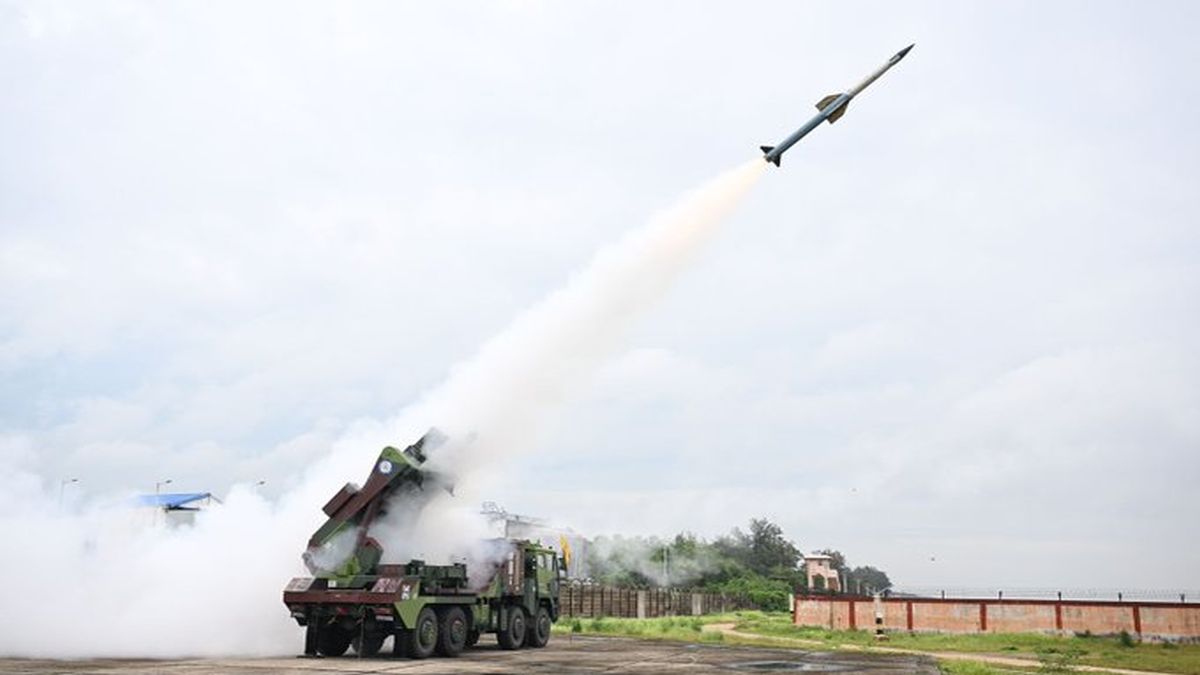
Now, nearly 10 days later, India made its first steps towards that goal after successfully conducting the maiden flight-tests of its Integrated Air Defence Weapon System (IADWS) off the coast of Odisha on Saturday (August 23).
Defence Minister Rajnath Singh took to X to laud the achievement, congratulating the Defence Research and Development Organisation (DRDO), the Indian Armed Forces, and industry partners for their role in developing the system. “I congratulate DRDO, India Armed forces and Industry for successful development of IADWS. This unique flight test has established the multi-layered air-defence capability of our country and is going to strengthen area defence for important facilities against enemy aerial threats,” he wrote in a post on his official handle on Sunday.
But what exactly are the components of the IADWS? How will this weapon serve India and strengthen its security?
What is an Integrated Air Defence Weapon System?
The IADWS is a multi-layered air defence system. Rather than one single weapon, it is an combination of elements organised to minimise threats emerging from the air. Defence experts note that an effective IADWS performs three functions — air surveillance, battle management, and weapons control.
Air surveillance is often described as the “eyes” of an air defence system. A radar will “detect” an aircraft entering the IADWS’ area of coverage, while the “initiate” function transforms radar returns into “tracks.” The “identify” function examines the track and categorises it as friend, foe, or unknown.
Following surveillance, the IADWS moves into battle management, which is the transition from identifying a threat to acting against it.
Many countries have developed their own IADWS; the US has the Patriot missile system as well as the Terminal High Altitude Area Defense ( Thaad). Russia has the S-400 whereas Israel has the Iron Dome.
Editor’s Picks
On Saturday, India tested its very own home-grown IADWS off the coast of Odisha. As per the defence ministry’s statement, all the weapon system components “performed flawlessly, which was confirmed by range instruments deployed by Integrated Test Range, Chandipur to capture the flight data.”
Maiden flight Tests of Integrated Air Defence Weapon System (IADWS) was successfully conducted on 23 Aug 2025 at around 1230 Hrs off the coast of Odisha.
IADWS is a multi-layered air defence system comprising of all indigenous Quick Reaction Surface to Air Missile (QRSAM),… pic.twitter.com/Jp3v1vEtJp
— DRDO (@DRDO_India) August 24, 2025
What are the elements of the IADWS that India tested?
India’s IADWS has three components: the Quick Reaction Surface to Air Missiles (QRSAM), the advanced Very Short Range Air Defence System (VSHORADS) missiles, and a high-power laser-based Directed Energy Weapon (DEW).
The QRSAM has been designed and developed by the DRDO. Meanwhile, the VSHORADS missiles and the DEW have been developed by Research Centre Imarat (RCI) and Centre for High Energy Systems and Sciences (CHESS) respectively.
The QRSAM are essentially short-range missiles, with the capability of engaging fast-moving aircraft, helicopters and stand-off precision weapons, including cruise missiles and glide bombs, at interception ranges of about 25-30 kilometres. It has the ability to engage multiple targets simultaneously, ensuring robust protection to units advancing in hostile territory.
Next comes the VSHORADS. A portable air defence system, it can be carried and operated by soldiers. It can hit enemy aircraft, drones, fighter jets and helicopters up to six kilometres away. According to experts, there is no better weapons system than the VSHORADS for short-range attacks.
In fact, a senior official from the Defence Ministry said, “The indigenously-developed fourth generation VSHORADS is technically superior to existing MANPADS (man-portable air defence systems) in the Indian Armed Forces because it has a state-of-the-art uncooled imaging infrared seeker.”
The last component of the IADWS is the Directed Energy Weapon (DEW), which is a high-power laser system. DEWs can be used for various purposes, including drone defence systems, missile defence, and disabling enemy electronics. As per a report in The Print, the DEW offers virtually unlimited firing capacity, allowing sustained engagements and the ability to neutralise multiple drones or loitering munitions at close range with greater cost-effectiveness and operational simplicity
Why is the IADWS important to India?
The success of the IADWS is of strategic importance to India. Experts note that by integrating multiple layers of missiles and directed-energy systems, the IADWS ensures that all types of aerial threats can be countered. For instance, the IADWS shows that both types of threats such as high-speed aircraft and cruise missiles, and swarming drones and loitering munitions can be countered with a single system.
A senior DRDO scientist was also quoted as telling The Indian Express, “This maiden test at lower ranges paves way for the use of the system at higher ranges, and can be looked at as a stepping stone towards Mission Sudarshan Chakra, a comprehensive defence shield.”
For the unaware, PM Modi had announced the Sudarshan Chakra from the ramparts of the Red Fort. He had then said that it would be a powerful weapon system that will not only neutralise the enemy’s attack but also hit back with overwhelming force. It is likely to be integrated with the IAF’s Integrated Air Command and Control System (IACCS) and the Army’s Akashteer subsequently.
With inputs from agencies
End of Article

&description=How+India%E2%80%99s+skies+will+be+safer+with+home-grown+Integrated+Air+Defence+Weapon+System)