
 "From paisley to saris, how India has been a fashion designer for the world")

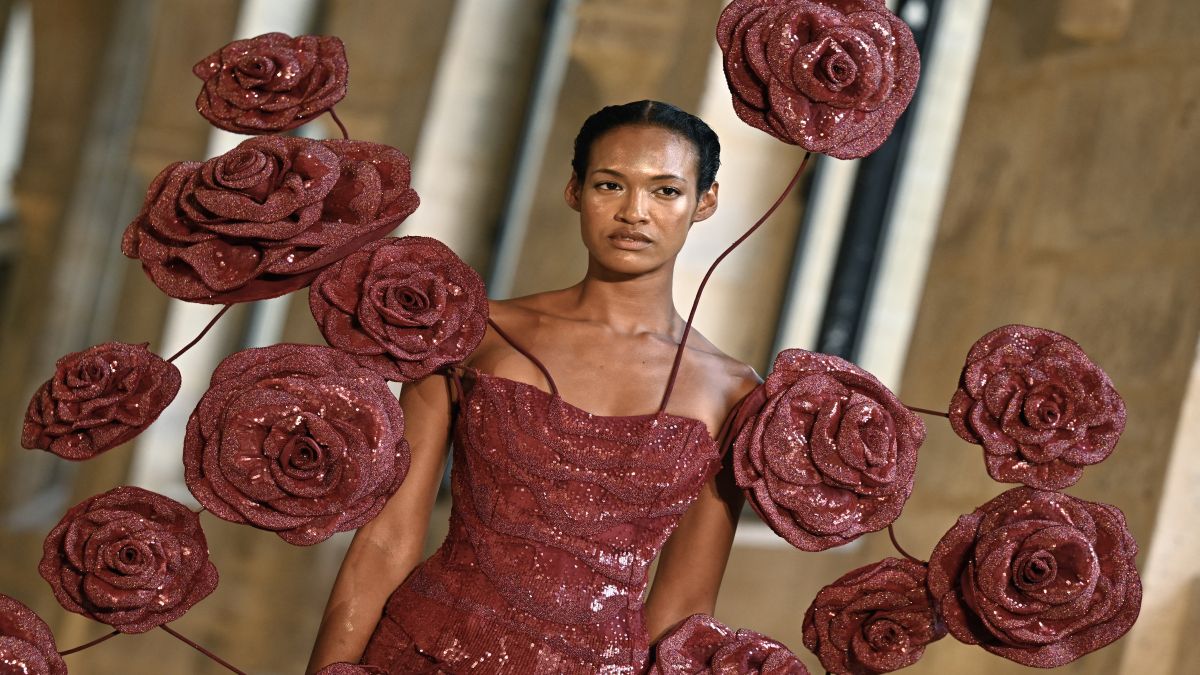
In recent times, the world has woken up to India’s fashion — be it Prada appropriating the humble ‘Kohlapuri’ chappal or designers Rahul Mishra and Gaurav Gupta enchanting audiences at fashion weeks and Met galas with their dramatic gowns.
But Indian fashion has always been serving it, as the young ones would call it today. Its textiles, its designs, its aesthetic has been a constant in the world of fashion and is embroidered into global fashion history. In fact, the desire for India’s excellence in fashion can be dated back to the 17th Century when the French courts of Marie Antoinette and Joséphine Bonaparte sourced fabrics and designs from India.
And it seems centuries later, India continues to serve as inspiration to the world. As we celebrate India’s independence from the British Raj, we take a closer look at India’s role in global design from the 1600s to the present.
When France courted Indian fashion
The year 1788 began as an unusually dull one for French fashion. “Nothing very novel for this winter,” the fashion-conscious Henriette Louise de Waldner de Freundstein, Baroness d’Oberkirch (1754–1803) complained.
But then the French fashionistas came across an Indian fabric known as chintz and they fell in love with the light, breathable, and strikingly vibrant feel of it. Soon, all of Europe had their hands on chintz — aristocratic women wore chintz gowns adorned with delicate vines and blossoms. Royalty lined their bedrooms with chintz draperies. Even Queen Mary of England had her private chambers decorated with the fabric.
It became so popular that in 1686, France banned its import with England following it. But the demand didn’t reduce; in fact, smugglers risked imprisonment and even execution to meet the insatiable demand. In some cities, women caught wearing chintz were forced to pay heavy fines or even had their garments confiscated in public.
Editor’s Picks
Years later, in 1759, France lifted its ban on chintz after it had figured out how to make its own. England, too, embraced industrialised cotton production, making cheap chintz-like fabrics in massive quantities.
Buta becomes paisley
Talking of Indian fabrics and motifs, we can’t forget the paisley and how it has become a trend all over. Designers from Dolce & Gabbana, JW Anderson among others have incorporated paisley in their designs.
But did you know that this motif, now associated with bohemian culture hails from India’s Kashmir? The original Persian droplet-like motif – the boteh or buta – is thought to have been a representation of a floral spray combined with a cypress tree, a Zoroastrian symbol of life and eternity.
In the 18th and 19 centuries, traders took the textile pattern to Europe and following the arrival of luxurious Kashmir shawls (some of which cost the price of a small house), the pattern took the continent by storm. The shawls were soon imitated throughout Europe, notably in Wales and the town of Paisley in Renfrewshire, Scotland. From that point onwards the English term for the motif was ‘paisley’.
The world can’t get enough of Khadi
When we think of India’s independence struggle, one often thinks of khadi and how the fabric became one of the foremost symbols of Indian resistance. And today, khadi has gone global. Think Vivienne Westwood’s latest collection that that fused its aesthetic with khadi and other hand-woven silks.
The name khadi comes from the word ‘khaddar’ (meaning handspun in the subcontinent) and is part of India’s ancient handmade textile traditions. Amid the freedom struggle, Mahatam Gandhi called for a boycott of foreign clothes, urging people to turn to hand-woven khadi. “Consume what you can produce,” he believed. The production of home-spun was the way forward, according to him.
And for him, khadi was not just a cloth, he referred to it as a “Livery of Freedom”. In an article in The Hindu in 2010, Ragini Nayak, a former national general secretary of the National Students’ Union of India, wrote that Gandhiji emphasised that khadi “should be worn with values which are inseparable to it”.
Thanks to Mahatma Gandhi’s khadi movement, one of the biggest cooperatives in the world was born. The Indian government institutionalised the khadi industry by establishing the Khadi and Village Industries Commission (KVIC) through an Act of Parliament in 1957.
And despite khadi seeing a drop in popularity, in recent years, it has got a boost — not just in India but also across the world. Indian and as well as global designers have embraced the fabric with it even being showcased at the Lakmē Fashion Week, held in March 2025.
As designers who have worked with khadi said, “Khadi has always had a quiet power, it’s honest, handmade, and deeply rooted in our culture. What’s exciting is that people are now seeking that authenticity more than ever. There’s a shift towards fabrics that tell a story, that feel grounded. Khadi brings with it a sense of realness and responsibility, which is resonating in fashion circles today.”
Sari not sorry
Perhaps, the biggest sign of Indian fashion inspiring the West is that of a simple garment — the sari. Time after time, the sari has been replicated by global designers; from Hermes, Balenciaga, Jean Paul Gaultier to John Galliano, all of them have tried to put their spin on the garment that is considered by many as the pinnacle of Indian fashion.
Even Gucci reimagined the sari for none other than Bollywood star Alia Bhatt, who wore the creation at the 78th Cannes film festival. The design featured a sleeveless, backless blouse with a plunging neckline and a floor-length skirt, topped with a palla-style drape that mimicked the classic saree silhouette.
India’s having a moment in fashion
Today, thanks to designers such as Sabyasachi, Gaurav Gupta, Rahul Mishra, Indian fashion is being talked about and praised all over the world. Their works are being featured on foreign runways and international stars are choosing their designs.
Even at the Met Gala this year, which is considered fashion’s night out, Indian designers were the talk of the town. Manish Malhotra not only designed Natasha Poonawalla’s outfit but his jewellery was also worn by none other than the ‘Queen of the Met’ — Rihanna.
Isha Ambani regaled fashion watchers with an Anamika Khanna design, whereas Gaurav Gupta, whose creations have appeared at the Met Gala before — most recently on Mindy Kaling last year — styled mom-to-be Kiara Advani for her debut at this year’s fashion gala. Together, they crafted a gown that paid homage to motherhood, resulting in a heartwarming moment on the blue carpet.
And that’s not the end of it. At Paris Fashion Week, Pharrell Williams unveiled his Louis Vuitton Spring/Summer 2026 mens wear collection on a runway that was inspired by India’s ancient game — Snakes and Ladders.
The trunks, long considered a Louis Vuitton signature, were detailed with embroidery motifs inspired by Indian iconography — florals, paisleys, and geometric metaphors that subtly referenced subcontinental storytelling.
All of this goes to prove that Indian fashion is here to stay and grow like never before. In fact, India Brand Equity Foundation (IBEF) notes that the Indian fashion industry is expected to grow at a rate of more than 10 per cent per year. It is expected to reach a market value of around Rs 45.3 lakh crore by 2032, at a projected 12.6 per cent growth rate.
So, this Independence Day, don’t be shy and wear your Indian fashion loud and proud!
With inputs from agencies
End of Article
 "Affordable but powerful’: PM Modi calls for self-reliant manufacturing to power exports amid tariff tensions")
 "100 days of Operation Sindoor: What all has happened since India hit Pakistani terrorists, backers")
&description=From+paisley+to+saris%2C+how+India+has+been+a+fashion+designer+for+the+world)