
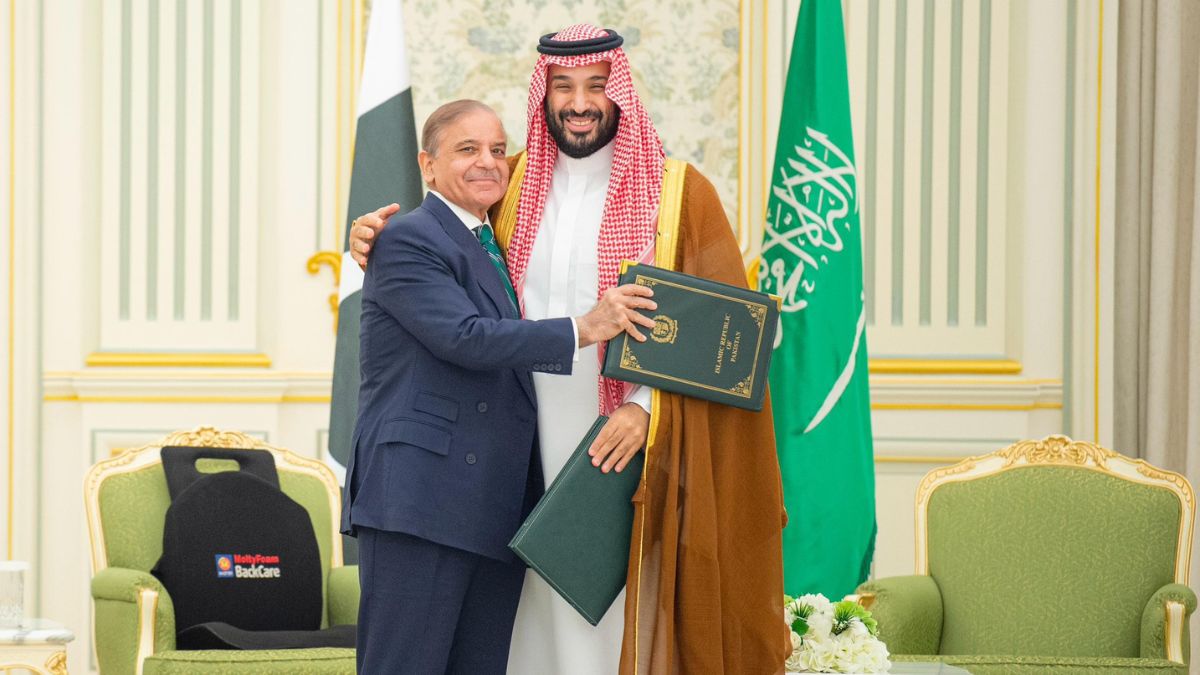
 "<div>With Saudi mutual defence pact, will Pakistans nuclear umbrella reshape West Asias security architecture?</div>")

With many Arab nations feeling a rising threat from Israel, the Saudi-Pakistan defense pact announced this week brings Pakistan —and its nuclear umbrella— into the region’s security equation.
The ‘Strategic Mutual Defense Agreement’ signed between Pakistan and Saudi Arabia on Wednesday effectively marries Riyadh’s money with Pakistan’s giant nuclear-armed military, analysts said.
Few details of the pact have been disclosed, and Pakistan’s stated nuclear doctrine says that its weapons are solely aimed against long-term adversary India.
But Riyadh is hinting that it will have a de facto nuclear shield under the agreement, while analysts say that Israel, widely understood to be the only nuclear state in the Middle East, will be watching closely.
Pakistani Defense Minister Khawaja Muhammad Asif told Reuters that nuclear weapons were “not on the radar” of the pact. He said the agreement could be extended to cover other Gulf nations.
“We have no intention of using this pact for any aggression,” said Asif. “But if the parties are threatened, then obviously this arrangement will become operative.”
Riyadh may see the nuclear issue differently.
Gulf Arab states said Israel, which has never confirmed or denied possessing nuclear weapons, had shown itself to be a direct threat following its unprecedented strikes on Qatar last week. Saudi Arabia has also said that if rival Iran acquired nuclear weapons, it would follow.
Asked whether Pakistan would now be obliged to provide Saudi Arabia with a nuclear umbrella, a senior Saudi official told Reuters: “This is a comprehensive defensive agreement that encompasses all military means.”
Analysts said that the agreement also reflects shrinking confidence in the security provided by the United States to the region.
“From the Saudi perspective, it is intended to plug the strategic and conventional deterrence deficit vis-a-vis nuclear-armed Israel,” said Hasan Alhasan, senior fellow for Middle East Policy at London’s International Institute for Strategic Studies.
A statement from Saudi Arabia said the pact “aims to develop aspects of defense cooperation between the two countries and strengthen joint deterrence”. The Saudi government media office did not immediately respond to a request for comment on whether Pakistan’s nuclear weapons were included in the agreement.
Foreign policy officials in Washington and Israel also did not immediately respond to requests for comment. The pact could also raise concerns in India and Iran.
Pakistan’s nuclear weapons
Pakistan, the only nuclear-armed Muslim nation, is one of the poorer countries in Asia, but it has an army of more than 600,000 soldiers to defend against its much larger adversary, India, with which it has fought three major wars, along with numerous clashes, including a four-day conflict in May that was their heaviest fighting in decades.
Wednesday’s announcement made no mention of nuclear weapons or any payment to Pakistan. “The agreement states that any aggression against either country shall be considered an aggression against both,” Pakistan said.
Pakistan’s Prime Minister Shehbaz Sharif thanked the Saudi crown prince, Mohammed bin Salman, for “his keen interest in expanding Saudi investments, trade and business ties”, in a statement on Thursday.
India and Pakistan went nuclear in the late 1990s, with Pakistan developing missiles that can hit deep into India. But if pointed the other direction, Pakistan’s longest-range missiles could —in theory— strike Israel.
Adil Sultan, a former military officer who has worked at Pakistan’s Strategic Plans Division, which oversees the nuclear arsenal, said its missiles could hit all of India’s sprawling land mass.
“Israel was never comfortable with Pakistan’s nuclear weapons,” said Sultan, now dean of the Faculty of Aerospace and Strategic Studies at Islamabad’s Air University. “But this capability is very modest and it is only for India.”
Last year, a senior White House official said Pakistan was developing long-range ballistic missile capabilities that eventually could allow it to strike targets well beyond South Asia. Islamabad denied that.
Abdulaziz Sager, chairman of the Saudi-based Gulf Research Center, said it was too early to draw conclusions on any nuclear element.
“Events have underscored the limitations of relying solely on external protection, especially from the United States,” Sager said.
US President Donald Trump hoped to expand the Abraham Accords, establishing diplomatic ties between Israel and Arab states, to include Saudi Arabia during his second term. But Riyadh has made it clear it will not establish ties with Israel until the Gaza war has ceased and there is a path to Palestinian statehood.
Pakistan leaps into the Middle East
Pakistan has long had a small military contingent in Saudi Arabia, but this week’s agreement points to far greater involvement.
“For Pakistan, the power projection into the Middle East is huge, even though it has inserted itself into a volatile region,” said Maleeha Lodhi, Pakistan’s former ambassador to the United States.
Mushahid Hussain, a former chairman of the defence committee of Pakistan’s Senate, said that Pakistan’s outlook had been pan-Islamist since it was founded.
“Pakistan has the military capability and, in turn, what we get is economic strengthening,” said Hussain. “Pakistan is the new strategic option for these Gulf nations.”
Pakistan struggles to compete with an Indian defence budget that is at least seven times as big, meaning any new Saudi injection of funds could even the balance somewhat. Saudi Arabia has helped Islamabad financially for decades, most recently with a $3 billion loan.
India said on Thursday it would “study the implications of this development for our national security as well as for regional and global stability”.
(This is an agency copy. Except for the headline, the copy has not been edited by Firstpost staff.)
End of Article

&description=With+Saudi+mutual+defence+pact%2C+will+Pakistan%E2%80%99s+nuclear+umbrella+reshape+West+Asia%E2%80%99s+security+architecture%3F)