
 "Why is Florida deploying robot bunnies to capture pythons?")

In a rather unusual move to tackle its exploding python problem, Florida is now turning to “robot rabbits” to lure the giant snakes out of hiding.
The southeastern US state has been battling these invasive predators for years. Burmese pythons, which can grow anywhere between 6 to 9 feet long, are not native to Florida. With no natural enemies, they have multiplied rapidly in the Everglades National Park, where they feast on everything in sight.
Officials say the snakes have wiped out as much as 95 per cent of small mammals in the area, including raccoons, rabbits, birds, and even alligators. Their incredible camouflage and giant size make them especially difficult to catch, turning them into one of Florida’s toughest wildlife challenges.
Now, in their latest attempt, the South Florida Water Management District is pinning its hopes on the robotic rabbits.
In this explainer, we look at how these robo-rabbits work, how Burmese pythons first ended up in America, their devastating impact on the local ecosystem, and what happens when they finally fall into the hands of authorities. Here’s a closer look.
What are robo rabbits?
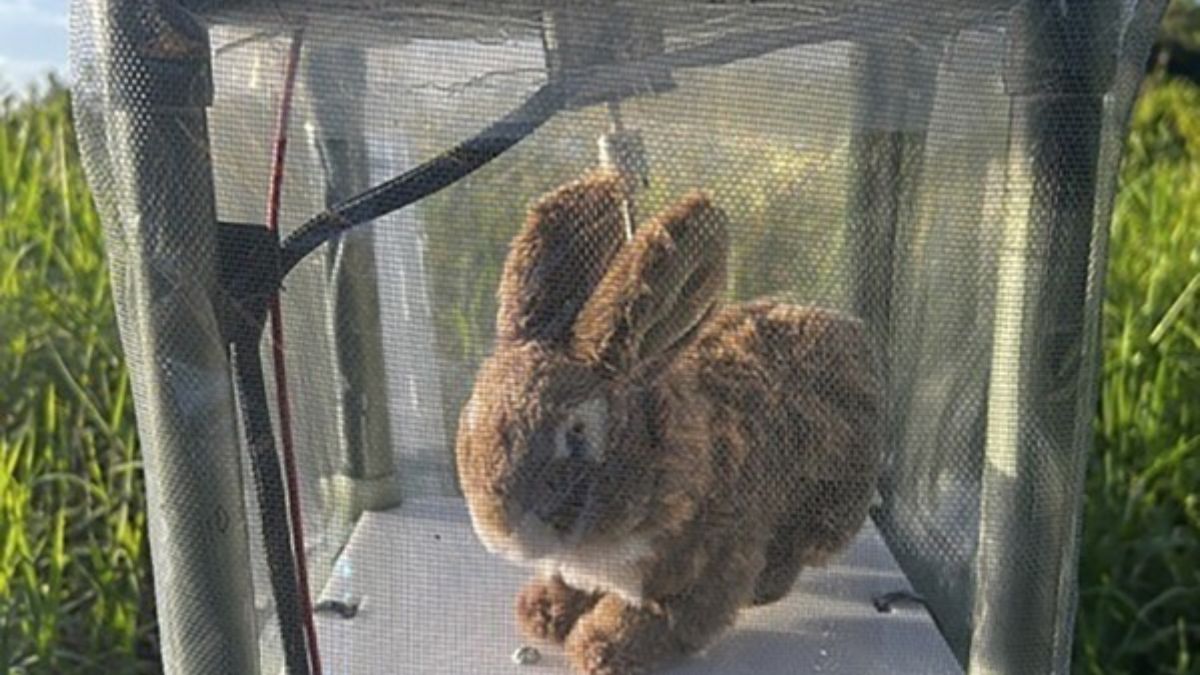
Robo rabbits are animatronic decoys designed to look, move, and even smell like real rabbits. The idea is simple: once released into the forests and swamps around Everglades National Park, these fake rabbits lure out Burmese pythons, making it easier for removal teams to catch them.
According to Smithsonian Magazine, the solar-powered rabbits are equipped with motors and internal heaters that mimic the movements and body temperature of marsh rabbits (Sylvilagus palustris), a favourite meal for Burmese pythons.
Each robo rabbit also carries a video camera. When a python approaches, the device sends an alert to monitoring teams, who can then dispatch specialists to capture the snake.
This summer, researchers from the University of Florida and the South Florida Water Management District released 120 robo rabbits as part of a new trial. In the past, authorities had tried using live rabbits as bait, but the process turned out to be costly and impractical.
Mike Kirkland, lead invasive animal biologist for the water district, told AP that each robot rabbit costs around $4,000, with funding provided by the water district.
It’s still too early to measure the success of the project, but officials are hopeful.
“This part of the project is in its infancy,” Kirkland said. “We are confident, though, that this will work once we are given enough time to work out some of these details.”
Also read: Pets on the menu? Why Denmark zoo wants you to donate animals
How pythons have become a headache in Florida
Burmese pythons are not native to Florida, they come from Southeast Asia. Most of them landed in the state through the exotic pet trade in the 1990s and early 2000s. Many either escaped or were released into the wild after they grew too large for owners to keep as pets.
The Everglades turned out to be the perfect home for them. The swampy, warm climate and lack of natural predators gave the snakes an ideal environment to thrive and multiply.
A female python can lay anywhere between 50 to 100 eggs at a time, with a gestation period of 60–90 days, according to the Florida Fish and Wildlife Conservation Commission.
No one knows exactly how many pythons now live in Florida. The US Geological Survey recently put the number at “tens of thousands,” though some official estimates go as high as 300,000. What’s clear is that their presence has already reshaped the local ecosystem.
According to the USGS, “Severe declines in mammal populations throughout Everglades National Park have been linked to Burmese pythons, with the most severe declines in native species having occurred in the remote southernmost regions of the Park where pythons have been established the longest.”
As per a 2012 study, small mammal populations have dropped drastically in Florida. Raccoon populations dropped by 99.3 per cent, opossums by 98.9 per cent, and bobcats by 87.5 per cent since 1997. Species like marsh rabbits, cottontail rabbits, and foxes virtually disappeared.
To tackle the problem, authorities have had to get creative. They’ve tried attaching trackers to male pythons to locate females and nests, placed bounties on the snakes, and even launched the annual Florida Python Challenge, a competition where hunters are rewarded for capturing pythons.
This year, 934 participants from 30 states joined the challenge in July, capturing 294 snakes. The top hunter, who caught 60 pythons, walked away with a $10,000 (Rs. 8.78 lakh) prize. Since 2000, more than 23,000 pythons have been removed from the wild, according to the Florida Fish and Wildlife Conservation Commission.
Also read: Jurassic Park: What the world would look like if dinosaurs hadn’t gone extinct
What happens after snakes are captured?
Once captured, the pythons are not released back into the wild, they are killed, but in what officials describe as a “humane manner.”
The Florida Fish and Wildlife Conservation Commission lays out the process clearly. First, the snake must be rendered completely unconscious so it cannot feel pain or distress. After that, its brain is destroyed in a procedure called pithing, which ensures the animal cannot regain consciousness and suffer while being killed.
“Nonnative reptiles are not protected in Florida except by anti-cruelty law. There is an ethical and legal obligation to ensure nonnative reptiles are killed in a humane manner,” the Commission’s website explains.
With input from agencies
End of Article

 "Man United dressing room questions Amorim’s tactics as manager gets ready for showdown talks: Report")
&description=Why+is+Florida+deploying+robot+bunnies+to+capture+pythons%3F)