
 "The big India factor behind Trump-Putin talks in Alaska")

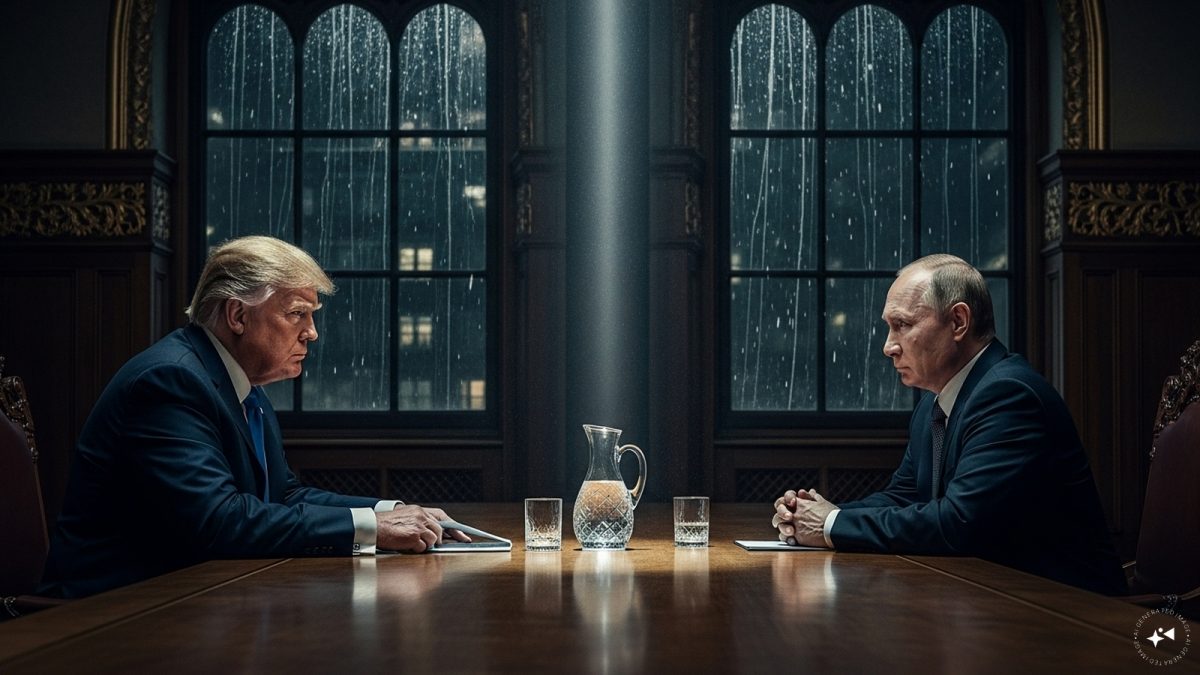
When US President Donald Trump and Russian President Vladimir Putin meet in Alaska to discuss the war in Ukraine, much of the global attention will be on potential shifts in the battlefield and peace negotiations. Yet, behind the scenes, a less obvious factor appears to have influenced the dynamics leading to the meeting. This turns out to be India’s role in global oil trade and Washington’s decision to target it with steep tariffs. Statements from both Trump and senior US officials in recent days have suggested that punitive measures against India’s purchases of Russian oil were part of a calculated bid to pressure Moscow into engaging in talks.
Trump’s claim: Tariffs as a strategic lever
Speaking on Fox Radio’s Brian Kilmeade Show, Trump remarked that his recent imposition of steep tariffs on India “may have played a role” in pushing Putin toward the negotiating table. He reasoned that the secondary tariffs effectively removed India — Russia’s second-largest oil customer — from the market. “Certainly, when you lose your second largest customer and you’re probably going to lose your first largest customer, I think that probably has a role,” the US president said.
According to Bloomberg, the tariffs, totalling 50 per cent, included a 25 per cent levy on Indian purchases of Russian oil, set to take effect from August 27. Trump suggested that the cumulative effect of these measures had “impact everywhere,” implying that economic isolation was a strategic tool to bring Russia into dialogue.
Secondary tariffs and the Putin equation
US Treasury Secretary Scott Bessent reinforced this link in an interview with Bloomberg, observing that Washington had expected Putin to come to the table “in a more fulsome way” and that the secondary tariffs on India were a piece of that leverage strategy. Bessent indicated that if talks in Alaska did not go well, these measures could be tightened further.
Bessent stressed that sanctions and tariffs were flexible — they could be increased, reduced or made indefinite. He also referenced the “Russian shadow fleet” of tankers operating globally, suggesting that Washington might intensify enforcement against them. His broader point was that the tariffs on India were not simply about trade disputes but about geopolitical positioning, particularly when paired with pressure on European allies to adopt similar measures.
India’s energy trade with US and Russia
The tariffs came despite a notable shift in India’s energy imports in Washington’s favour. According to official figures, Indian oil and gas imports from the US surged 51 per cent between January and June this year, a report in The Statesman said. LNG imports from the US nearly doubled year-on-year, rising to $2.46 billion in 2024–25 from $1.41 billion in the previous financial year.
In February, Prime Minister Narendra Modi had assured that India would increase its energy imports from the US to $25 billion in 2025, up from $15 billion in 2024, specifically to help reduce America’s trade deficit — a stated goal of Trump’s trade policy. This commitment was followed by discussions between Indian state-owned oil companies and US suppliers for long-term purchase agreements.
India’s defence: Policy consistency and price math
From New Delhi’s perspective, its purchases of Russian oil have been consistent with both domestic needs and the parameters of US-led policy. Indian officials have repeatedly noted that they only buy Russian crude below the price cap imposed by G7 nations — a mechanism designed by Western powers themselves to keep global oil prices stable while limiting Moscow’s revenue.
India has also pointed out that Washington still continues to import certain commodities from Russia, including fertilisers, chemicals, uranium and palladium. Moreover, New Delhi has emphasised that energy import diversification — including a growing share from the US — is part of a broader national strategy to reduce dependence on any single source, including Russia.
Strategic ties beyond trade
India’s Ministry of External Affairs has characterised the targeting of Indian imports as “unjustified and unreasonable”, a Bloomberg report said. India has repeatedly reiterated that its US relations are “multi-layered” and rest on strategic and geopolitical foundations beyond trade disputes. In a briefing to the Parliamentary Standing Committee on External Affairs, the government confirmed there was no change to the planned sixth round of India–US talks, which could eventually lead to a trade agreement.
This diplomatic posture appears aimed at preserving the broader bilateral relationship even while contesting the fairness of the tariffs. New Delhi’s position underscores that it sees Washington as a long-term partner, even if short-term disputes flare.
Alaska summit: Leverage in action
The Alaska meeting between Trump and Putin is set against this backdrop of trade friction and strategic manoeuvering. Trump has publicly said he believes Putin is now convinced to “make a deal” and suggested the talks could lead to a second meeting involving Ukrainian President Volodymyr Zelenskyy. In his remarks, Trump envisioned such a follow-up as the venue for deeper negotiations on “boundaries, lands, etc.” although he avoided explicitly describing it as “divvying things up”.
Trump acknowledged the risk of failure, estimating a 25 per cent chance that the first meeting might not be successful. Nevertheless, he cast the Alaska talks as setting up a “chess game” in which the initial moves — including the India tariffs — were designed to create maximum negotiating leverage.
The China factor
While India has been singled out in recent days, China remains Russia’s largest oil buyer. Asked about Beijing’s role, Bessent avoided direct commentary but reiterated that Trump was adept at creating leverage and keeping “all options on the table.” He recalled a moment at the G7 summit in Canada when he floated the idea of a 200 per cent secondary tariff on China and observed that other leaders quickly shifted the conversation — a sign, perhaps, of reluctance among allies to adopt such aggressive measures.
Bessent’s comments suggested that the administration sees secondary tariffs not just as punitive trade measures but as tools for orchestrating broader geopolitical pressure. By targeting India — a country with significant oil trade with Russia but also deepening ties with the US — Washington may be testing both its ability to influence Moscow and the resilience of its partnership with New Delhi.
India’s balancing act
For India, the challenge lies in maintaining strategic autonomy while handling intensifying pressure from both Washington and Moscow. The country has long positioned itself as a balancing power, purchasing arms and energy from Russia while cultivating defence and technology partnerships with the US.
Indian has been careful to point out that the country’s energy security depends on stable, affordable supplies, which in turn require flexibility in sourcing. This approach has allowed India to take advantage of discounted Russian oil in recent years without breaching Western sanctions regimes.
At the same time, the expansion of US energy imports has been a deliberate effort to strengthen economic ties with Washington — a point New Delhi may quietly expect to weigh in its favour as tariff disputes unfold.
Potential fallout if talks fail
If the Alaska talks do not yield progress, Bessent’s warning that tariffs could rise further could put India in a more difficult position. Additional measures might target other sectors of Indian trade or tighten restrictions on energy transactions, potentially disrupting existing contracts with both Russian and US suppliers.
Such escalation could also test India’s willingness to continue aligning with US positions on issues like the Indo-Pacific security framework or technology cooperation. While New Delhi has stressed the independence of its foreign policy, sustained economic pressure from Washington might force more overt recalibrations.
A calculated gamble by Washington
From Washington’s perspective, linking the India tariffs to the Putin talks is a calculated gamble. The move risks alienating a strategic partner, but it also highlights a willingness to use every available lever to influence Moscow’s calculus on Ukraine. Trump’s framing — that losing India as a buyer would significantly hurt Russia — rests on the assumption that the economic impact will translate into political flexibility.
Whether this proves true depends not only on the outcome of the Alaska summit but also on Moscow’s ability to redirect its exports to other markets, particularly China. If Russia can compensate for lost Indian purchases through alternative buyers, the pressure may be blunted.
India as an unintended fulcrum
As Trump and Putin sit down in Alaska, India’s role in the global oil trade has unexpectedly become a key element of US strategy. Tariffs ostensibly aimed at trade imbalances have been repurposed into geopolitical bargaining chips, with Washington betting that squeezing Moscow’s second-largest oil customer will hasten movement toward a negotiated settlement in Ukraine.
For India, this development highlights both its growing importance in global energy markets and the risks of being caught in the crossfire of great-power rivalry. While New Delhi continues to emphasise the strategic breadth of its partnership with Washington, it is clear that economic measures tied to third-party conflicts can quickly complicate even the most carefully managed bilateral ties.
The Alaska talks may ultimately be remembered for their substantive progress — or lack thereof — on Ukraine. But in the run-up, they have already showcased how India, without being at the table, has become a quiet yet central player in one of the most consequential geopolitical negotiations of the year.
End of Article
 "Taliban rule in Afghanistan: Key moments and turning points")
 "‘Our stance is clear, well-defined’: Lavrov on Putin-Trump summit as he lands in Alaska")
&description=The+big+India+factor+behind+Trump-Putin+talks+in+Alaska)