
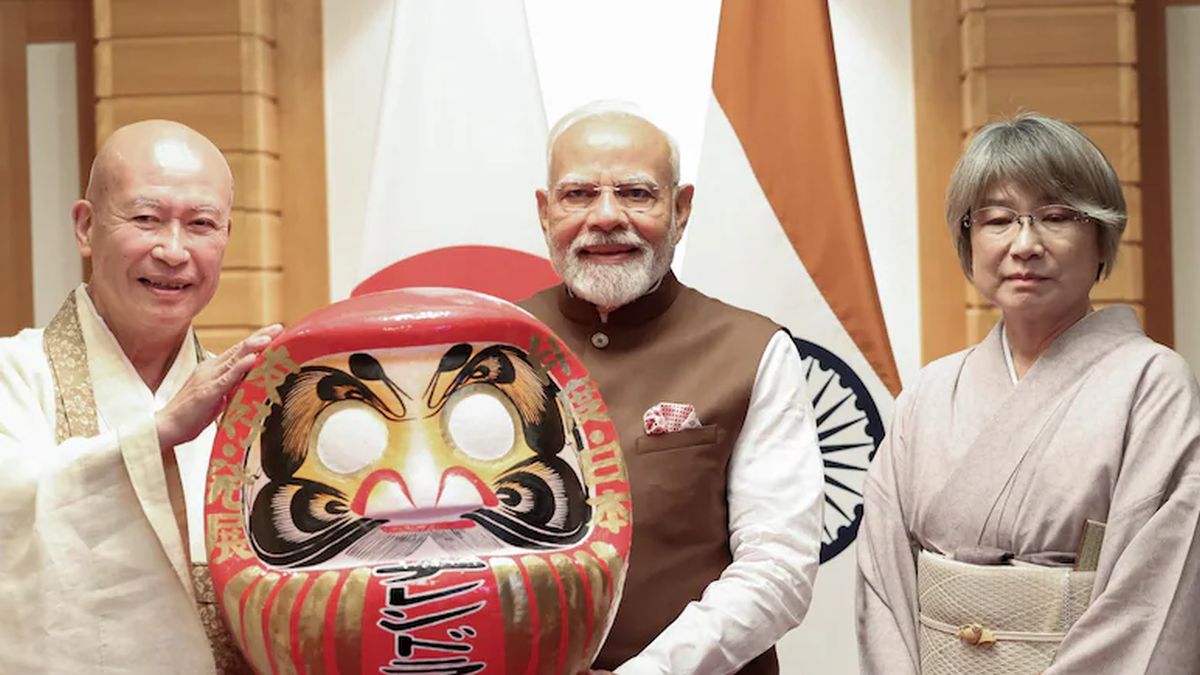
 "PM Modi honoured with Japan’s most famous souvenir. What is the Daruma doll?")

As part of his two-day visit, Prime Minister Modi has been gifted Japan’s most famous souvenir — a Daruma doll. This round, red, hollow figure is believed to bring good luck to the recipient. It is visible in every nook and corner of the country, often displayed in the windows of Japanese stores, on the shelves of restaurants, and inside many homes
When people travel to foreign countries, they often like to bring home a souvenir to serve as a reminder of their visit. It could be a fridge magnet, a keychain or some other kitschy item. And it seems that even world leaders are given such souvenirs of their visits — case in point, Prime Minister Narendra Modi in Japan.
Prime Minister Narendra Modi has received a Daruma doll from Seishi Hirose, the chief priest at the Shorinzan Daruma-Ji Temple. For those who are unaware, this doll, which can be spotted everywhere in the Asian nation, has become one of Japan’s most famous souvenirs.
#WATCH | Tokyo | Chief Priest of Shorinzan Daruma-Ji Temple presents Daruma Doll to PM Modi
(Video source: ANI/DD) pic.twitter.com/m4alaRQBMZ
— ANI (@ANI) August 29, 2025
But what exactly is a Daruma doll? And what’s the history behind them?
What are Daruma dolls?
Believed to be symbols of good fortune and future prosperity, Daruma dolls are often displayed in the windows of Japanese stores, on the shelves of restaurants, and inside many homes.
Round with scowling expressions, the dolls represent the Bodhidharma (or, “Daruma” in Japanese), the fifth-century monk who founded Zen Buddhism. It is believed that Bodhidharma once meditated for nine years straight without moving, which eventually caused his arms and legs to atrophy and fall off. And that’s why the dolls look like they do. They are meant to resemble a head and torso missing all of its limbs.
Marco Fasano, an Italian tour guide living in Japan tells CNN that Daruma Dolls are a symbol of perseverance. According to Zen Buddhism, the answers are already inside you. It’s not something that comes suddenly as a gift, but it’s something that you need to work on diligently and find in yourself.”
Editor’s Picks
Another legend says that Bodhidharma cut off his eyelids to avoid falling asleep during his meditation, which is why the doll has a wide-eyed stare.
Daruma dolls are often painted with gold kanji beneath their eyes, which is pronounced fuku-iri and translates to “bringing luck.” The face of the doll is designed with features symbolic of two mythical Japanese animals: the crane and the turtle. The crane is associated with good fortune and longevity, as it is believed to live for a thousand years. Similarly, the turtle is also thought to live for centuries and is regarded as a symbol of protection. Both creatures are revered for their connection to health, long life, and safeguarding well-being.
They also come in different colours, though red is the traditional colour of this doll. One theory for the red is that is in connection to the devastating smallpox outbreak in Asia. At the time, people began wearing red garments and decorating front doors with red ropes, to please the god of smallpox and discontinue the illness.
But, today Daruma dolls are painted in a myriad of different colours, each having its own significance. For instance, yellow Daruma dolls are symbolise security and protection, whereas white signifies love and harmony.
What are the origins of Daruma dolls?
The Daruma Dolls first emerged in the 17th Century in Takasaki, Gunma prefecture. Traditionally, farmers in the city of Takasaki crafted the figures as charms to be blessed by monks. Made from papier-mache, they were made in such a way that they could right themselves even after being knocked down. This is meant to symbolise the Buddhist principle of ‘Nanakorobi Yaoki’, which roughly means falling down seven times but getting up after the eighth.
The farmers not only believed the dolls would bring them a good harvest but also began selling them as a way to supplement their income during tough economic times.
Today, Daruma dolls are typically bought at the beginning of the Japanese new year with the belief that they can help you achieve your goals. Today, Daruma dolls are embedded in every part of Japanese life; the doll appears frequently in literature, film, television, anime, manga, and video games.
Where are Daruma dolls made?
While Daruma dolls are available across Japan, 80 per cent of them are made in Takasaki. In fact, the Daruma doll that PM Modi will receive is from the Shorinzan Daruma-ji Temple, which is believed to be where these dolls were initially made over 200 years ago.
According to the temple, visitors began placing dolls around the grounds about 100 years ago. So much so, that today the dolls are placed throughout the temple grounds, making it a tourist attraction.
How to use Daruma dolls for wishes?
But Daruma dolls aren’t like any other ordinary good luck charm. There’s a process to make a wish with a Daruma doll. Once you decide your wish, you are expected to paint on the first eye on the doll — symbolically giving it a soul. You then use the luck you derive from the doll to make your wish come true. Once your wish has come true, you are then expected to paint in the second eye.
It was originally believed that the beneficial effect of the doll would expire after one year. After this time, the doll was supposed to be burned to free the god inside. There is even a ceremony called daruma kuyo or dondoyaki in several temples across Japan, where thousands of people go to have their dolls blessed before a mass ritual burning.
So, the next time you go to Japan, you know which souvenir to get back home.
With inputs from agencies
End of Article
 "Why is Texas banning the Chinese, Russians from buying land?")

&description=PM+Modi+honoured+with+Japan%E2%80%99s+most+famous+souvenir.+What+is+the+Daruma+doll%3F)