
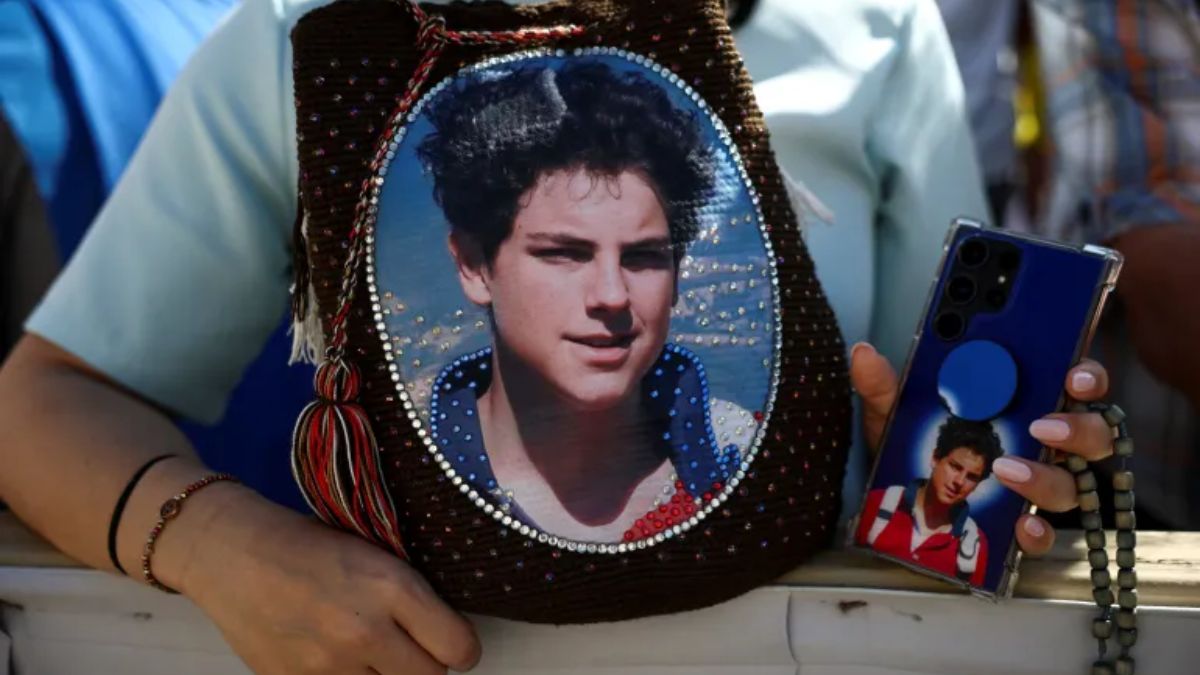
 "‘God’s influencer’: How 15-year-old Carlo Acutis became the Church’s first millennial saint")

Carlo Acutis, an Italian teenager nicknamed “God’s Influencer,” has been declared the Catholic Church’s first millennial saint.
The canonisation ceremony took place on Sunday in St Peter’s Square, with Pope Leo XIV leading the ceremony, with tens of thousands of devotees present to witness the moment.
Acutis, who died of leukaemia in 2006 at the age of 15, is remembered as a normal kid who happened to have a deep faith. Since his death, his story has spread quickly, especially among young Catholics.
For many, he has become something of a modern icon, a figure the Church hasn’t had in a long time. Part of that is down to how the Vatican has framed him: not as a distant, untouchable saint, but as a boy of the digital age who loved computers and used them to share what he believed.
Today, Acutis is celebrated as the first saint of this “digital age,” with stories of his miracles still drawing attention. Here’s a look at his story
Who was Carlo Acutis?
Carlo Acutis was born on 3 May 1991 in London, into a wealthy Italian family. His father, Andrea Acutis, worked at a bank in the city before later becoming chairman of an Italian insurance firm. Carlo, however, spent most of his childhood in Milan, where he grew up surrounded by sports, friends, and computers.
His mother, Antonia Salzano, told CNN that Carlo lived a “normal” life. He loved football, had a sharp sense of humour, and even made playful “Star Wars”-style films with his cats and dogs, voicing each of the animals himself.
But Salzano also noticed something unusual in her son from very early on. Speaking to NPR, she said she used to call him her “little Buddha,” sensing there was “something special” about him, even though theirs was not a particularly religious household.
She recalls that Carlo’s development was extraordinary. He uttered his first words at three months old, and by five months, he could speak, Salzano said. As an infant, he would even try to give away his new toys, saying he didn’t need so many.
Growing up, Carlo’s compassion was evident. He asked his parents to take blankets to people sleeping on the streets, his mother told Italian newspaper Corriere della Sera. He stood up for classmates with disabilities who were bullied, helped friends through their parents’ divorces, and often gave food and sleeping bags to the city’s rough sleepers.
By the age of seven, Salzano says, he “insisted” on attending Mass every day. At nine, he was already reading “university-level texts” on computing and had taught himself multiple coding languages.
His most well-known tech legacy is the website he created about so-called Eucharistic miracles, available in nearly 20 different languages. The site compiles information about the 196 seemingly inexplicable events in the history of the church related to the Eucharist, which the faithful believe is the body of Christ.
As Salzano recounts in her memoir My Son Carlo, he suddenly fell ill in 2006 and was diagnosed with an aggressive form of leukaemia. He died soon after, at only 15 years old.
For Salzano, the loss was crushing. She was 39 at the time and did not expect to have more children. But she recalls a moment years later when Carlo appeared to her in a dream. “He said: ‘Don’t worry, you will become a mother again,’” she wrote. A month later, at 43, she became pregnant with twins.
“This was his present to his parents,” Salzano said. “Each day we receive news of a miracle by Carlo; of a healing. So of course, the parents get a miracle too.”
Miracles by Acutis
Carlo Acutis’s path to sainthood began with a boy in Brazil. A seven-year-old suffering from a rare pancreatic illness was reportedly healed after touching one of Carlo’s T-shirts, while a priest prayed for his intercession.
The recovery was examined by the Vatican and personally authorised by Pope Francis, who declared it a miracle.
A second case came years later in Florence. A university student suffered a brain bleed after a cycling accident, leaving her with what doctors described as “severe head trauma,” according to Vatican News. Surgeons had to remove part of her skull to relieve pressure, but even then, her survival looked unlikely.
Her mother travelled to Carlo’s tomb in Assisi and prayed for her daughter’s recovery. Just 10 days later, scans showed the brain injury had vanished. Doctors could not explain the turnaround. The Vatican recognised this as Carlo’s second miracle, a must-have for canonisation.
Normally, sainthood is a slow and painstaking process that can take centuries. The Church demands clear evidence of holiness and at least two miracles attributed to the candidate’s intercession. Each case is examined by separate teams of medical experts and theologians before being approved. For Carlo, the process moved unusually quickly.
‘God’s influencer’
Pope Francis was a driving force behind Carlo’s cause, convinced the Church needed a figure like him, someone relatable to younger generations and able to bridge the world of faith with the challenges of the digital age.
Also read: How to spread faith? The Vatican is calling on ‘hot priests’
Carlo is now often nicknamed “God’s influencer.” Unlike traditional images of saints in robes and halos, he is remembered in jeans, a sweatshirt, and sneakers. His global following has grown rapidly, with many young Catholics seeing him as someone who lived a life much like theirs.
The tomb of Carlo Acutis in Italy
“Jesus is my great friend and the Eucharist my highway to Heaven” –
Carlo Acutis
Video: 206 Tours pic.twitter.com/y5BGQ6bGqh
— Sachin Jose (@Sachinettiyil) May 24, 2024
For those who cannot travel to Assisi, a live webcam streams visitors at his tomb, a level of digital access even popes buried in St Peter’s Basilica don’t have.
The connection many feel to Carlo is deeply personal. Diego Sarkissian, a young Catholic from London, told the BBC that Carlo’s life resonates with him.
“He used to play Super Mario video games on the old Nintendo consoles, and I’ve always loved video games. The fact that you can think of a saint doing the same things [as you], wearing jeans, it feels so much closer than what other saints have felt like in the past,” he said.
Now that he has been canonised, churches and schools around the world can officially be dedicated in Carlo Acutis’s name, a lasting legacy for the teenager who became the first saint of the digital age.
With input from agencies
End of Article


&description=%E2%80%98God%E2%80%99s+influencer%E2%80%99%3A+How+15-year-old+Carlo+Acutis+became+the+Church%E2%80%99s+first+millennial+saint)