
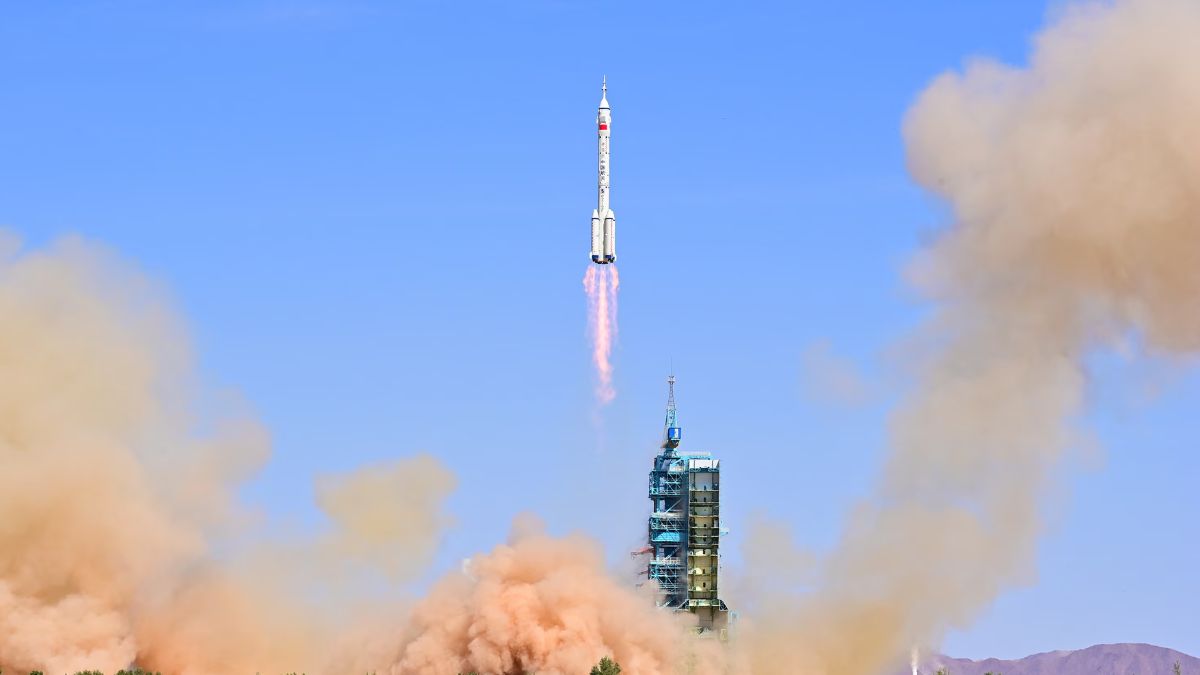
 "China turns to car-style production to accelerate rocket and satellite manufacturing")

China is reshaping its space sector with a lean manufacturing ‘pull’ system inspired by the car industry. The approach seeks to mass-produce rockets and satellites with speed, quality and flexibility, supported by AI-driven assembly lines and a national digital supply chain platform.
As the global race for space dominance intensifies, China is introducing a new manufacturing model that aims to make rockets and satellites as efficiently produced as cars, a shift that could redefine industrial space production.
The country’s state-owned enterprises are introducing a new philosophy called the ‘final assembly pull’ system, an approach rooted in lean manufacturing principles drawn from the automotive industry. The reform aims to deliver space systems not only at speed but also with consistent quality, lower costs and greater adaptability.
With forecasts suggesting that orbital launches could reach 170,000 tonnes of payload annually by 2045, researchers argue that whichever nation can master scalable space manufacturing will hold a decisive advantage.
From ‘push’ to ‘pull’: A manufacturing revolution
Traditionally, aerospace production has been driven by a “push” model where components are manufactured based on forecasts, often leading to mismatches and costly delays. The “pull” model turns this approach on its head by ensuring that parts are only supplied when demanded by the next stage of production. Toyota pioneered this approach through its mid-20th-century Toyota Production System, using tools such as kanban cards to minimise waste and increase efficiency.
China’s aerospace industry is now applying the same just-in-time logic to rockets and satellites. From raw materials to complex subsystems, each step in the supply chain is activated only when signalled by the stage downstream. The result is a tightly synchronised network where rocket engines, solar panels and circuit boards are built in line with launch schedules.
However, the reform also restructures the organisation of China’s space sector. What was once a relatively flat system, where suppliers had greater autonomy, is being reshaped into a pyramid-style hierarchy.
“It represents a systemic and disruptive transformation of existing manufacturing models,” noted Wang Guoqing, chief information officer of China Aerospace Science and Technology Corporation (CASC), in a July paper published in the Journal of Mechanical Engineering.
For decades, rockets and satellites were hand-crafted one by one, each a bespoke piece of engineering. But growing demand for satellite constellations, reusable rockets and long-term lunar missions has outpaced that artisanal model. Wang and his colleagues said the global space race has shifted from “can we build it” experiments to a focus on reliable parallel production of multiple models.
They described today as a “mass customisation era” where high-frequency launches and vast satellite constellations demand scalable, repeatable and flexible manufacturing.
China’s networked model
SpaceX has already demonstrated the value of industrialised production through Starlink, which has placed over 7,000 satellites in orbit. While the United States has seen one company dominate this shift, Wang’s team highlighted that China is following a more networked model, combining state-owned enterprises, private firms and research institutions into a coordinated national ecosystem.
Mega-constellations such as Guowang, Qianfan and Hongtu-3 are accelerating the pressure to industrialise satellite and rocket factories capable of producing thousands of units.
According to Wang’s paper, a central manufacturing integrator is now being tasked with controlling the production process. This body manages scheduling, contracts, quality and supplier coordination. China is also introducing modular and reconfigurable systems such as pulsed assembly lines, which move products in steady cycles to reduce downtime. AI-driven flexible assembly centres can be reconfigured to build multiple types of rockets on the same line.
One of the most significant innovations is the creation of a collaborative digital platform connecting factories, laboratories and suppliers across China. Using cloud systems, IoT, AI and digital twin technologies, it provides real-time visibility of bottlenecks, sends alerts on missing parts and enables secure data sharing across different networks. The researchers called this the “digital pull board”, describing it as a live dashboard of the country’s aerospace supply chain.
The reforms are being introduced as China’s launch cadence picks up. Even so, the United States continues to lead, recording 158 launches in 2024, most of them by SpaceX, compared with China’s 68.
End of Article


&description=China+turns+to+car-style+production+to+accelerate+rocket+and+satellite+manufacturing)