
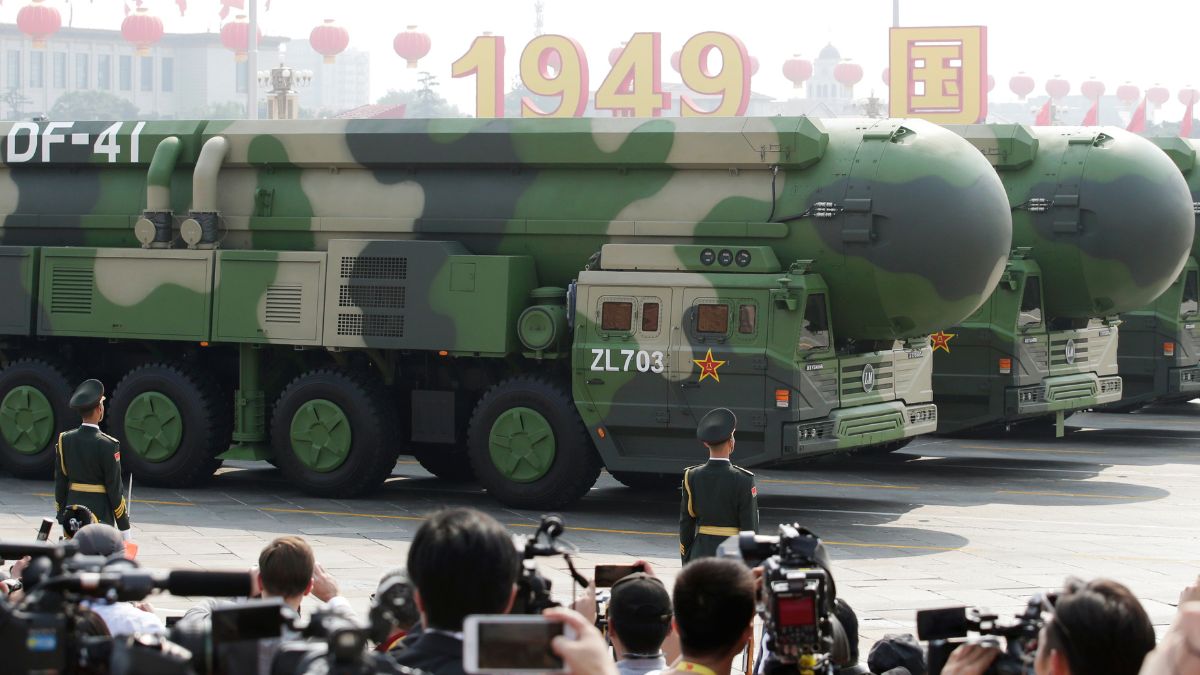
 "China to display DF-41 at military parade: How does it stack up against India’s BrahMos?")

China is preparing to stage one of the most significant military parades in recent years, with its newest missile systems, combat drones and advanced armoured vehicles set to be displayed in central Beijing.
At the heart of the showcase will be the DF-41 intercontinental ballistic missile (ICBM), the longest-range and most powerful weapon in the arsenal of the People’s Liberation Army Rocket Force (PLARF).
The September 3 parade commemorates the 80th anniversary of the end of World War II and is expected to feature President Xi Jinping at Tiananmen Square.
For China, the event is an opportunity to highlight its military modernisation. With buyers of Chinese weaponry also expected to attend, the display will serve not only as a domestic demonstration of strength but also as a potential pitch to international partners.
The parade follows a summit of the Shanghai Cooperation Organisation (SCO) in Tianjin, where Xi is scheduled to meet Russian President Vladimir Putin, Indian Prime Minister Narendra Modi and other leaders.
What is China planning to showcase at the military parade?
Satellite imagery captured on August 9, revealed rows of equipment positioned at a staging ground outside Beijing in preparation for the parade.
The images, analysed by the Open Nuclear Network in Vienna, showed armoured vehicles, air defence batteries, artillery systems including rocket launchers, and a range of cruise missiles.
Among the equipment, several covered transporter erector launchers strongly resembled the DF-41 ICBM. Though concealed, analysts concluded that the missiles were almost certainly among the hardware lined up for the event, reported Bloomberg.
Editor’s Picks
Other systems spotted included reconnaissance and combat drones, some of which are thought to be prototypes of “loyal wingman” designs.
These unmanned aircraft are intended to fly in coordination with piloted fighter jets, extending combat capability through weapons carriage, electronic warfare, and surveillance roles.
China introduced its Feihong FH-97 drone in 2021, which is regarded as its first combat-ready loyal wingman system.
Social media posts from Beijing in the days before the parade also showed new models of tanks and infantry fighting vehicles.
Analysts suggested these were equipped with advanced protection systems and sensors, including compact short-range defences designed to intercept incoming drones or missiles.
Hypersonic anti-ship weapons were also believed to be among the assets moved into position.
While not easily identifiable from satellite images, specialists said their presence in the parade would be consistent with China’s emphasis on developing weapons that can overcome advanced naval defences.
“Few countries have developed so many anti-ship missiles that cover all imaginable categories,” Tianran Xu, senior analyst at the Open Nuclear Network told Bloomberg.
He added that the growing importance on unmanned systems and long-range strike capabilities demonstrated China’s focus on preparing to “win a high-tech, high-intensity war.”
What is the DF-41, cornerstone of China’s nuclear arsenal?
The central feature of the parade will be the DF-41 (Dong Feng-41 or East Wind-41), designated CSS-20 by Western analysts.
This intercontinental ballistic missile is considered the most advanced system fielded by the PLARF. It was first displayed in the 2019 National Day parade but has since undergone further tests and deployment.
The DF-41 is a solid-fuelled, three-stage missile with an estimated launch weight of 80,000 kilogrammes and a length of 20-22 metres. It has a diameter of roughly 2.25 metres and can carry a payload of up to 2,500 kilogrammes.
The missile is designed to deliver multiple independently targetable reentry vehicles (MIRVs), with Chinese state media claiming it could carry as many as ten nuclear warheads.
Defence experts, however, suggest that a smaller number of warheads paired with penetration aids is more likely in practice.
Its operational range is assessed to be between 12,000 and 15,000 kilometres. This places nearly the entire continental United States, Europe and Africa within reach, along with most of Asia and the Pacific region.
With a top estimated speed of Mach 25 and a circular error probable (CEP) accuracy of around 100 metres, the missile is considered one of the most precise and powerful ICBMs in existence.
How did China’s DF-41 come about?
Development of the DF-41 began in July 1986 under a programme called Project 204, led by China’s Academy of Launch Vehicle
Technology. Initial work was merged into the DF-31 program in the late 1990s, but a renewed effort in the mid-1990s revived the DF-41 as a distinct project. By 2010, deployment-ready versions were transferred to the PLARF.
The missile underwent multiple flight tests, beginning with its first launch on July 24, 2012, from the Wuzhai missile launch center in Shaanxi province. A series of subsequent tests in 2013 and 2014 demonstrated its range and warhead delivery systems.
In August 2015, US officials confirmed that China had flight-tested the DF-41 with two independently targetable warheads. Later that year, China tested a canister-ejection system for a rail-mobile version of the missile.
Further trials in 2016 and 2017 included tests with guided warheads. By 2019, the DF-41 was believed to have entered limited production, with 18 launch vehicles observed at a training site in Inner Mongolia.
Sixteen launchers were unveiled publicly at China’s 70th anniversary parade that same year.
In September 2024, the missile was tested in the Southern Ocean, reinforcing its capability to strike distant targets. Analysts believe China has begun constructing silos capable of housing the DF-41, with at least 16 identified under development at a training facility in Jilantai as of 2021.
The missile is also capable of being launched from mobile road vehicles and has been trialled with a rail-based system.
Experts estimate that China aims to produce between 50 and 100 DF-41 missiles, which would significantly expand its strategic arsenal.
The weapon places Beijing on par with the United States’ Minuteman III and Russia’s RS-28 Sarmat ICBMs, consolidating its position as one of the world’s foremost nuclear powers.
How does China’s DF-41 compare with India’s Brahmos?
While China’s DF-41 represents a global strategic weapon, India’s missile programmes are oriented toward regional security and deterrence. One of the most prominent systems of India is the BrahMos cruise missile, developed in partnership with Russia.
First tested in June 2001, the BrahMos is recognised for its supersonic speed, precision, and ability to be launched from multiple platforms, including land-based vehicles, aircraft, and naval ships.
The standard version has a range of 300-500 kilometres, while the extended-range BrahMos-ER can strike targets up to 1,500 kilometres away.
Development of the BrahMos-II aims to achieve hypersonic speeds of Mach 8, while the BrahMos-NG (Next Generation) version will reduce weight for deployment on a wider variety of platforms, including submarines.
The BrahMos gained prominence during India’s Operation Sindoor, where it demonstrated its combat effectiveness against Pakistan.
Unlike the DF-41, which is a nuclear-capable ICBM designed for intercontinental deterrence, the BrahMos serves as a tactical precision strike weapon suitable for conventional warfare scenarios.
India has also leveraged the BrahMos as a strategic export tool. In April, it delivered a batch of the missile to the Philippines as part of a defence contract.
Southeast Asian nations such as Indonesia, Vietnam, and Malaysia have also shown interest in acquiring the system, with Indonesia formally discussing a potential $450 million deal.
These exports strengthen India’s security ties in the Indo-Pacific, particularly in response to China’s assertive actions in the South China Sea.
What does the military parade mean for China?
China’s upcoming parade will not only commemorate a historic anniversary but also highlight the rapid modernisation of the PLA. The DF-41, with its unmatched range and warhead capacity, symbolises Beijing’s pursuit of a robust second-strike capability.
Alongside the parade’s display of hypersonic anti-ship missiles, drones, and advanced armoured vehicles, it demonstrates a military strategy focused on countering US dominance in the Pacific and preparing for technologically advanced conflicts.
“Few countries have developed so many anti-ship missiles that cover all imaginable categories,” said Xu, reflecting on the broader trends evident in China’s military development.
China is already the world’s fourth-largest exporter of arms, with clients mainly in developing countries such as Pakistan. By exhibiting weapons like the DF-41, Beijing wants to reinforce its status as a major player in the international defence market.
With inputs from agencies
End of Article
 "Pakistani drone strikes kill 3, injure 7 in Afghanistan, Taliban summons envoy")
 "Trump wants to take ‘drill, baby, drill’ global: He is pressuring nations to curb clean energy push")
&description=China+to+display+DF-41+at+military+parade%3A+How+does+it+stack+up+against+India%E2%80%99s+BrahMos%3F)