
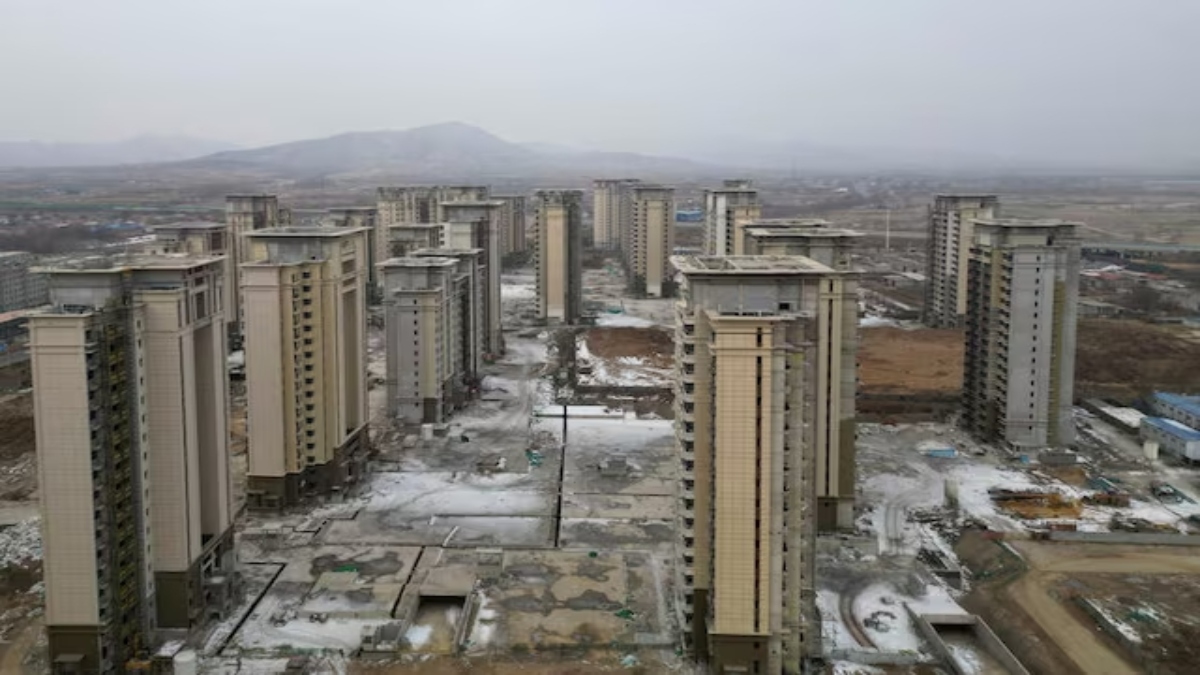
 "<div>Beyond Evergrande: Chinas property giant has vanished its big crisis hasnt</div>")

China Evergrande Group, once the country’s largest property developer and a symbol of its construction boom, has officially disappeared from the Hong Kong Stock Exchange. On Monday, the bourse enforced a long-expected delisting, ending a 15-year run that had begun with one of the hottest initial public offerings in the city’s history.
The delisting follows years of crisis. Evergrande first defaulted on its massive debts in 2021, weighed down by more than $300 billion in liabilities, an AFP report said. Earlier this year, a Hong Kong court ordered the company to be wound up after it failed to present a workable restructuring plan. Liquidators have since assumed control of more than 100 of its subsidiaries and are now suing former auditors to recover creditor funds.
For a company once worth over $50 billion, the fall is staggering. At its peak, Evergrande epitomised China’s rapid urban expansion and helped power nearly a third of the economy through land sales, construction and housing demand, a report in The Strait Times said. Its collapse now embodies the deep challenges that continue to weigh down the property sector.
A crisis that refuses to end
Evergrande’s demise might be definitive, but the broader property crisis that it helped trigger still looms over China’s economy. What began with Beijing’s 2020 “three red lines” policy—a set of borrowing restrictions meant to curb excessive developer leverage—has spiralled into a prolonged slowdown.
Unlike the United States’ sharp housing collapse in 2008, China’s crisis has been managed into a drawn-out decline. Authorities have prevented outright systemic failure, but at the cost of an economy that has been dragging under real estate’s weight for half a decade, The New York Times reported.
Data reflects the depth of the slump. In July, new home prices across 70 major cities fell again, continuing a steady downward trajectory. In the first seven months of 2025, the amount of new housing under construction dropped nearly 20 percent year-on-year, while unsold housing stock surged to more than twice historical averages, The New York Times said.
The result is a grinding stagnation. Families who once viewed property as a safe store of wealth are increasingly reluctant to buy, and many owners are being forced to accept losses on sales. The faith in real estate as a guaranteed investment—long a cornerstone of middle-class security in China—has been badly shaken.
Country Garden, Vanke and the ripple effect
Evergrande is not the only casualty. Other giants, once seen as relatively insulated, are faltering too. Country Garden, which defaulted in 2022, remains mired in restructuring efforts. Vanke, long regarded as financially sound and bolstered by ties to state-owned Shenzhen Metro, shocked investors earlier this year with a record annual loss of 49.5 billion yuan, its first since going public in 1991, The Strait Times said.
Even with state backing, Vanke’s struggles reveal just how pervasive the downturn has become. Home sales across the industry have plummeted to their lowest levels in a decade. Developers are weighed down by debt burdens incurred during years of aggressive expansion and a growing number of mid-tier firms have been liquidated after failing to restructure.
The crisis has radiated beyond developers. Construction companies, landscapers, real estate agents and local governments—all deeply reliant on the sector—are suffering significant losses. Land sales, which once filled local coffers, have collapsed leaving municipalities scrambling for revenue.
Beijing’s selective interventions
Faced with this systemic strain, Beijing has opted for selective interventions rather than a sweeping bailout. Authorities have eased some restrictions on housing purchases, lowered mortgage rates and extended targeted loans to help developers finish stalled projects.
The approach reflects a policy dilemma. While Beijing wants to avoid a “Lehman moment” that could trigger financial panic, but it is wary of reigniting the speculative frenzy that created the crisis in the first place. The government is “propping up just enough indebted property companies to prevent a broad collapse” while the overall market continues to weaken, The New York Times said.
Local governments are experimenting with easing restrictions to revive demand. Beijing recently rolled back rules on suburban home purchases and other major cities may follow suit.
But these measures have so far yielded little impact, with most signs of stabilisation limited to top-tier urban markets. Even in these cities, sellers report difficulty finding buyers willing to pay close to past prices, The New York Times said.
The human impact
Behind the statistics are millions of ordinary households caught in the fallout. Families who purchased homes at peak prices face mounting losses. Some who invested heavily in renovations or second properties are now stuck with assets they cannot sell without steep discounts.
Mortgage distress is rising, with delinquency ratios climbing to the highest in four years, The Strait Times said. Many homeowners are being forced to offload properties at lower prices to cover debts, further accelerating the downward spiral. Stories of sellers in mid-tier cities like Hefei unable to break even illustrate how far sentiment has shifted from the once feverish optimism of the boom years.
What lies ahead
The property sector once defined China’s economic miracle. It accounted for up to 30 per cent of GDP, provided a reliable investment vehicle for households and funded local governments through land sales. Today, it has become a drag on growth, consumer confidence and financial stability.
The government’s balancing act—averting collapse without reviving excess—suggests the crisis will persist for years. Without a new growth model less dependent on property investment, China risks being trapped in a cycle of weak demand, overhang of unsold housing and slow structural adjustment.
Evergrande’s delisting might symbolise the end of a giant, but it is far from the end of China’s property crisis. Instead, it marks another chapter in a story that continues to define the challenges of the world’s second-largest economy.
End of Article

 "What’s behind the growing India-Algeria defence ties?")
&description=Beyond+Evergrande%3A+China%E2%80%99s+property+giant+has+vanished+its+big+crisis+hasn%E2%80%99t)