
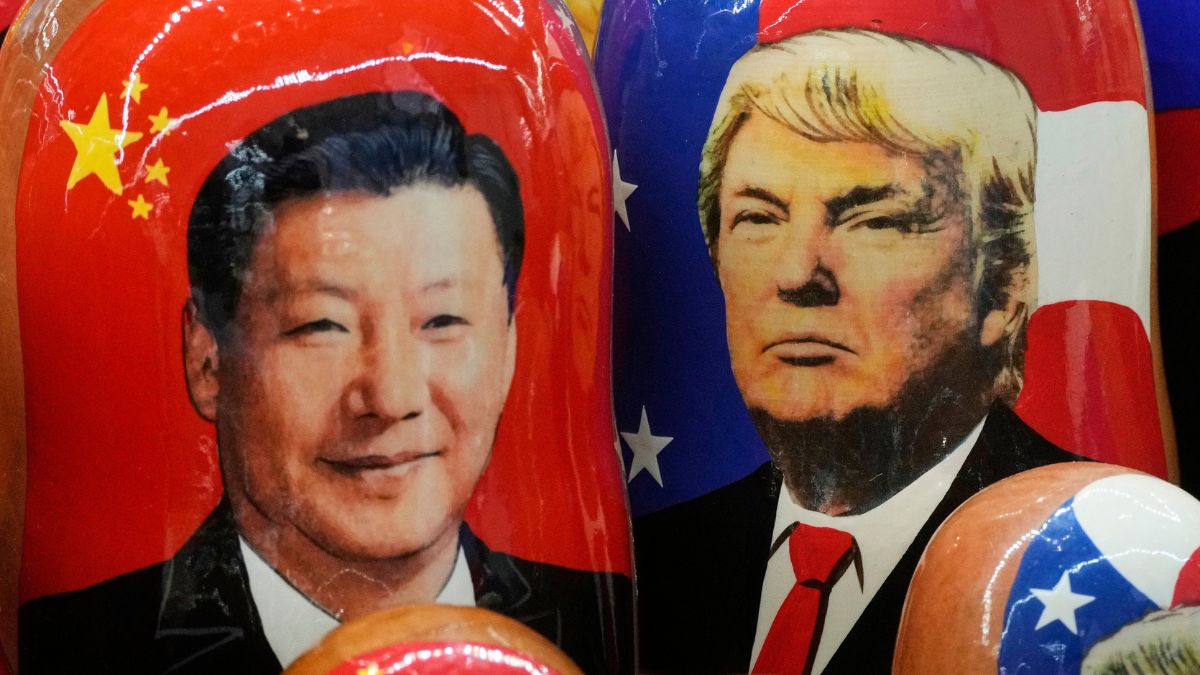
 "US Tariffs: Why is Trump going soft on China but playing hardball with India?")

United States President Donald Trump has adopted sharply different approaches toward two of its largest trading partners — maintaining an extended tariff truce with China while imposing steep trade penalties on India.
Trump signed an executive order on Monday granting a further 90-day extension to the existing tariff pause between Washington and Beijing.
The previous suspension was due to expire just after midnight on August 12.
Without action, tariffs on Chinese imports could have risen from the current 30 per cent to as high as 145 per cent, with China prepared to respond by raising its own duties on American goods from 10 per cent to 125 per cent.
Trump announced the extension on his Truth Social platform, stating that “all other elements of the Agreement will remain the same.”
China’s Ministry of Commerce confirmed the move, also declaring that it would suspend certain restrictions against American companies previously placed on an export control list and the “unreliable entities” list.
Some companies will see these restrictions lifted entirely, while others will have a further 90-day relief period.
The extension gives both countries additional time to address long-standing trade disputes.
US officials have described the talks as aimed at tackling “trade imbalances” and “unfair trade practices,” while also seeking greater access for American exporters and addressing national security concerns linked to technology and critical materials.
China’s embassy in Washington stated that “win-win cooperation between China and the United States is the right path; suppression and containment will lead nowhere.”
Beijing also urged Washington to lift “unreasonable” restrictions, particularly in the semiconductor sector, and work together to ensure stability in global supply chains.
Editor’s Picks
What’s at stake for US-China
Analysts warned that the threatened tariff rates (Washington threatened 145 per cent on Chinese goods, Beijing countered 125 per cent on US exports) would have effectively ended trade between the two economies, triggering severe global market disruption.
In May, both sides agreed during talks in Geneva to roll back those rates in order to stabilisde markets and resume negotiations.
That agreement also included US pledges to ease export restrictions on items such as advanced computer chip technology and ethane, an important input in petrochemical production.
China, in turn, committed to easing access for US firms to rare earth minerals and magnets, which are critical for industries ranging from electric vehicles to aerospace.
Sean Stein, president of the US-China Business Council, called the extension “critical” for allowing time to reach a trade agreement that could “improve their market access in China and provide the certainty needed for companies to make medium- and long-term plans.”
He also noted the importance of agreements on issues such as fentanyl, telling AP, “Securing an agreement on fentanyl that leads to a reduction in US tariffs and a rollback of China’s retaliatory measures is acutely needed to restart US agriculture and energy exports.”
Why Trump has gone soft on China
The US approach toward China has been influenced by Beijing’s control over rare earth minerals and components vital to modern manufacturing.
In April, China imposed licensing restrictions on exports of rare earth elements and magnets to the US, prompting strong reactions from American industries, particularly automotive suppliers, which rely heavily on these imports.
US firms quickly pressed the administration to find a resolution to prevent domestic production slowdowns.
According to Claire Reade, senior counsel at Arnold & Porter and former assistant US trade representative for China affairs, “The US has realised it does not have the upper hand.”
The rare earth issue puts into spotlight Beijing’s capacity to retaliate in ways that could disrupt US manufacturing and technology sectors, making negotiation a more attractive option for Washington.
Ali Wyne, a specialist in US–China relations at the International Crisis Group, assessed that “by overestimating the ability of steep tariffs to induce economic concessions from China, the Trump administration has not only underscored the limits of unilateral US leverage, but also given Beijing grounds for believing that it can indefinitely enjoy the upper hand in subsequent talks with Washington by threatening to curtail rare earth exports.”
Trump plays hardball with New Delhi
While the White House has sought compromises with China, it has taken a much harder line against India, particularly over New Delhi’s continued imports of Russian oil.
Trump has confirmed that the US has imposed 25 per cent reciprocal tariffs on Indian goods, combined with an additional 25 per cent levy on purchases of Russian oil, amounting to a 50 per cent total tariff burden.
Speaking from the White House, Trump said the measure had delivered a “big blow” to Moscow’s economy.
“Doesn’t help when the President of the United States tells their largest or second-largest oil buyer that we’re putting a 50 per cent tariff on you if you buy oil from Russia. That was a big blow,” he remarked, adding, “No one else would have been so tough, and I haven’t stopped there.”
Trump also argued that his tariff strategy has yielded diplomatic gains, claiming it contributed to resolving conflicts in several regions.
“The tariffs have helped, gives us not only the money, but it gives us great power over enemies. We solved five wars — Pakistan and India. Azerbaijan and Armenia — it was raging for 37 years, and the two leaders got up and they said, we never thought this would be solved. Russia tried to solve it. They all tried to solve it. It was a very tough situation, but we got it done,” he said.
Why the contrasting strategy
China remains a central player in US supply chains and a top-tier trade partner. The US trade deficit with China stood at $262 billion last year, the largest with any single country, making continued engagement a necessity for both economic and political reasons.
India, by contrast, has been seen by Trump’s team as both a competitor in certain sectors and a less indispensable trade partner. Long-standing tensions over H-1B visa policies and outsourcing have already strained relations.
The administration has also taken issue with India’s role in refining and exporting Russian oil, which reaches markets including Europe — an area where Washington has sought to maintain unity against Moscow following its actions in Ukraine.
Analysts point out that Trump’s policy agenda seems to be anchored in ending the war in Ukraine and reshoring jobs to the US.
In this framework, India becomes a target for pressure, while China, despite being a strategic rival, is approached with more caution.
What next for Trump, China
Despite the extensions and temporary agreements, major points of contention between Washington and Beijing remain unsettled.
US concerns include inadequate protection of intellectual property rights in China, extensive subsidies to Chinese industries, and state-led policies that, according to American officials, give Chinese firms unfair advantages in global markets.
Jeff Moon, former US diplomat and trade official, warned that while limited agreements — such as increased Chinese purchases of American soybeans or cooperation on countering fentanyl — are possible, “the trade war will continue grinding ahead for years into the future.”
Regarding a possible truce in the Russia-Ukraine conflict, Trump stated, “Well, we’re going to have a meeting with Vladimir Putin. And at the end of that meeting, probably in the first two minutes, I’ll know exactly whether or not a deal can be made.”
With inputs from agencies
End of Article

&description=US+Tariffs%3A+Why+is+Trump+going+soft+on+China+but+playing+hardball+with+India%3F)