
Last Updated:
From border talks to trade assurances, the tone of Wang Yi’s India visit points to a cautious but deliberate effort to reset strained ties.



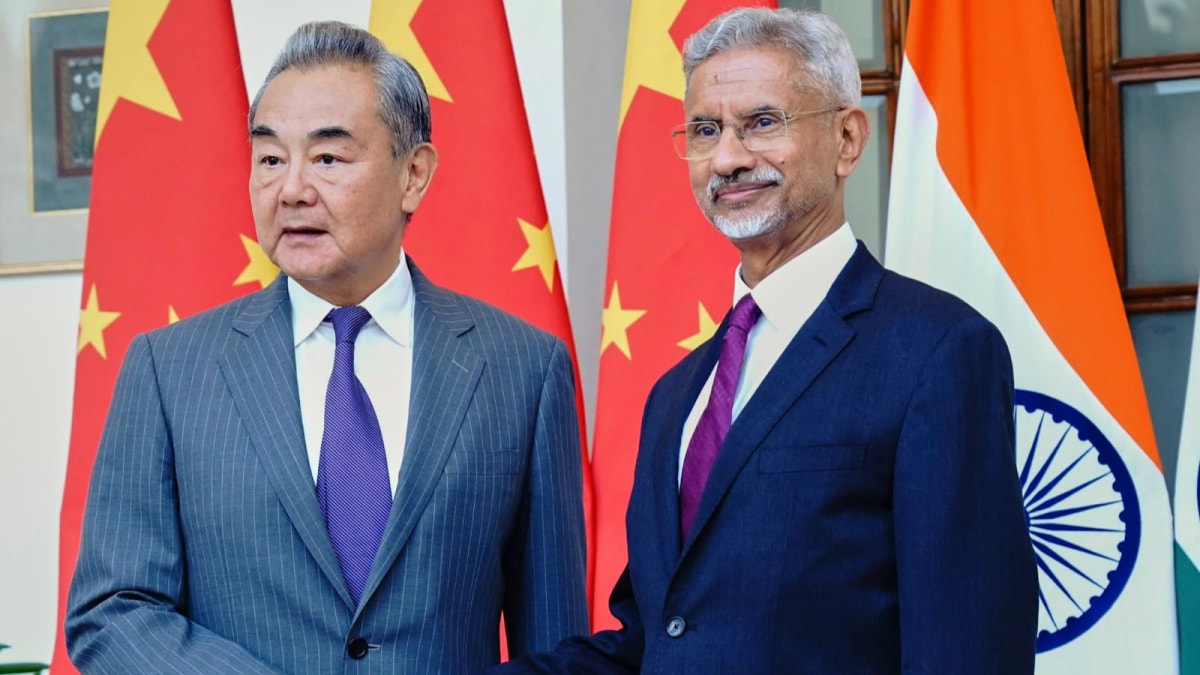
Indian Foreign Minister S Jaishankar shakes hand with his Chinese counterpart Wang Yi, left, in New Delhi, India, Monday, Aug. 18, 2025. (AP Photo)
Chinese Foreign Minister Wang Yi’s visit to India, his first in three years, comes at a crucial juncture. It is taking place just weeks ahead of Prime Minister Narendra Modi’s scheduled trip to Tianjin for the Shanghai Cooperation Organisation (SCO) summit, his first visit to China in seven years. The timing and tone of the meetings suggest both sides are consciously working to project a shift away from the mistrust that has defined bilateral relations since the 2020 Galwan Valley clashes.
In meetings with External Affairs Minister S Jaishankar and National Security Advisor Ajit Doval, Wang Yi repeatedly struck a conciliatory tone. He called the moment an “important opportunity of improvement and growth” in ties. He added that a “healthy and stable China-India relationship serves the fundamental and long-term interests of both of our countries,” and emphasised the need to follow “the strategic guidance of our leaders”.
Recommended Stories
Jaishankar, on his part, acknowledged that “having seen a difficult period in our relationship”, both sides now seek to move ahead. His remarks, delivered during Monday’s meeting, reflected an effort to lower the temperature in bilateral messaging. “Differences must not become disputes, nor competition conflict,” Jaishankar said. He reiterated that stable and constructive relations between India and China were in the interest not just of both countries, but of the world.
Wang Yi’s call for India to make its contribution to a successful SCO summit was coupled with praise for the Modi–Xi Jinping meeting at Kazan last year. Both sides have referred to that meeting as a turning point that helped set a “new trend” for bilateral engagements.
Border Remains The Core Issue, But Dialogue Is Back
While the shift in diplomatic tone is noteworthy, the core friction point remains the border. During his Tuesday meeting with NSA Ajit Doval, held under the 24th round of the Special Representatives (SR) dialogue, Wang Yi reaffirmed China’s willingness to stabilise conditions along the Line of Actual Control (LAC). The SR-level talks are the primary mechanism for discussing the boundary issue, and Doval’s comments reflected cautious optimism.
Doval said the border had been “quiet” and acknowledged an “upward trend” in overall ties. He pointed to the gains made after the Kazan meeting, describing them as “substantial”, and praised the “new environment” for helping both sides resume work across areas previously stalled by tensions.
Wang Yi echoed this view, saying that the stability restored at the border was encouraging and that the 23rd round of SR-level talks had already produced “important consensus” on managing disagreements and advancing toward settlement. He added that both sides had identified specific goals and created a working framework for future consultations.
Significantly, the border issue was not discussed during Jaishankar’s meeting with Wang, it was deliberately reserved for the Doval–Wang dialogue. This division of responsibility underscored the importance placed on handling the boundary issue at the highest strategic level.
Yet the situation on the ground remains complex. Despite progress in disengagement at certain friction points, large troop deployments remain along the 3,488-km LAC. Doval’s meeting was expected to focus heavily on de-escalation, not just disengagement, in order to reduce the risk of future confrontations. The long-term goal remains to return troops to their pre-2020 positions, but no breakthrough was announced during this round of talks.
Fertilisers, Rare Earths, And Tunnel Machines: New Points of Convergence
Beyond border stability, one of the most consequential outcomes of Wang Yi’s visit was a renewed push to revive cooperation in emerging and critical sectors. According to NDTV, Wang gave an in-principle assurance to address India’s requirements for rare earth materials, fertilisers, and tunnel boring machines (TBMs), a move that marks a significant shift after over a year of export slowdowns and restrictions.
Sources told NDTV that Wang gave these assurances directly to Jaishankar, and confirmed that China would resume supplies of these crucial goods. The backdrop here is important: China had curtailed exports of urea, rare earths, and TBMs, all essential for India’s agriculture, renewable energy, and infrastructure sectors. According to HT, China supplies nearly 30 per cent of India’s fertiliser needs, dominates the rare earth market globally, and is a key supplier of TBMs used in urban and road infrastructure.
Rare earths, in particular, are vital for sectors ranging from electronics and renewable energy to medical devices and manufacturing. A report from the State Bank of India notes that India spends around USD 33 million annually on importing rare earths and compounds. China, meanwhile, controls an estimated 60–70 per cent of global rare earth mining. The SBI report further highlights that disruptions in these imports have already impacted critical Indian industries such as basic metals, transport equipment, construction, and electricals.
India has officially identified 30 minerals as critical for its economic security, and the restoration of rare earth access from China is being viewed as a major step toward rebuilding disrupted supply chains.
The assurances came after Jaishankar raised these issues during his July 2025 visit to China, and followed up again in Delhi this week. The EAM underscored the need to avoid “restrictive trade measures and roadblocks” and reiterated that relations should be based on mutual respect and mutual interest. He also listed other bilateral areas of cooperation, including pilgrimages, river data sharing, border trade, and people-to-people exchanges.
The Trump Factor: A Shared Pushback Against Washington’s Trade Offensive
Wang Yi’s visit, and the language surrounding it, cannot be separated from the broader geopolitical churn. More than six months into Donald Trump’s second term, both India and China are facing renewed pressure from his administration’s resurgent protectionism.
Under Trump 2.0, Washington has revived its tariff-first approach and launched a fresh trade tirade targeting BRICS nations, accusing them of enabling global trade imbalances, weaponising energy partnerships, and undermining US manufacturing interests.
Within BRICS, China and India stand out as the two largest economies by far, together accounting for over two-thirds of the group’s total GDP. According to April 2025 IMF estimates, China’s economy is valued at over USD 17 trillion, while India’s GDP stands at approximately USD 4 trillion — significantly ahead of Brazil (USD 2.1 trillion), Russia (USD 1.9 trillion), and South Africa (under USD 400 billion).
This economic weight has made both countries high-priority targets in Trump’s second-term trade strategy, though the severity of tariffs has varied.
Beijing has responded with direct public criticism. Following Wang Yi’s meetings in New Delhi, the Chinese Foreign Ministry said “unilateral bullying is rampant”, as reported by Bloomberg. The statement urged that India and China should “contribute to promoting a multipolar world” and strengthen themselves as responsible powers representing developing nations. The message was unambiguous: Washington’s coercive trade moves are seen in Beijing as a shared threat, and New Delhi is being positioned as a potential partner in resisting it.
India has taken a more measured tone, but has not held back in calling the tariffs “unfair, unjustified, and unreasonable.”
The numbers reinforce that concern. Trump has slapped 50 per cent tariffs on Indian exports, including a punitive 25 per cent surcharge specifically targeting India’s continued purchases of Russian oil. These tariffs are scheduled to take effect on August 27 and have reportedly led to the near-collapse of trade negotiations between New Delhi and Washington.
China, too, has been targeted, with 30 per cent tariffs imposed on a range of exports under Trump’s revived trade war, but has so far avoided additional sanctions despite being the world’s largest importer of Russian oil. This disparity has not gone unnoticed in Delhi.
As Hindustan Times reported, both Indian and Chinese officials acknowledged during the Jaishankar–Wang meeting that current US policies are targeting both countries, creating what one official described as “an imperative for the two sides to come closer.” While this does not signal a formal shift in alignment, it is clear that shared economic pressure from Washington is accelerating tactical coordination.
Conclusion: A Cautious Reset, Nudged By External Pressure
India and China are not strategic allies, and deep differences, especially on the border, remain. But Wang Yi’s visit, PM Modi’s planned trip to China, and the revival of economic cooperation indicate that both sides are cautiously signalling a willingness to move beyond the worst of the Galwan-era rupture.
For Delhi, securing critical supplies like rare earths and fertilisers is both a tactical necessity and a diplomatic opening. For Beijing, rebuilding ties with India offers a buffer against Western pressure and a chance to reinforce its multipolar world narrative.
Donald Trump’s trade salvos may not be the official reason for this thaw, but they are undeniably part of the story. In navigating an unpredictable global order, India and China are discovering that, at least for now, selective cooperation may be the path of least resistance.
About the Author

Karishma Jain, Chief Sub Editor at News18.com, writes and edits opinion pieces on a variety of subjects, including Indian politics and policy, culture and the arts, technology and social change. Follow her @kar…Read More
Karishma Jain, Chief Sub Editor at News18.com, writes and edits opinion pieces on a variety of subjects, including Indian politics and policy, culture and the arts, technology and social change. Follow her @kar… Read More
Loading comments…
Read More