
Last Updated:
These two issues need to be understood and tackled separately as the first is a problem of medical culture and the other is a failure of manufacturing and regulation

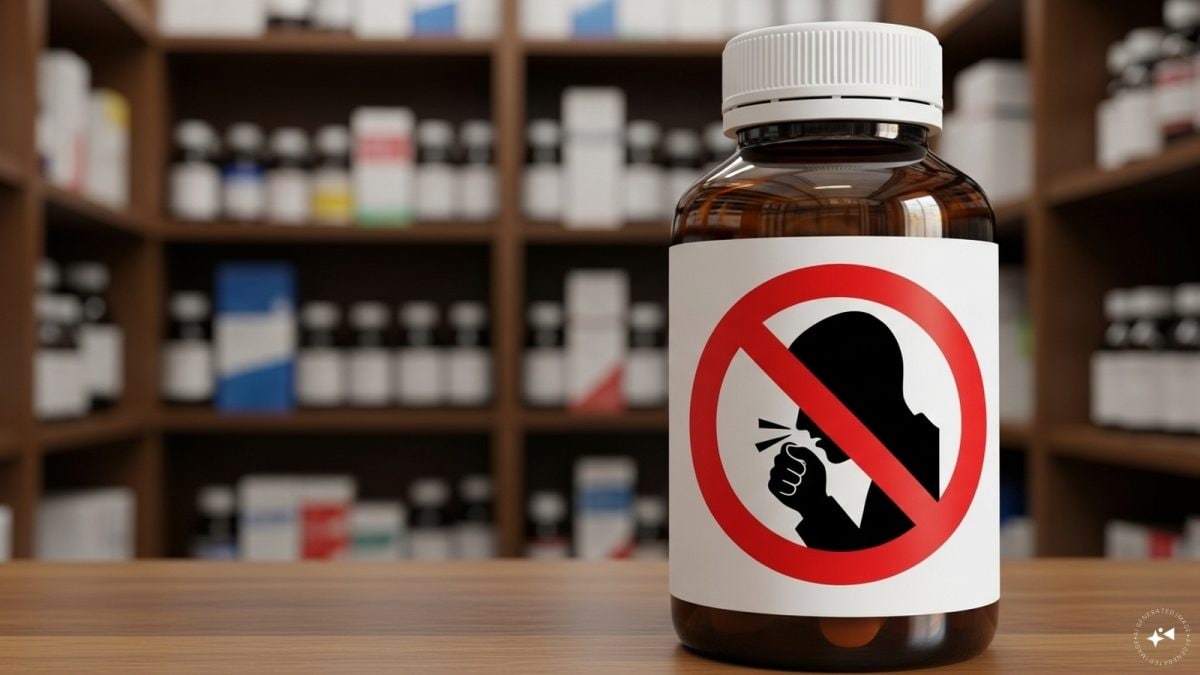
The tragedy unfolding across MP and Rajasthan, where several children have reportedly died after consuming certain batches of two different cough syrups, has once again exposed the cracks in India’s pharmaceutical oversight. (Image for representation)

India’s relationship with cough syrups has long been one of misplaced comfort. A bottle on the bedside table feels harmless – a symbol of care, not danger.
But the recent spate of child deaths linked to contaminated cough syrups has forced India to confront a bitter truth: what we often consider a routine remedy has now become a public health concern.
Recommended Stories
The tragedy unfolding across Madhya Pradesh and Rajasthan, where several children have reportedly died after consuming certain batches of two different cough syrups, has once again exposed the cracks in India’s pharmaceutical oversight. Laboratory tests have confirmed the presence of diethylene glycol (DEG) – a toxic industrial solvent used in brake fluid – in some samples used in Madhya Pradesh.
News18 has seen the lab reports of Tamil Nadu and Madhya Pradesh’s regulators. Lab reports by state drug regulators have confirmed alarming levels of contamination in Coldrif cough syrup.
The Madhya Pradesh regulator found diethylene glycol (DEG) levels as high as 46 percent, while the permissible limit is just 0.1 percent. Similarly, a report from the Tamil Nadu drug authority detected 48.6 percent DEG contamination.
The concentration of this toxic chemical is so dangerously high that it would be unsafe not only for a child’s body but even for an adult. At least a dozen children have lost their lives to what was meant to soothe a cough.
The Union ministry of health and family welfare on Sunday (October 5) called a meeting with state health officials and drug controllers to discuss two urgent issues: the rational use and prescription of cough syrups and the quality of the drugs themselves.
According to the health ministry’s press release, the meeting discussed “compliance with Schedule M and other GSR provisions relating to quality standards in drug manufacturing units” along with “rational use of cough syrups in children, including the need to avoid irrational combinations and inappropriate formulations”. Officials also discussed “strengthening the regulation of retail pharmacies to prevent sale and misuse of such formulations”.
While the intent of the discussion is on the right lines, the incident involves two problems –over-prescription and drug contamination – which are not the same. They need to be understood and tackled separately. One is a problem of medical culture while the other is a failure of manufacturing and regulation.
Let’s understand how.
The first issue is the misuse and overuse of cough syrups.
For decades, Indian households have relied on them as the go-to treatment for any cold or sore throat, often without consulting a doctor. Many doctors, too, continue to prescribe them out of habit or patient expectation.
Yet scientific evidence has been consistent for years – most viral coughs, especially in children, resolve on their own and do not need cough suppressants. The American Academy of Paediatrics, the WHO, and even Indian health authorities recommend avoiding cough syrups altogether in children under four and using them very cautiously up to age 11. For teenagers and adults, too, most experts agree that multi-ingredient syrups – the ones that sedate, suppress and decongest all at once – do more harm than good.
The cultural reflex to medicate every cough is part of the problem. The syrup may temporarily ease symptoms, but it does little to shorten the illness.
For children, it can bring unnecessary side effects like drowsiness or breathing trouble. For older adults, it can trigger dangerous drug interactions. Over-prescription is a behavioural issue – one that demands awareness, restraint, and responsible prescribing, not bans or panic.
In the health ministry’s press release, Dr Rajiv Bahl, director general of the Indian Council of Medical Research (ICMR), advised that children should not be prescribed cough syrups or any combination of drugs to prevent any side effects.
Dr Sunita Sharma, director general of Health Services (DGHS), also spoke about the need for rational use of cough syrup for the paediatric population. According to her, “cough medications have minimal proven benefit in children but carry significant risks”. She underlined the need for checking all medications to avoid combined overdose and checking the concentration of drugs.
Then there is the second crisis – contamination and quality failure – and this one is far more lethal.
The discovery of DEG and ethylene glycol in cough syrups is not about overuse; it is about poisoned manufacturing. The same chemicals were found in Indian-made syrups linked to child deaths in the Gambia and Uzbekistan in 2022.
In 2020, 12 children were killed in Jammu after consuming DEG-laced Coldbest PC syrup manufactured by the Indian firm, Digital Vision. This is a regulatory and industrial collapse, not a medical one.
It points to systemic failures in raw material testing, excipient purity, and batch monitoring. The problem here is not how often the syrup is prescribed – it is how safely it is made.
Mixing these two issues – prescription misuse and manufacturing lapses – risks diluting accountability. Doctors cannot fix contamination, and regulators cannot reform prescribing culture. Each crisis needs its own solution.
The first demands public education and rational prescribing; the second requires tighter quality control, mandatory excipient testing, and faster recall systems. The Centre’s current discussions on the “rational use” of cough syrups are logical but look more like an attempt to avoid the main issue.
We need to understand that overuse of syrups leads to dependency, side effects and unnecessary exposure to medicines, but poor-quality syrups lead to tragedy and death. The line between the two must be clearly drawn if India is to restore faith in its pharmaceutical system.
India’s cough syrup crisis is not just one story of negligence, it is two parallel failures playing out at once. We must separate the debate, address each problem with the right tools, and distinguish between medical misuse and manufacturing malpractice. Because when medicine meant to heal becomes a cause of death, the real sickness lies in our systems.
About the Author

Himani Chandna, Senior Associate Editor at CNN News18, specialises in healthcare and pharmaceuticals. With firsthand insights into India’s COVID-19 battle, she brings a seasoned perspective. She is particular…Read More
Himani Chandna, Senior Associate Editor at CNN News18, specialises in healthcare and pharmaceuticals. With firsthand insights into India’s COVID-19 battle, she brings a seasoned perspective. She is particular… Read More
October 06, 2025, 09:00 IST
Loading comments…
Read More