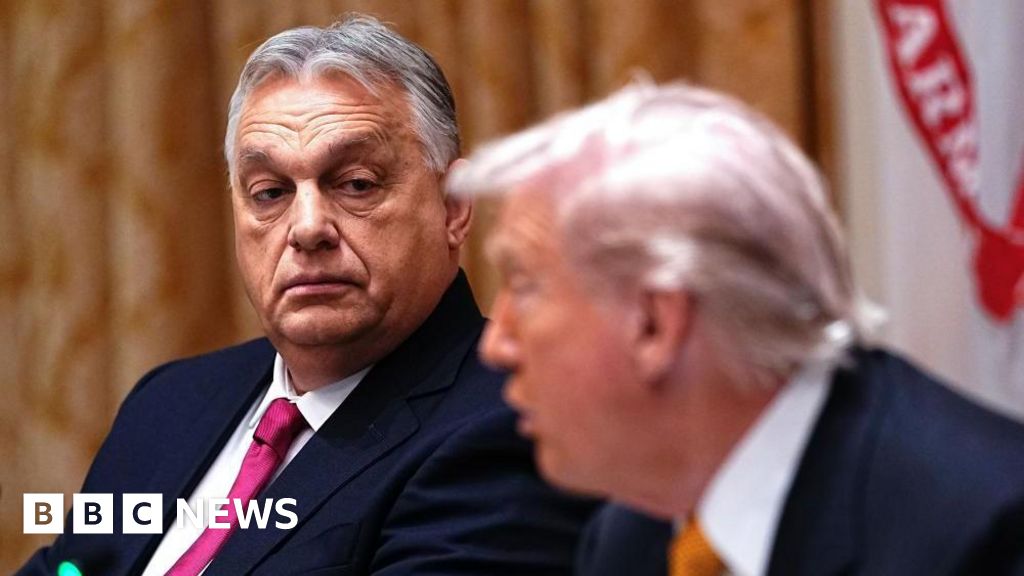

On the surface, the Hungarian prime minister’s trip was exactly what he went to Washington for: luxuriant praise and an exemption from sanctions on Russian oil, gas and nuclear supplies.
And all that just five months out from a difficult election.
Look closer, however, and the picture is less clear cut. The US side struck a hard trade deal – and an expensive one for Hungary.
And there’s no progress on Viktor Orban’s biggest headache: ending the war in neighbouring Ukraine, and with it the long shadow the conflict casts over Hungary.
Let’s look first at Orban’s key win – an exemption from US sanctions, which a White House official told the BBC was time-limited to one year, although Péter Szijjártó, Hungary’s foreign minister, said would be indefinite.
The time span is interesting. Trump clearly wants to help his friend win the election in April. And the exemption even partially dovetails with the European Commission demand to all member states to end the import of Russian oil, gas and nuclear fuel by the end of 2027.
What is missing, from an EU perspective, is any political commitment from Orban to meet that demand – a commitment made and fulfilled by the Czech government. And the EU is trying to tighten energy sanctions – to the fury of Hungary and Slovakia.
Away from the media spotlight, the Hungarian energy company MOL has been upgrading two of its refineries – Százhalombatta in Hungary and the Slovnaft facility in Bratislava – to process Brent crude instead of the high-sulphur Urals crude which flows through Russian pipelines.
On Friday, MOL said 80% of its oil needs could be imported through the Adria pipeline from Croatia, albeit with higher logistical costs and technical risks.
So Orban’s argument, which so impressed Trump, that Hungary, as a landlocked country, has no alternative to Russian oil may not strictly be true.
Overall, Hungary and Slovakia have together paid Russia $13bn (£10bn) for its oil between its full-scale invasion of Ukraine in February 2022 and the end of 2024.
The one-year window granted by the US is nevertheless a valuable respite for Hungarian households this winter.
Orban told pro-government reporters who travelled with him to Washington that otherwise utility bills “could have gone up by up to three times in December”. Capping those bills by various means has been a central plank of his popularity in Hungary since 2013.
Under the US exemption, Hungary can also continue to buy Russian gas through the Turkstream pipeline, which traverses the Balkans, and pay for it in hard currency ($185m in August alone) using a Bulgarian loophole. Orban has agreed to buy LNG from the US worth $600 million, according to Bloomberg.
Another key part of the Washington deal is nuclear.
Hungary agreed to buy US nuclear fuel rods for its Paks 1 nuclear power station (at a cost of $114m), in parallel to those bought from Russia’s Rosatom and France’s Framatome.
Russian plans to finance and build the nuclear extension, called Paks 2, have been long delayed by technical and licensing issues. The US agreement to lift all nuclear sanctions on Hungary may help restart that project, but thorny problems remain.
Hungary has also agreed to buy US technology to extend the short-term storage of spent nuclear fuel at Paks for between $100m and $200m.
Perhaps the biggest part of the deal was a Hungarian commitment to buy up to 10 small modular nuclear reactors from the US, for somewhere between $10bn and $20bn.
Hungary needs electricity to power the huge Chinese battery plants being built around the country. Smaller nuclear plants are less plagued by building delays, and are easier to licence.
Finally, a currency swap deal – similar to a recent US-Argentina deal to prop up the peso – under which US and Hungarian central banks can exchange currency is being discussed.
This would mean that in a future financial crisis in Hungary, the US central bank could feed dollars to Budapest, which boosts financial security in Hungary.
So in summary, Hungary struck a deal to buy US gas, nuclear energy and unspecified weapons systems in exchange for a temporary waiver from US sanctions on Russian oil and gas.
But it failed to get the re-introduction of the US visa waiver system, abolished in 2022, which harms mutual trade. And it did not get a new date for a potential Trump-Putin summit in Budapest as part of efforts to end the Russia-Ukraine war.
Critics say energy dependence on Russia is being replaced by energy dependence on the US. The Orban government argues it is achieving greater diversity of supply.