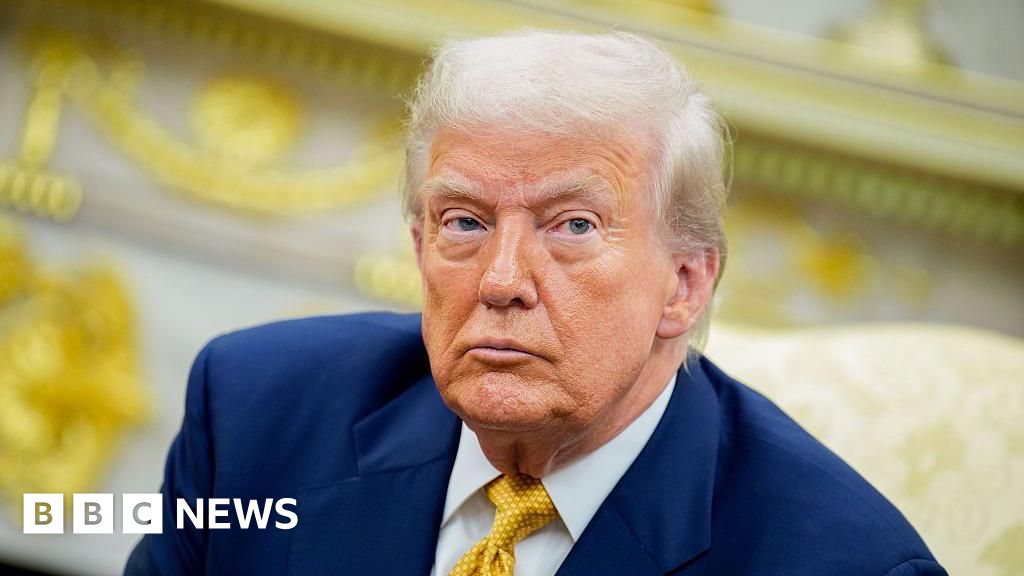

A US appeals court has ruled that most tariffs issued by US President Donald Trump are illegal, setting up a potential legal showdown that could upend his foreign policy agenda.
The ruling affects Trump’s “reciprocal” tariffs, imposed on most countries around the world, as well as other tariffs slapped on China, Mexico and Canada.
In a 7-4 decision, the US Court of Appeals for the Federal Circuit rejected Trump’s argument that the tariffs were permitted under an emergency economic powers act, calling them “invalid as contrary to law”.
The ruling will not take effect until 14 October to give the administration time to ask the Supreme Court to take up the case.
Trump criticised the court and its ruling on Truth Social, saying: “If allowed to stand, this Decision would literally destroy the United States of America.”
“Today a Highly Partisan Appeals Court incorrectly said that our Tariffs should be removed, but they know the United States of America will win in the end,” he wrote.
“If these Tariffs ever went away, it would be a total disaster for the Country. It would make us financially weak, and we have to be strong.”
Trump had justified the tariffs under the International Emergency Economic Powers Act (IEEPA), which gives the president the power to act against “unusual and extraordinary” threats.
Trump has declared a national emergency on trade, arguing that a trade imbalance is harmful to US national security. But the court ruled that imposing tariffs is not within the president’s mandate, and that they are “a core Congressional power”.
In its judgement, the US Court of Appeals for the Federal Circuit rejected Trump’s argument that the tariffs were permitted under his emergency economic powers, calling the levies “invalid as contrary to law”.
The 127-page ruling says that the IEEPA “neither mentions tariffs (or any of its synonyms) nor has procedural safeguards that contain clear limits on the President’s power to impose tariffs”.
The power to impose taxes and tariffs therefore continues to belong to Congress, the court ruled, and the IEEPA does not override this.
The court wrote that it is unlikely that when Congress passed the law in 1977, it was intended to “depart from its past practice and grant the President unlimited authority to impose tariffs”.
“Whenever Congress intends to delegate to the President the authority to impose tariffs, it does so explicitly, either by using unequivocal terms like tariff and duty, or via an overall structure which makes clear that Congress is referring to tariffs,” the judges wrote.
The ruling comes in response to two lawsuits filed by small businesses and a coalition of US states.
The lawsuits were filed after Trump’s executive orders in April, which imposed a baseline 10% tariff on almost every country in the world, as well as “reciprocal” tariffs on dozens of countries. Trump declared the date to be America’s “liberation day” from unfair trade policies.
In May, the New York-based Court of International Trade declared the tariffs were unlawful. That decision was put on hold during the appeal process.
In addition to those tariffs, Friday’s ruling also strikes down tariffs on Canada, Mexico and China, which Trump argues are necessary to stop the importation of drugs.
However, it does not apply to other tariffs, like those imposed on steel and aluminium, which were brought in under a different presidential authority.
Ahead of the ruling, lawyers for the White House argued that invalidating the tariffs would lead to a 1929-style financial collapse, a stock market crash which led to the Great Depression.
“Suddenly revoking the President’s tariff authority under IEEPA would have catastrophic consequences for our national security, foreign policy, and economy,” they wrote in a letter.
“The President believes that our country would not be able to pay back the trillions of dollars that other countries have already committed to pay, which could lead to financial ruin.”
It also raises questions about deals some nations agreed with the US for reduced tariffs rates.
The latest development means the case is now almost certain to head to the US Supreme Court, which has in recent years taken a sceptical view toward presidents who try to implement sweeping new policies that are not directly authorised by Congress.
During Joe Biden’s presidency, the court expanded on what it called the “major questions doctrine” to invalidate Democratic efforts to use existing laws to limit greenhouse gas emissions by power plants and to forgive student loan debt for millions of Americans.
The top court’s nine justices, if they agree to consider the case, could weigh whether Trump’s expansive tariff programme is another example of presidential overreach or if it is sufficiently grounded in law and presidential authority.
Even though the appellate court handed the president a defeat, the White House may take solace in the fact that only three of the court’s 11 judges were appointed by Republicans.
The Supreme Court has six Republican appointees, including three who were selected by Trump himself.