
Yogita LimayeSouth Asia and Afghanistan correspondent

 Aakriti Thapar / BBC
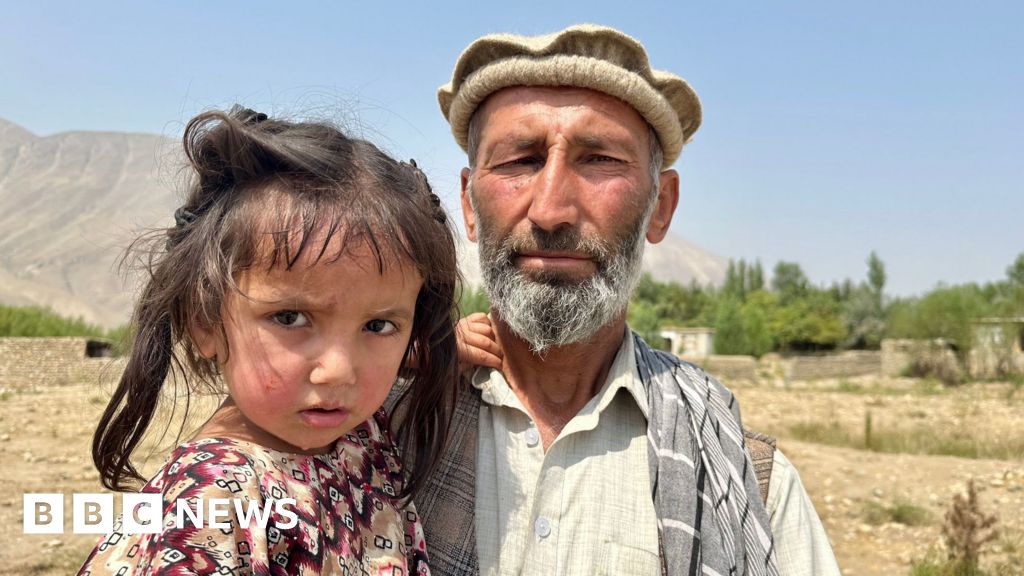
When Shahnaz went into labour, her husband Abdul called a taxi to take them to the only medical facility accessible to them.
“She was in a lot pain,” he says.
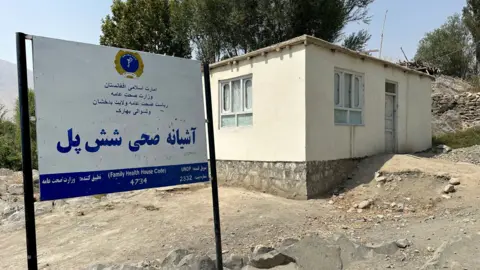
A 20-minute drive away, the clinic was in Shesh Pol village in Afghanistan’s north-eastern Badakhshan province. It was where their two older children were born.
Abdul sat next to Shahnaz comforting her as they drove over gravel tracks to reach help.
“But when we reached the clinic, we saw that it was closed. I didn’t know it had shut down,” he said, his face crumpling with agony.
Warning: Readers may find some details in this article distressing.
The clinic in Shesh Pol is one of more than 400 medical facilities that closed down in Afghanistan, one of the world’s poorest countries, after the Trump administration cut nearly all US aid to the country earlier this year, in a drastic and abrupt move following the dismantling of the US Agency for International Development (USAID).
A single-storey structure with four small rooms, white paint peeling off its walls, the Shesh Pol clinic has USAID posters tacked up everywhere with information and guidance for pregnant women and new mothers.
 Aakriti Thapar / BBC
It doesn’t look like much but in Badakhshan’s mountainous, unforgiving terrain, where a lack of access has been a major reason for historically high maternal mortality rates, the clinic was a critical lifeline, part of a wider programme implemented during the tenure of the US-backed government in the country, to reduce maternal and newborn deaths.
It had a trained midwife who assisted around 25-30 deliveries every month. It had a stock of medicines and injections, and it also provided basic healthcare services.
Other medical facilities are simply too far from Abdul’s village, and it was not without risk for Shahnaz to travel on bumpy roads. Abdul also didn’t have money to pay for a longer journey – renting the taxi cost 1,000 Afghani ($14.65; £12.70), roughly a quarter of his monthly income as a labourer. So they decided to return home.
“But the baby was coming and we had to stop by the side of the road,” Abdul said.
Shahnaz delivered their baby girl in the car. Shortly after, she died, bleeding profusely. A few hours later, before she could be named, their baby also died.
 Aakriti Thapar / BBC
“I wept and screamed. My wife and child could’ve been saved if the clinic was open,” said Abdul. “We had a hard life, but we were living it together. I was always happy when I was with her.”
He doesn’t even have a photo of Shahnaz to hold on to.
There’s no certainty the mother and baby would’ve survived if they’d been treated at the clinic, but without it, they didn’t stand a chance, underlining the undeniable impact of US aid cuts in Afghanistan.
For decades, America has been the largest donor to Afghanistan, and in 2024, US funds made up a staggering 43% of all aid coming into the country.
The Trump administration has justified withdrawing it, saying there were “credible and longstanding concerns that funding was benefiting terrorist groups, including… the Taliban”, who govern the country. The US government further added that they had reports stating that at least $11m were “being siphoned or enriching the Taliban”.
The report that the US State Department referenced was made by the Special Inspector General for Afghanistan Reconstruction (SIGAR). It said that $10.9m of US taxpayer money had been paid to the Taliban-controlled government by partners of USAID in “taxes, fees, duties, or utilities”.
The Taliban government denies that aid money was going into their hands.
“This allegation is not true. The aid is given to the UN, and through them to NGOs in provinces. They identify who needs the aid, and they distribute it themselves. The government is not involved,” said Suhail Shaheen, the head of the Taliban’s political office in Doha.
The Taliban government’s policies, especially its restrictions on women, the harshest in the world, have meant that after four years in power, it is still not recognised by most of the world. It’s also a key reason donors have been increasingly walking away from the country.
The US insists no one has died because of aid cuts. Shahnaz and her baby’s deaths are not recorded anywhere. Neither are countless others.
The BBC has documented at least half a dozen first-hand, devastating accounts in areas where USAID-supported clinics have shut down.
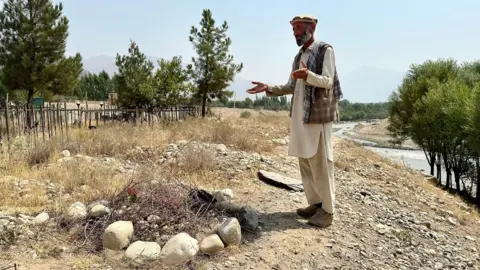
Right next to Shahnaz’s grave, villagers who had gathered around us pointed to two other graves. They told us both were of women who died in childbirth in the past four months – Daulat Begi and Javhar. Their babies survived.
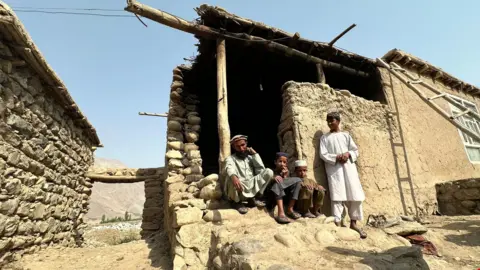
Not far from the graveyard, we met Khan Mohammad whose wife, 36-year-old Gul Jan, died in childbirth five months ago. Their baby boy Safiullah died three days later.
 Aakriti Thapar / BBC
“When she became pregnant, she would go to the clinic for check-ups. But midway through her pregnancy it shut down. During the delivery she had a lot of pain and blood loss,” Khan Mohammad said. “My children are sad all the time. No one can give them the love of a mother. I miss her every day. We had a sweet and loving life together.”
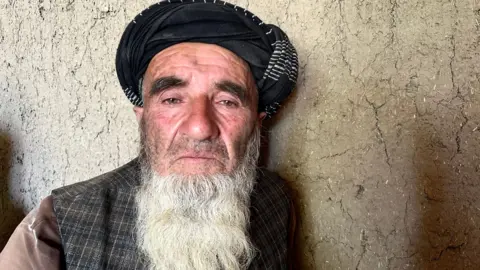
A roughly five-hour drive from Shesh Pol, in Cawgani, another village where a USAID-backed clinic closed down, Ahmad Khan, the grief-stricken father of Maidamo showed us the room in their mud and clay home where she died giving birth to baby Karima.
 Aakriti Thapar / BBC
“If the clinic had been open, she might have survived. And even if she had died, we would not have had regrets knowing the medics tried their best. Now we’re left with regret and pain. America did this to us,” he said, tears rolling down his face.
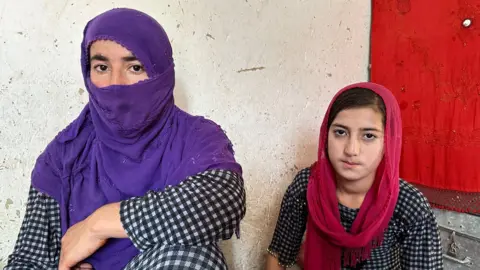
In another home a few lanes away, Bahisa tells us how terrifying it was to give birth at home. Her three other children were born in the Cawgani clinic.
“I was so scared. In the clinic, we had a midwife, medicines and injections. At home I had nothing, no painkillers. It was unbearable pain. I felt like life was leaving my body. I became numb,” she said.
Her baby girl, named Fakiha, died three days after she was born.
 Aakriti Thapar / BBC
The closure of clinics in villages has resulted in a surge of patients at the maternity ward of the main regional hospital in the provincial capital Faizabad.
Getting to it, through Badakhshan’s treacherous landscape is risky. We were shown a horrifying photo of a newborn baby, who was delivered on the way to Faizabad, and whose neck snapped before he got to the hospital.
We had visited the hospital back in 2022, and while it was stretched then, the scenes we saw this time were unprecedented.
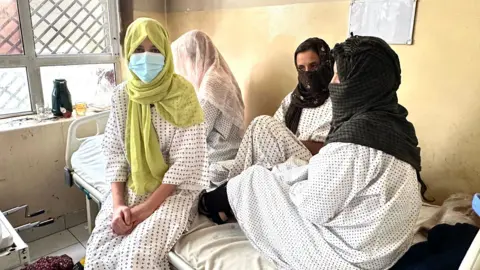
In each bed, there were three women. Imagine having gone into labour, or just having gone through a miscarriage, and not even having a bed to yourself to lie in.
 Aakriti Thapar / BBC
It’s what Zuhra Shewan, who suffered a miscarriage, had to endure.
“I was bleeding severely and didn’t even have a place to sit. It was really hard. By the time a bed is free, a woman could die bleeding,” she said.
Dr Shafiq Hamdard, the director of the hospital, said: “We have 120 beds in the hospital. Now we’ve admitted 300 to 305.”
While the patient load is swelling, the hospital, too, has faced sharp cuts in its funding.
“Three years ago our annual budget was $80,000. Now we have $25,000,” Dr Hamdard said.
By August this year, there had been as many maternal deaths recorded as there were for the whole of last year. Which means that at this rate, maternal mortality could increase by as much as 50% over last year.
Newborn deaths have already increased by roughly a third in the past four months, compared with the start of the year.
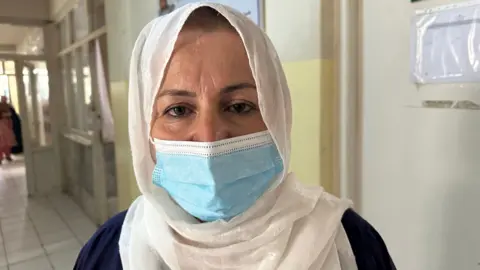
Razia Hanifi, the hospital’s head midwife, says she’s exhausted. “I have been working for the past 20 years. This year is the toughest, because of the overcrowding, the shortage of resources and the shortage of trained staff,” she said.
 Aakriti Thapar / BBC
But no reinforcements are coming because of the Taliban government’s restrictions on women. Three years ago, all higher education, including medical education was banned for women. Less than a year ago, in December 2024, training for midwives and female nurses was also banned.
At a discreet location, we met two female students who were midway through the training when it was closed. They didn’t want to be identified for fear of reprisal.
Anya (name changed) said they both were in graduate courses at university when the Taliban took over. When those were closed in December 2022, they began midwife and nursing training, as it was the only path left to getting an education and a job.
“When that was also banned, I became depressed. I was crying day and night, and I wasn’t able to eat. It’s a painful situation,” she said.
Karishma (named changed) said: “There is already a shortage of midwives and nurses in Afghanistan. Without more being trained, women will be forced to give birth at home which will put them at risk.”
We asked the Taliban government’s Suhail Shaheen how they can justify bans which effectively curb access to health for half the population.
“It is our internal issue. These are our issues, how to handle them, how to consider them, how to take decisions, this is something internal. That is up to the leadership. Based on the needs of the society, they will take a decision,” he said.
With their access to medical services severely restricted, by wave after wave of crushing blows, for Afghanistan’s women, their right to health, and life itself, is at grave risk.
Additional reporting, photography and video: Aakriti Thapar, Mahfouz Zubaide, Sanjay Ganguly
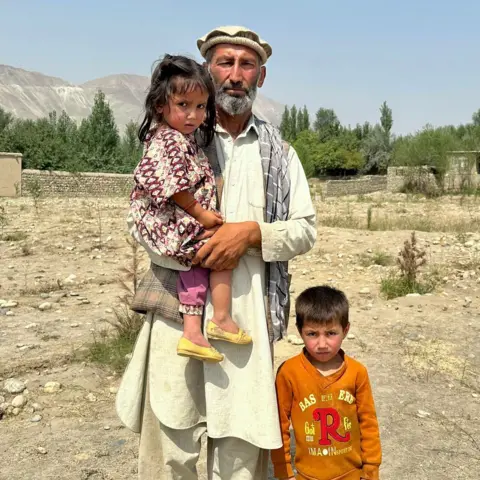
Top image shows Abdul with his daughter and son in Shesh Pol.