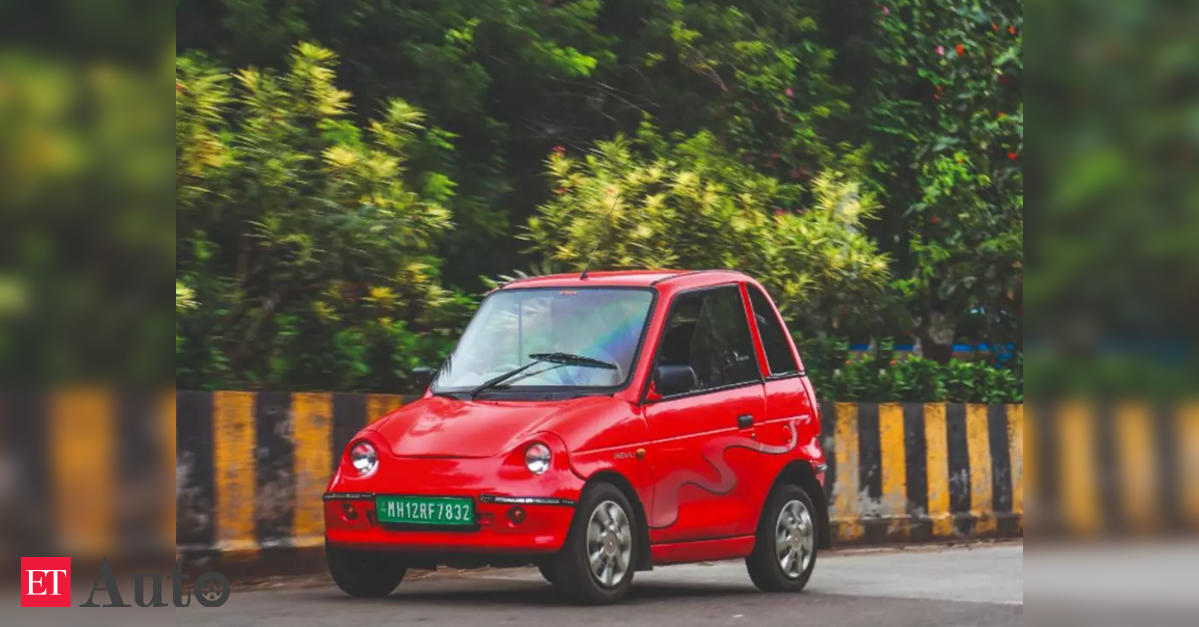

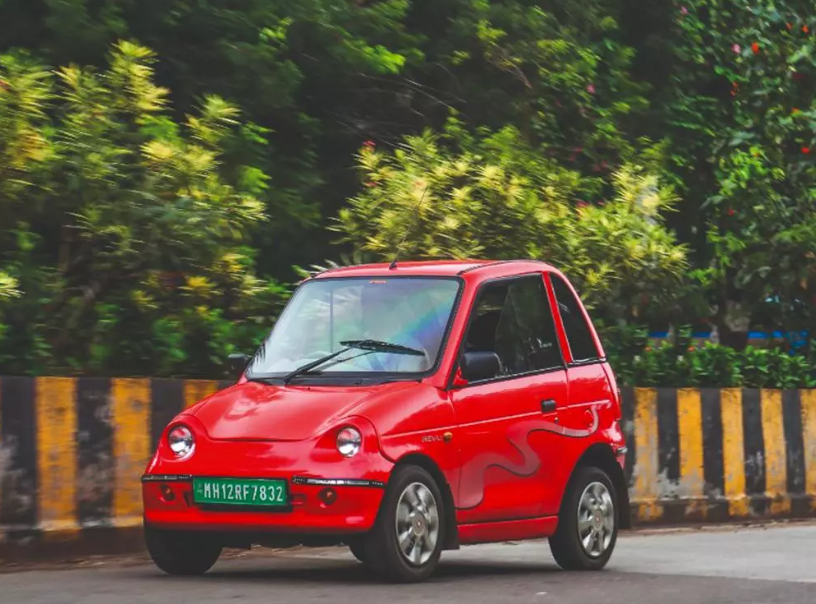
 When the Reva made its debut on Indian roads, EVs were barely a topic of discussion, and a very different conversation consumed the country’s automotive industry. (Picture credits- EVO India)
It was in July 2001 that India’s first electric car, Reva, began being delivered to customers. The microcar, launched on 11th May (also India’s National Technology Day) twenty-five years ago, had a claimed driving range of only 80 kms per full charge (under ideal conditions), and a top speed of 65 kmph.
Cut to today: the newest electric PV on the market – Tata Sierra EV SUV claims a driving range of over 550 km on a full charge and a top speed of 170 kmph. But the microcar would qualify as the proverbial ‘single step in a journey of a thousand miles’.
When the Reva made its debut on Indian roads, electric vehicles (EVs) were barely a topic of discussion, and a very different conversation consumed the country’s automotive industry.
Passenger vehicle penetration was still low, diesel cars were beginning to gain popularity, fuel prices rarely dictated buying decisions, and emissions regulations were nowhere close to becoming the strategic imperative they are today.
Leave alone an ‘ecosystem’, there was no EV motor supplier, no charging infrastructure, no lithium-ion battery ecosystem, no Production Linked Incentive (PLI) schemes, and certainly no billion-dollar bets on electric mobility.
Against that backdrop, an Indian startup introduced a compact electric city car that challenged almost every convention of personal mobility. The market wasn’t ready.
Technology choice driven by a sustainability focus
For Chetan Maini, founder of Reva Electric Car Company, electrification was never simply about replacing an internal combustion engine with an electric motor. His conviction emerged much earlier, during a solar-powered expedition across the United States and Australia while he was studying engineering.
“Before that, I was the biggest petrol head,” Maini recalls in an interview with ETAuto.
“After I drove across the US and Australia on solar energy, I said, ‘Wow, if you can cross a continent on solar energy, this is the future.’ Clearly, I had gone to electrification.” Maini’s solar-powered electric car was a project during his undergrad course.
Returning to India in the early 1990s, he believed the country’s rapid economic liberalisation would inevitably lead to a surge in personal vehicle ownership—but also greater dependence on fossil fuels. “I came back in 1993-94 and said India was going in the wrong direction,” he reminisces.
Instead of trying to build an electric version of an existing hatchback, he questioned whether Indian cities required a completely different kind of automobile.
“The question wasn’t simply about making an electric car,” Maini says. “It happened to not just be electric. In electric, how could you bring about something that would be ideal for our cities?” That philosophy shaped every aspect of the Reva.
The Reva was designed to carry two adults and two children, negotiate narrow city roads, park in tight spaces, run at operating costs comparable to a two-wheeler, charge at home and require minimal maintenance. The microcar was only 2.63 metres long, 1.32 metres wide, 1.51 metres tall, and had a turning radius of only 3.5 metres.
Much of what the industry today describes as “urban mobility” had already been incorporated into the Reva’s design brief.
Building an ecosystem
If the product itself was unconventional, the ecosystem behind it was almost non-existent. “There wasn’t really a supply chain,” Maini says. Battery management systems, chargers, controllers, DC-DC converters and transmission technologies were developed internally because suppliers simply did not exist.
The company established separate businesses for plastics (now an independent entity as a plastic parts supplier), chassis manufacturing, and several other components, while convincing suppliers such as Rane, Subros, and Pricol to participate in a segment whose commercial future was uncertain.
“It needed a lot of selling,” Maini says. “But a lot of them believed this was the right thing for India.” Looking back, those efforts were among the earliest attempts to build an indigenous EV technology ecosystem in the country. Several of those capabilities—and some of the businesses that emerged from them—continue to operate within India’s automotive supply chain today.
Made in India, also for the world
Many of the innovations associated with today’s electric vehicles had already found their way into the Reva. The company developed much of its technology stack in-house, integrated electronic systems to reduce costs, and used lightweight, recyclable thermoplastic body panels that resisted dents and, in later versions, eliminated the need for conventional paint by integrating colour into the material itself.
“It was always there,” Maini says. “The cars were lightweight, dent-proof, sustainable and recyclable. That philosophy was an integral part of how we built it.” The company’s ambitions extended well beyond India.
The Reva eventually reached 24 international markets. The UK was its largest export market. It was followed by Norway, also considered the EV capital of the world. At one stage, exports to Europe outpaced domestic sales, aided by congestion charge exemptions and parking incentives that made electric mobility economically attractive. Exporting was a better business, as margins were higher than in the domestic market.
Engineering solutions developed for Scandinavian winters—including heated batteries, heated seats, and remotely operated cabin heaters for temperatures as low as minus 25 degrees Celsius—highlighted the technical capabilities of a small Indian company that operated years before EVs entered the mainstream.
Mahindra & Mahindra, which is currently the second-largest electric PV player in the country, began its journey as an electric car maker with the acquisition of a majority stake in Reva Electric Car Company. Mahindra’s first electric car was the production version of the Reva NXR concept, showcased first at the 2009 Frankfurt Motor Show.
“More than the hardware acquisition, it was the inheritance of invaluable EV intelligence based on millions of kilometres of data, and the innovation culture, that was more valuable,” recounts Ashish Tarte, who M&M deputed to lead product and vendor development at Mahindra Reva. Tarte is currently the CTO at Reliance New Mobility.
Business challenges
The Reva’s pioneering status, however, did not insulate it from commercial challenges. A month or so before its launch, an expected government subsidy (under the Ministry of New and Renewable Energy) of ₹75,000 was withdrawn, raising the effective purchase price significantly. And that played spoilsport for Maini’s plan to launch the Reva at ₹1.75 lakh, a price that would have made it even cheaper than the most affordable and popular car then – the Maruti 800.
Even though the car’s operating cost was about 40 paise per kilometre—comparable to a scooter—the economics remained difficult for many buyers. The broader market, too, was not yet prepared. By the end of the decade, global manufacturers like Nissan, General Motors and Tesla had begun committing billions of dollars to electric mobility.
For Maini, the implications became clear. “This is a big boys’ game now,” he says. “Either I continue licensing technology, or I need very large investments,” Maini adds.
Reva Electric Car Company was acquired by Mahindra & Mahindra (M&M), but the original plan was to license EV technology to the utility vehicle major. The eventual acquisition by M&M gave the programme the financial backing needed to continue India’s early EV journey under a larger industrial umbrella.
Still answers today’s questions
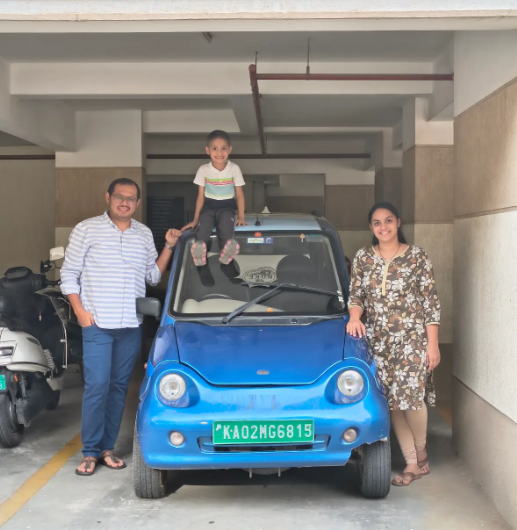
Interestingly, some of Reva’s strongest validations come from owners who discovered the car much later after its launch. Bengaluru-based automotive engineer Nithyananda Bhat, who works in a global OEM’s India engineering centre, bought a pre-owned Reva only three years ago.
His requirements had little to do with nostalgia. Instead, he was searching for a practical vehicle that sat between a two-wheeler and a conventional hatchback. “There’s a huge gap (in terms of price) between the two-wheeler segment and the entry-level segment in cars,” he says.
For his family, the Reva offered a safer alternative for daily commuting. “For me, it has really been a game changer because even when it rains, I’m at peace when I’m at work because I know my family is much safer than they would be on a two-wheeler.”
Its compact dimensions remain equally relevant. “Parking it with the least inconvenience to others—that’s where the Reva has been to our rescue.”
The fact that a 25-year-old product continues to solve contemporary urban mobility challenges perhaps says as much about India’s cities as it does about the vehicle itself. Bhat will be among an expected 100 or so Reva customers/fans planning to celebrate India’s first electric car turning 25, at the Bangalore International Centre, Domlur.
More than the numbers
Around 10,000 first-generation Revas were produced, with roughly half exported overseas. These figures appear modest compared with today’s EV ambitions. The production volumes alone do not fully explain the car’s significance.
It demonstrated that Indian engineers could develop core EV technologies in-house. It helped create supplier capabilities that would later support the industry’s transition to electrification. It introduced ideas around home charging, lightweight design, low running costs and sustainable manufacturing years before they became mainstream.
Equally, if not more interestingly, it also built a community. The Reva’s 25th anniversary celebrations are not being organised by an automaker, but by owners themselves—including many who no longer possess the car. “We wanted to make it all about the people,” says Bhat. “Though the Reva is no longer part of some people’s lives, everybody still has stories.”
As an engineer himself, Bhat believes today’s industry often underestimates what Reva achieved. “Launching an EV today with all the design tools, AI, and talent available isn’t very surprising. But to do it 25 years ago, when internet speeds were in KBs, the tools weren’t around, and the talent wasn’t around—that was a big deal.”
That observation perhaps best captures the Reva’s place in India’s automotive history. The country’s electric passenger vehicle market did not begin on a large scale. It began with a bold idea—that urban mobility could be cleaner, simpler, and fundamentally different. It’s also more relevant today.
So, could Maini make a re-entry into the automotive industry now that the EV industry is maturing, while it’s still in a ‘more the merrier’ phase in terms of players?
“I don’t know. I would never say no to that,” the technopreneur quips. He still thinks about vehicle design even as he focuses on further building Sun Mobility to make a bigger impact in the industry as an energy and technology provider for electric mobility.
Maini Group’s businesses include auto components, plastics, powertrain, and deep and rich EV know-how. It also has access to the brand ‘Reva’ for use in “some cases”.
It won’t be surprising if Maini plays again in the EV space, as a “deep passion” for EVs remains.
“We know EVs in and out. Yes, of course, there are opportunities in the future,” says Maini, but also clarifies that there’s “nothing really on the cards today”.