
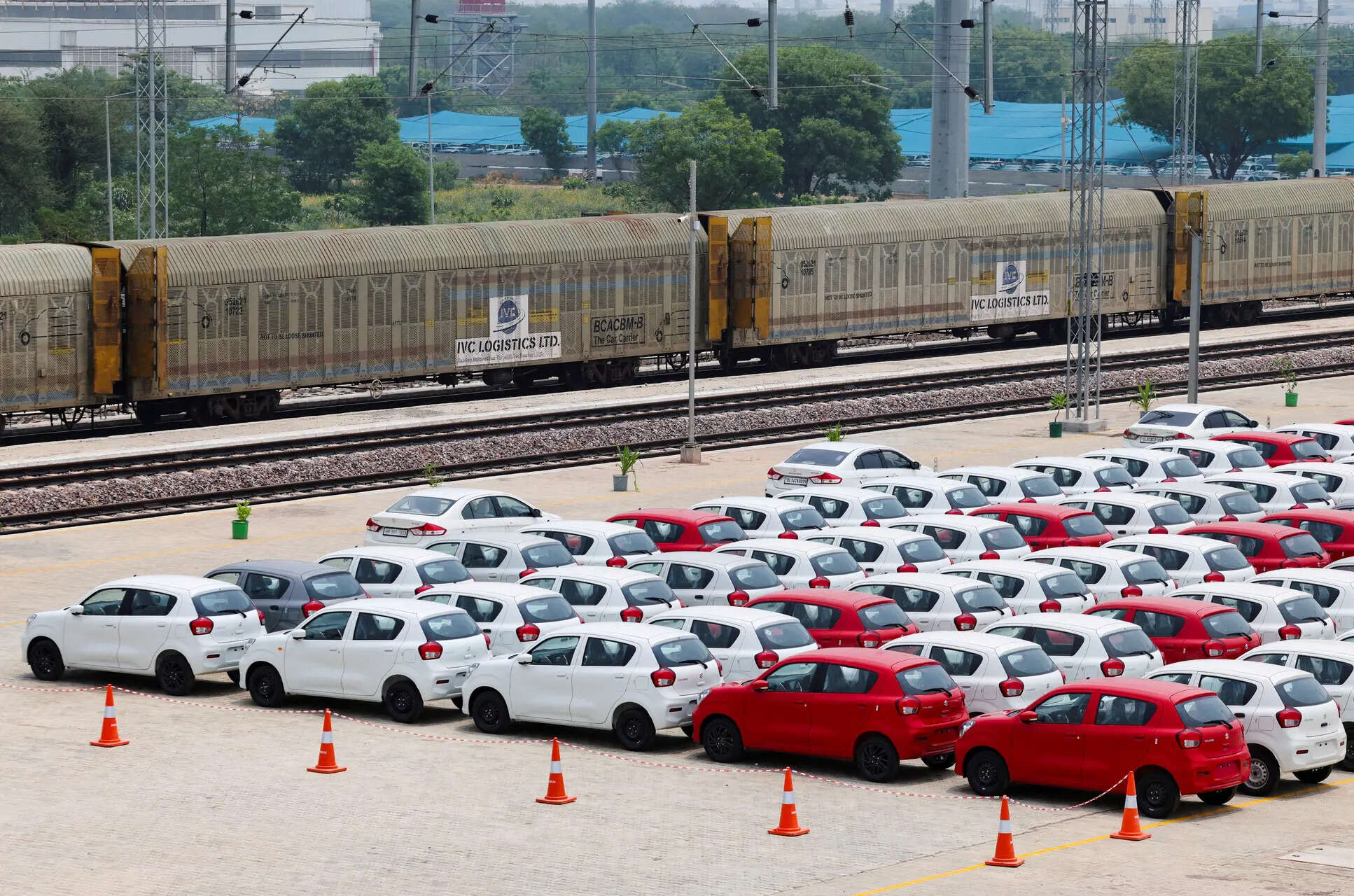
New Delhi: India’s carmakers ended a turbulent global year on a high, exporting a record number of vehicles, buoyed by rising demand across Africa, South America and West Asia, cementing the country’s place as an emerging manufacturing hub.
Industry estimates show India exported 858,000 cars, sedans and utility vehicles in 2025, a jump of 15 per cent over 2024, driven by deepening supplier base, cost competitiveness, technological advancements and growing trust in made-in-India cars, senior industry executives told ET.
However, sustaining this run will depend as much on trade diplomacy as factory output. With Mexico — the third-largest destination for Indian car exports — more than doubling tariffs on various Indian goods from January 1, 2026, outbound shipments could be affected unless the two countries finalise a trade agreement quickly.
Officials indicated last month that the terms of reference for a trade pact with Mexico are likely to be finalised shortly.
Indian carmakers are targeting increasing passenger vehicle exports to 30 per cent of total production over the next five years, up from about 15 per cent in 2024. India’s footprint has started growing even in developed car markets such as Europe, Japan and Australia, industry executives said.
Manufacturing prowess
“India’s automotive industry has reached a stage where it plays an increasingly influential role globally,” Shailesh Chandra, president of industry body Society of Indian Automobile Manufacturers (SIAM), told ET in an exclusive interaction recently. “We are already the fourth-largest passenger vehicle manufacturer in the world and third-largest passenger vehicle market in the world.”
Chandra, who is also managing director of Tata Motors, said the Indian automotive industry will play an “important role across multiple economies” as the sector navigates the transition to sustainable mobility.
Maruti Suzuki — which recently started shipping its first electric vehicle e-Vitara to Europe — reported a 21 per cent increase in overall exports at 395,000 units in calendar 2025.
“Today out of 17 car companies in India, just one company, Maruti Suzuki, alone accounts for 46 per cent of India’s total exports,” said Rahul Bharti, senior executive director at Maruti Suzuki India.
He noted that India’s annual car exports have more than doubled in the last five years, by about 445,000 units from 413,000 in CY2020. Out of this incremental growth, Maruti Suzuki accounted for 308,000 units, or 69 per cent.
Bharti said the company’s top markets include South America, Japan, Africa, West Asia and Southeast Asia.
Maruti Suzuki shipped out 18 models to around 100 countries in 2025. It exported over 13,000 units of e-Vitara to 29 countries predominantly in Europe, Bharti said.
He said rising exports reflect “India’s manufacturing strength and trust of customers worldwide.”
Honda, too, is looking at scaling up exports, with India scheduled to be the sole manufacturing hub for its yet-to-be-launched EV.
“We currently export to 33 countries in both left-hand drive and right-hand drive markets including Japan, Mexico, Middle East, South Africa, SADC countries, Saarc region, Caribbean and South America, reinforcing India’s role as an important manufacturing and export base for Honda and our commitment to the ‘Make In India’ initiative,” said Kunal Behl, vice-president (marketing and sales) at Honda Cars India.
The Japanese carmaker exported more than 36,000 units of Elevate, City and Amaze from India in 2025, he said.
For Korean auto major Hyundai, India is the manufacturing hub for emerging markets like Africa, West Asia and Latin America. In 2025, Hyundai Motor India’s exports rose by 18 per cent year-on-year to 186,528 units. In all, it has exported over 3.8 million made-in-India cars since inception.
Automobiles are the third most valuable exported product in the world.
In calendar 2024, Indian carmakers had shipped out 744,000 passenger vehicles.