
Long before he took on the flashy job of selling super sports cars and shaping Formula 1 championship strategies, Benedetto Vigna – the global CEO of Ferrari – had a far more understated and less-visible profile in the world of semiconductors and subnuclear physics.
A graduate in subnuclear physics from the University of Pisa, Vigna spent over two decades in European semiconductor giant STMicroelectronics where he emerged as a key innovator, filing more than 200 patents on micromachining. He took on the high-octane role at Ferrari at the height of Covid pandemic in September 2021.
On a visit to India earlier this month – almost his fiftieth over the last two-and-a-half decades – Vigna visited Varanasi to talk to IIT students, before heading to Mumbai for the company’s first brand event.
He was fascinated by Varanasi’s ancient and spiritual name of Kashi and was ecstatic to find out that it means ‘City of Light’ as he drew a parallel to Ferrari’s first electric car Luce (pronounced ‘Loo-cheh’) which also means ‘light’.
India may be small when it comes to sales of Ferraris, but the brand doesn’t mind that – considering it itself values “exclusivity” over scale. “It is a country that is very ‘sparkling’… People here dare more. Similar to what I said, “Hoga Kaise Nahi“. This is what this brand represents and what I see in India. So, there is a good fit,” he tells Times Internet in an exclusive interview, almost sounding like a man who is in love with the country and its culture.
And what does he have to say on the criticism of the highly-acclaimed (former) Apple designer Jony Ive working on the Ferrari Luce, Vigna dismisses the naysayers. “If you want to do something new, you need to put together people with different points of view, and that’s what we did. We have the Ferrari team and then the team of LoveFrom (Ive’s company)… Open innovation is fundamental for the sustainable growth of a company… Working with Jony has been useful because we have been putting materials in the car that we were not considering as much before, like anodized aluminium and the story of glass.” Excerpts: Varanasi, and the connect of Ferrari’s First EV Luce with ‘Kashi’
Q: In a world of global uncertainty and economic and geopolitical tensions, how are luxury brands navigating this landscape? The world around us right now is very chaotic. We see wars, markets crashing, and oil prices going up. But we discuss business, let’s talk about your journey to Varanasi. You spoke very beautifully when you said, “Hoga Kaise Nahi’ in Hindi. This in English means, ‘How will it not happen? It has to happen.” Please tell us about your journey to Varanasi. What did you learn there? And since you’ve been to India 50 times in the past two-and-a-half decades, what are your views about the country?
Benedetto Vigna: India is a special place for me because it is now more than 25 years that I have been coming here. I have a lot of friends and several colleagues here, and I have Indian friends a little bit everywhere else in the world. What I like when I come here is that you have a peaceful approach, kindness, and a spiritual approach.
On my trip to Varanasi, I gave a speech at the IIT over there as I was invited by the students there. A lot of people attended. It always surprises me when I come here – the attachment and the passion for our brand, but also the passion for learning. That is very unique.
When I was in Varanasi, I saw this panel many times – “I Love Kashi.” I asked my team that was does the word ‘Kashi ‘mean? They told me Kashi is the original name of Varanasi. It means, as you know, the City of Light. And it was particularly interesting for me because this year we are launching our electric car, Ferrari Luce. Luce also means light. Everything was like a sign.
Q: It was like a divine signal to you.
Benedetto Vigna: I never thought of it this way, but I will send an email to my colleagues because it’s pretty unique.
Q: Talking about business, in a world that is torn apart with war and challenges, at least there is some spirituality, kindness, and peace out here in India. Is that what you feel?
Benedetto Vigna: I think there is. Every time I have come to India, I have seen it. It is also true that if I look at India over the last 20-25 years, a big change has been happening here. This is also the reason why we believe that India is an important market for Ferrari. We see this change coming.
We already have a lot of clients from different industries and business sectors (in India). They are very passionate, and I think we are a good fit between Ferrari and India. Because, in Ferrari, tradition and innovation go end-to-end. In a luxury brand, you usually need to put together tradition and innovation.
The same is true here in India. It’s pretty common to see these places where the past and the future – tradition and innovation – absolutely live together.
War, oil price shock, and economic uncertainty
Q: How do you look at the luxury market when you see a situation like this globally. We are in the middle of a war, oil prices are up, and stock markets are crashing. There is uncertainty. How do you see the demand for luxury products today?
Benedetto Vigna: Today we don’t see any change in our demand, partly because we make only 14,000 cars. Clearly, if we were making many more cars, this would have had a bigger impact.
Today we don’t see any impact because our client base is pretty much differentiated in the world and also because we make only a limited number of cars.
This does not mean that we don’t have to pay attention. What I always keep repeating to myself and the team is that we need to have the four wheels on the ground because things can change. We need to be prepared in this period.
Also, how do you cope with the uncertainty? First of all, we cannot pretend to manage it. You don’t manage things that are outside of you; you cope with them. You take them as a fixed condition and see how to cope.
Secondly, we need to be united and cohesive.
And thirdly, we need to be agile with our feet on the ground. That’s the reason why I was telling you about coming to India – that’s at least the effect it has on me. It always reminds me of the importance of humility.
The trip to Kashi was the first time for me to go there and spend time on the river, on the banks of the Ganges. It was a kind of spiritual journey. It reminds me that in this period of uncertainty, more than ever, humility means a lot. Also, working together with other people, being united, cohesive, and collaborating and learning – these are fundamental things that I believe luxury companies, and all other companies, have to do.
Q: So, have faith and know that “this too shall pass.”
Benedetto Vigna: I think this is not the first and will not be the last crisis. We have had many other situations like this in the world. It is maybe in the nature of human beings.
If you think about it, we had Covid, we had the semiconductor chip crisis, then the Ukraine war, and then the other Middle East war, and now the supply chain stress. So, we’ve had five or six years of disruptions, but we’ve been able to cope with that… by working in a united and cohesive way and always staying close to reality.
I remember once we were risking shutting down the production line, but by cooperating with the suppliers and among ourselves, we were able to keep the production running despite the potential risks.
Thrill of driving supercars diminishing as AI, autonomous, EVs come in?
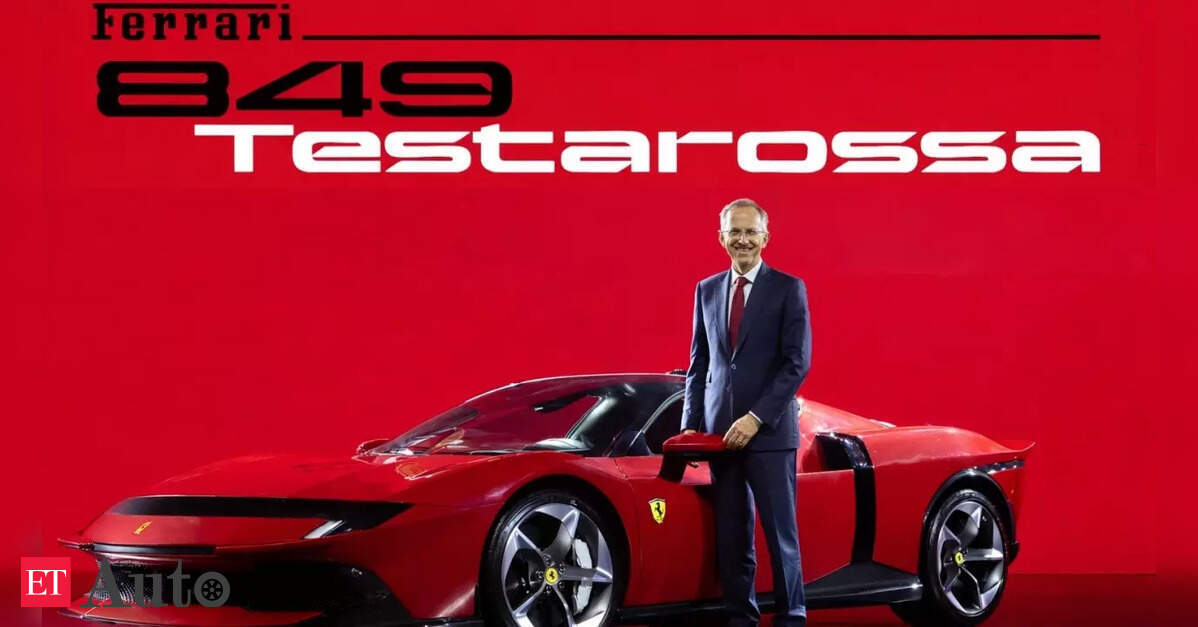
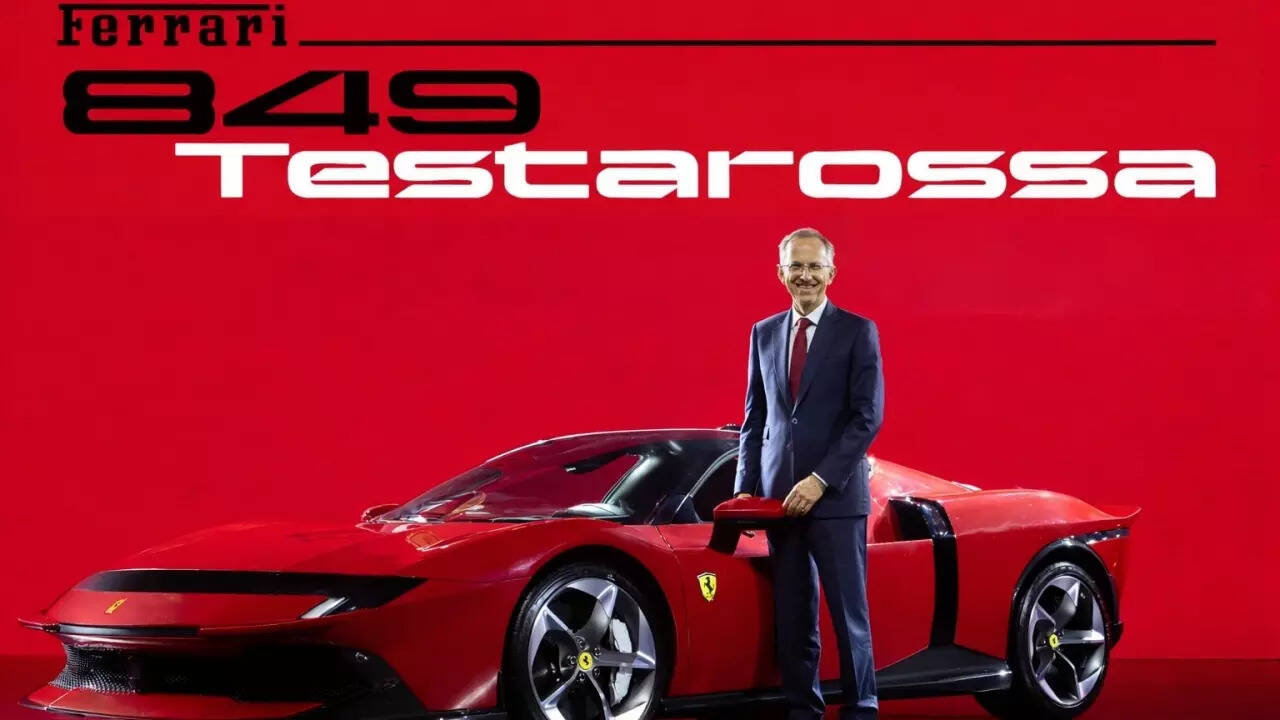
Q: You just unveiled the Ferrari 849 Testarossa supercar in India. It’s a pure delight to look at the car. But we are moving into an era where we talk about AI and autonomous driving, as the pleasure of self-driving is gradually going away. Do you think this passionate love for driving is going to go down as cars become quiet, electric, and autonomous? Does it worry a brand like Ferrari, where it is all about the thrill of driving cars.
Benedetto Vigna: That’s a good point. I would like to highlight a couple of points. One, we believe that in our case, we need to offer our clients any kind of car – be it internal combustion, hybrid, or the electric Ferrari Luce. I think that if you use technology properly, you can deliver unique emotion whatever is the technology is.
If you use technology starting from the emotion that you want to deliver, we are able to do something unique. Our responsibility in front of the client and the world is to be able to manage these technologies in a way that, whatever the core of the powertrain is, people can have fun. This is one point.
The other point is the relation of human beings with all these technologies. I believe that we pretend to believe that we are faster than our predecessors, but human beings are always the same in the way we interact with objects.
Today we are pretending to be multitaskers and pretending to be faster, but in reality, we are not. We are not so much different form the past. When we do something, we have to do it with full concentration. When you drive, you have to be fully concentrated on the driving. So, we will make cars that will deliver the driving emotion to the driver, not to chips or the running AI algorithms. Ferrari may use some assisted driving functions, but that’s a different story.
‘Emotions cannot be outsourced’
Q: But this new generation is growing up with smartphones and screens all around. Do you think the answer is to put in more screens and give them less control, or will they be okay with a product where the control is in their hands?
Benedetto Vigna: I mean, we would have two kinds of cars. There will be a car for everyday use, a car meant for mobility and utility. And then, there will be cars meant to address the unique driving emotion of the people.
If you look at the market in Europe, the total number of cars sold decreased, but the premium car market has always been there. It’s true that the number of cars is reducing in some consolidated markets, but it’s true that the high-end is always there because in the end, you want to have fun when you drive a car. It is even more in luxury. You buy a Ferrari not because you need it from a functional point of view, but because you need it from an emotional point of view.
Q: Hopefully that emotion stays with us, because we need to reward ourselves and feel that passion and thrill. Otherwise, we will become very boring.
Benedetto Vigna: We already outsourced the memory function because now we don’t even remember phone numbers anymore. We have to outsource maybe rational reasoning in the some ways, but I don’t think emotion is something that can be outsourced. We are having this interaction; we could have had this interview through written questions, but it would have been a colder interview. It would not have been interactive because I see your eyes and the way you respond to my answer – it’s a closed loop.
Q: I love that: emotion cannot be outsourced.
Benedetto Vigna: I don’t think so. I don’t think that part will be outsourced.
Electrics not silent + humanisation of technology need of the hour
Q: But the brute force of a sports car – the noise and the grunt – is a different emotion altogether. As we move into the era of electrics like the Ferrari Luce, will we miss that pleasure? With electrics, how do you think that things will evolve for a company that prides itself on the kind of engines that it makes, or the noise and grunt of its engines. We seem to be moving into an era of silence?
Benedetto Vigna: First of all, electric motors are not silent. People believe they are, but in reality, they have their own sound. You have to work to extract it and listen to it properly.
Today there are some biases and prejudices against electric cars. One is the sound, and in reality, there is a sound. Two is the weight of the car, which people think doesn’t allow you to drive it easily, but our car is very light.
Then there is the engaging dimension. Our car has the paddle shift – the Ferrari Luce has the paddle shift. Other electric cars do not have it.
The point is that whatever the technology is, you need to spend time and invest time and money to humanize it. Humanization of technology does not come for free. So far, electric cars have been driven only for environmental reasons, and it is simply replacing one powertrain with another.
This is not the case with Ferrari Luce. The Luce is electric, but it is humanized. It appeals to the emotions of people. There are three ways you can do innovation. One is “technology push,” where you just push a technology, but this is not good. Two is market-driven, where you wait for the client to tell you what they want, but then you’re too late. And then there is the emotion-driven innovation. I believe in emotion-driven innovation because it is at the heart of what we make.
Ace Apple designer Jony Ive and Ferrari Luce
Q: You brought in Apple’s one-time Ace designer Jony Ive for the design of the Luce, but there have been polarized views on his work. Some called his work soulless design or suggested it was borrowing too much from the Silicon Valley and moving away from your core values. How do you see the most iconic Apple designer working on a car?
Benedetto Vigna: First of all, Ive has been working on the car together with the Ferrari team. We didn’t outsource the design. This is very important.
If you want to do something new, you need to put together people with different points of view, and that’s what we did. We have the Ferrari team and then the team of LoveFrom. They have been challenging themselves to create something new. This was also the case in the past when Ferrari was working with Pininfarina or other people outside.
Open innovation is fundamental for the sustainable growth of a company.
Open innovation means putting together different points of view.
It’s not a matter of Italians and Americans; it’s a matter of people sharing a goal and working together.
Today, too often people give judgments very fast because of social media. They are in favour of the extreme reduction of reality. But reality is not just black and white; there are many grey levels. Having polarized comments is a demonstration that we are doing something new. If it were standard, you wouldn’t have polarization.
Q: What specific benefits did Jony Ive bring to the design philosophy?
Benedetto Vigna: Working with Jony has been useful because we have been putting materials in the car that we were not considering as much before, like anodized aluminium and the story of glass. The design language has been changing in terms of the materials we put inside the car and the way we interact with the display and the dashboard.
This is something that already started at Ferrari-getting rid of too many touch buttons that distract the driver. Digital is useful, but it must be used in the right way. You cannot have too much digital because it is not coherent with the way we are. We are analogue beings.
There is an interesting statistic about display-induced distraction in a car. In 2021 in the US, roughly 10 people died every day and 10,000 people were injured. Technology must be humanized and at the service of human beings, not the other way around. In new language, simpler to use.
We even took care of the physical key. Today with an electric car, very often you don’t know if the engine is on or off. You press the throttle a little bit to see if it is moving. We took care of this in a particular way. When you have the key with the Prancing Horse and you put it in the slot of the car, the Prancing Horse is “flying and rides” to the cluster in front of you.
We have been thinking about the way people enter the car, use the car, and interact with it. We used high-tech elements – electronic ink, organic LED displays, advanced glass, anodized aluminium – but we humanized those technologies.
We took organic LED and put a hole in it to fit a physical needle, something other cars would just illuminate on a screen. We want to do things in a unique way because creating a unique car means having unique technologies, unique design, and unique manufacturing. To be unique in manufacturing, you need strong collaboration between people.
If you come to Maranello (Ferrari’s headquarters in Italy where it also makes its cars and has a museum), you don’t see many robots; you see a lot of human beings using their hands and skills to make something unique.
Ferrari and exclusivity
Q: Exclusivity is something you hold very dearly. How do you balance the situation where others are going for scale, but you hold on to exclusivity and not produce at mass scale?
Benedetto Vigna: Exclusivity is one of our fundamental values. We value quality over quantity. To be exclusive means that if I have a car, you cannot have that same one. If you keep increasing the number of cars, you lose exclusivity.
Ferrari wants to preserve exclusivity. We want to grow by a very low amount over the years. We want to invest more and more in personalization, innovation, and experience – which is client intimacy.
These are the three vectors of growth on our roadmap. If you balance product innovation and client intimacy, you have something that is sustainable in the long term.
What makes India special for Ferrari
Q: You mentioned that India is a big opportunity, even though the numbers here are small. The luxury car market in India is only 50,000 units out of 4.3 million. This despite the fact that we have a large and a fast-growing number of millionaires and billionaires. What makes it special for you?
Benedetto Vigna: You’re right that Ferrari is small here. But what is convincing us that this is the right investment is that we see a lot of passion and attachment to our brand.
Also, the wealth in this country is growing domestically, not just from Indians going abroad.
We see the market growing because wealthy people are staying here. On the other side, it is a country that is very “sparkling.” Yesterday I was in Varanasi delivering a speech at IIT, and you can see in all generations a strong interest to “dare.” People here dare more. Similar to what I said, “Hoga Kaise Nahi“.
This is what this brand represents and what I see in India. So, there is a good fit.
It is an investment we are making, and it takes time. We want to be closer to our customers to show that Ferrari is a global brand.
Here in Mumbai, we are having our first brand event at a national scale in India. This is an important milestone for our company and for India.
There are also other opportunities coming, such as the free trade agreement between Europe and India. This is going to simplify the way we deal with India. Also, this is a country that believes a lot in sustainability in every term.
Q: Any unique characteristics of Indian consumers that you’ve noticed compared to those in the US, China, or Europe?
Benedetto Vigna: I wouldn’t say there is any one specific characteristic. In this trip, I’ve been to Australia, Japan, and India, and I met clients in all three locations. All the clients that I met recently share the same passion and the same sense of belonging.
I got a beautiful letter from a client in Japan last week that was incredible, and I shared it with the whole team. I have similar comments also from Indian clients.
Maybe the only difference is that in India, the age is a little bit younger because you have a younger population. But if you put these people behind a curtain and I just listen to them, I am not able to tell the difference. They are all passionate people.
Q: Successful people are often very demanding and possibly repeat customers. How do you say “no” to these guys when they want a limited car?
Benedetto Vigna: There are many ways to say no or yes. We have repeaters, but we also have many different Ferraris. Our strategy has been to make different models, each of them limited in volume, instead of making a few models with unlimited volume.
Q: Is infrastructure in India a concern for sports cars makers?
Benedetto Vigna: Last time I was here in December, I was in a Ferrari 296 model and had no problem. Yesterday I was talking with some clients who have the Purosangue, and they can manage the bumps on the road. It’s okay.
It is an area of investment for us. We are aware it will take time, but the land is very fertile. There is a lot of passion and attachment to the brand. We see the economy is driving well, wealth is growing and staying in the country, and relations between India and Italy are becoming easier.