


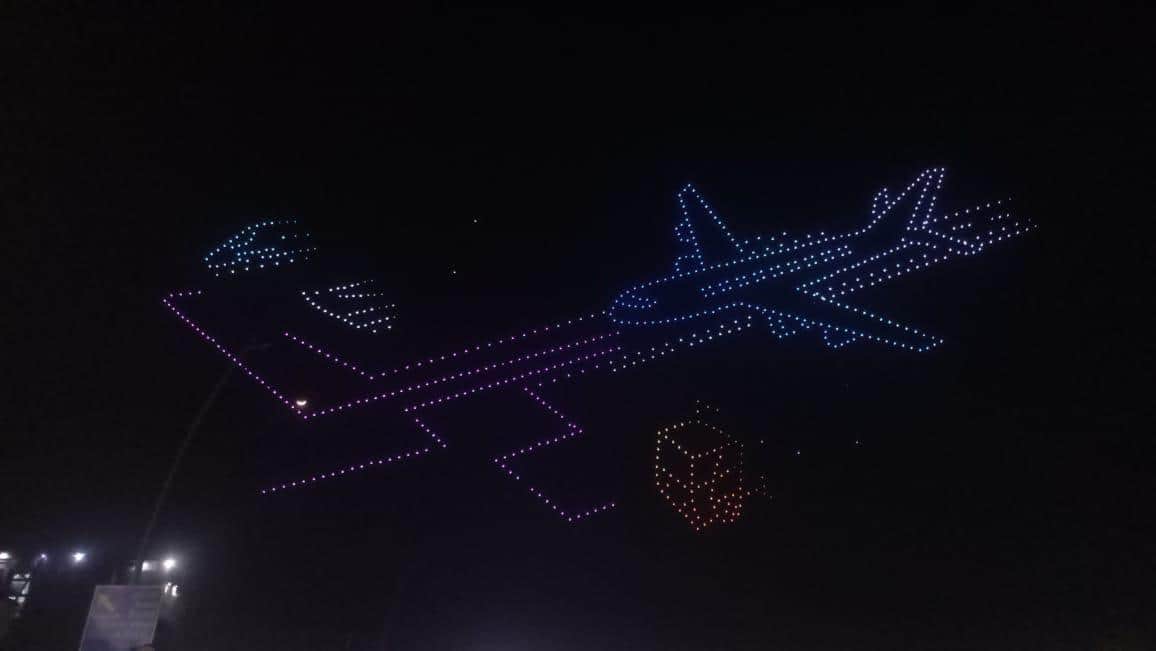
The night sky over Navi Mumbai turned into a spectacle of light and motion on December 24, as 1,515 drones lit up the horizon to herald the operational launch of the Navi Mumbai International Airport (NMIA).
On the eve of the airport’s first commercial operations, the choreographed drone show offered a dramatic countdown to what is being seen as one of the most significant additions to India’s aviation infrastructure in recent years.
The aerial display, built around the theme of innovation and national pride, featured intricate formations ranging from three-dimensional lotus blooms and lotus-inspired interiors to the airport’s logo, a green airport motif, an aircraft soaring over Mumbai and visual narratives symbolising India’s rise on the global stage.
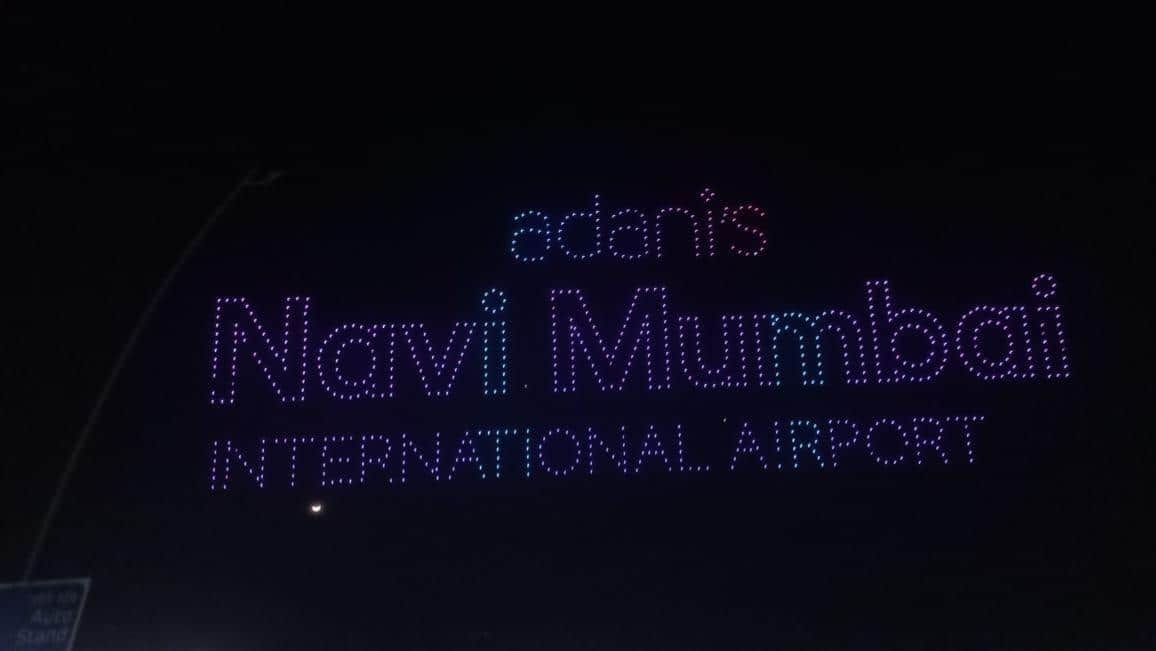
For many in the audience, including specially abled individuals, young athletes and NMIA employees, the evening was not just a celebration, but a moment of participation in a landmark chapter of Indian aviation.
From Drone Lights to Runway Action
Barely hours after the final drone faded from the sky, NMIA officially entered the aviation map with the start of commercial airside operations on December 25, 2025. The airport marked its first day with a time-honoured aviation tradition, a ceremonial water cannon salute, welcoming its inaugural commercial arrival.
IndiGo flight 6E460 from Bengaluru touched down at 08:00 hours, becoming the first scheduled passenger flight to land at Navi Mumbai International Airport. The milestone arrival was followed shortly by the airport’s first departure, IndiGo flight 6E882 to Hyderabad, which took off at 08:40 hours. Together, the two flights completed NMIA’s inaugural arrival-and-departure cycle, formally opening the airport to regular passenger operations.
The start of scheduled flights is being viewed as a critical milestone for India’s civil aviation sector, particularly for the Mumbai Metropolitan Region (MMR), which has long faced capacity constraints at its existing airport.
A Long-Awaited Second Gateway for Mumbai
Navi Mumbai International Airport was inaugurated by Prime Minister Narendra Modi on October 8, 2025, following years of planning and construction. Since 2021, Adani Airports Holdings Limited (AAHL) has been responsible for the development, construction and operational readiness of the greenfield project.
Bringing a large-scale airport from concept to commercial operations within a compressed timeframe has underscored the Adani Group’s execution capability in complex infrastructure projects, according to industry observers.
Developed under a public-private partnership (PPP) model, Navi Mumbai International Airport Limited (NMIAL) has Adani Airports Holdings Limited holding a 74 per cent stake, while CIDCO, a Maharashtra government undertaking, holds the remaining 26 per cent. Spread across approximately 1,160 hectares, NMIA is expected to emerge as one of the busiest and most technologically advanced airports in the country once fully developed.