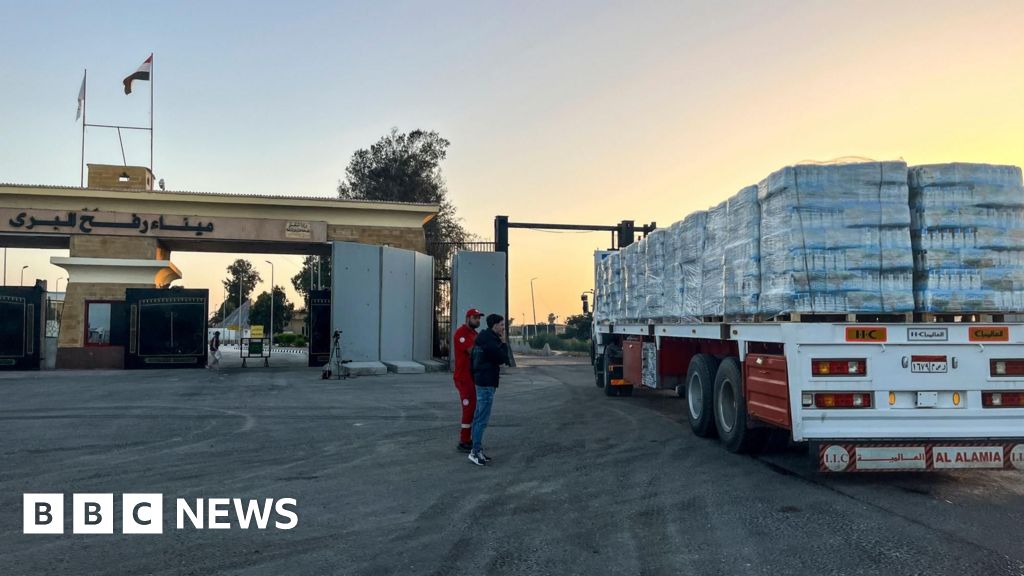

Israel has announced it will open the key Rafah crossing between Gaza and Egypt in the coming days to allow Palestinians to leave the territory.
Israeli military body Cogat said exits would be “facilitated through co-ordination with Egypt, following security approval by Israel and under the supervision of the European Union mission”. It added that this would be “similar to the mechanism that operated in January”, when the crossing opened during a previous ceasefire.
An Israeli security official said it was an expression of Israel’s support for the current ceasefire with Hamas, which began seven weeks ago.
However, Egypt denied it was co-ordinating with Israel to reopen the Rafah crossing.
The State Information Service cited an official Egyptian source as saying that “if an agreement is reached to open the crossing, it will be in both directions, to enter and exit the Gaza Strip, in accordance with the plan of US President Donald Trump”.
Trump’s 20-point Gaza peace plan states that “opening the Rafah crossing in both directions will be subject to the same mechanism” implemented under the January ceasefire deal.
The crossing has been mostly closed since May 2024, when the Palestinian side was seized by Israeli forces. Before then, it was the main exit point for Palestinians allowed to leave during the conflict and a key entry point for humanitarian aid.
At least 16,500 severely ill or injured Palestinians in need of lifesaving medical treatment abroad are currently waiting to be evacuated from Gaza, according to the World Health Organization. It says only 235 patients, almost all of them children, have been evacuated via crossings with Israel since the ceasefire took effect.
Israel’s Haaretz newspaper reported that Palestinian Authority (PA) forces would assist in operating the reopened Rafah crossing alongside the EU’s Border Assistance Mission.
It cited a European source as saying Palestinian representatives had also helped during the previous ceasefire but without wearing PA insignia due to “Israeli sensitivity” over their presence in Gaza. Israeli Prime Minister Benjamin Netanyahu has ruled out any role in the future governance of the territory for the PA, which governs parts of the occupied West Bank.
Haaretz also reported that Netanyahu had so far blocked the reopening of the Rafah crossing because of the delayed return of the bodies of deceased hostages held by Hamas and other armed groups in Gaza.
Under the first phase of the ceasefire deal, which took effect on 10 October, Hamas agreed to return the 20 living Israeli hostages and the bodies of the 28 dead Israeli and foreign hostages still in Gaza within 72 hours.
All the living hostages were released on 13 October in exchange for 250 Palestinian prisoners and 1,718 detainees from Gaza.
So far, the remains of 23 dead Israeli hostages have been handed over, along with those of three foreign hostages – one of them Thai, one Nepalese and one Tanzanian. In exchange, Israel has handed over the bodies of 345 Palestinians killed during the war.
One of the remaining dead hostages is Israeli – Ran Gvili, 24 – and the other is a Thai – Suthisak Rintalak, 43.
The Israeli prime minister’s office said on Wednesday morning that forensic testing had shown that human remains handed over by Hamas in Gaza the previous day did not belong to either of the two men.
On Wednesday afternoon, the military wing of Palestinian Islamic Jihad, an ally of Hamas, said it had recovered the body of a hostage in northern Gaza. The body will be transferred later to Israeli forces via the Red Cross, according to Hamas’s military wing.
The two dead hostages still in Gaza were among the 251 people abducted by Hamas and its allies on 7 October 2023, when about 1,200 other people were killed.
Israel responded to the attack by launching a military campaign in Gaza, during which more than 70,100 people have been killed, according to the territory’s Hamas-run health ministry.