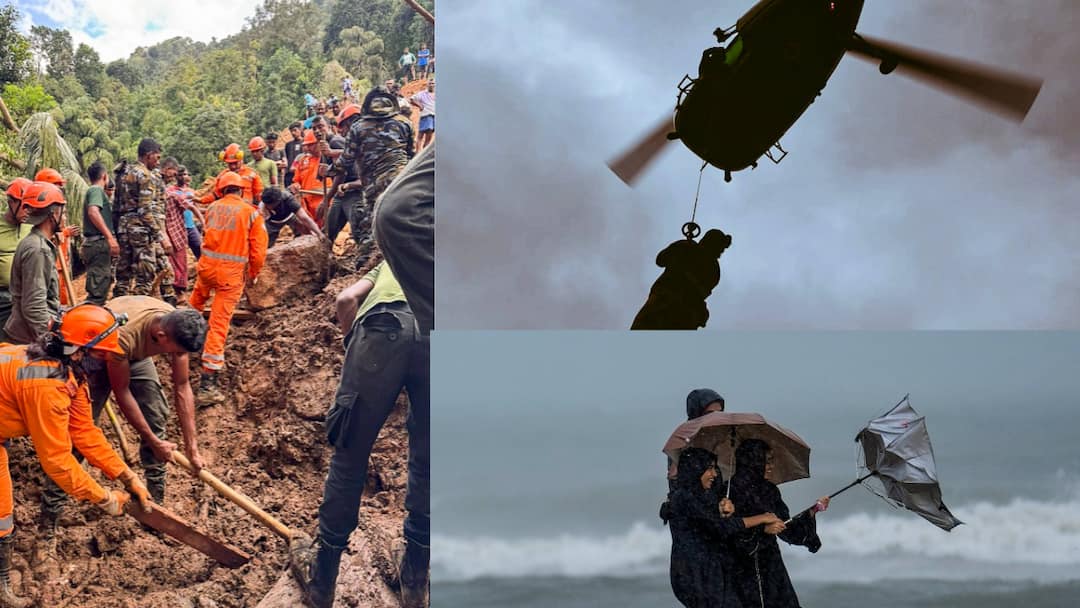

Cyclone Ditwah has ravaged countries across the Indian Ocean basin for nearly a week, unleashing severe flooding, landslides and large-scale humanitarian distress. What began as a low-pressure system southeast of Sri Lanka on November 26 intensified into a deadly storm whose slow crawl along the island’s eastern rim proved catastrophic.
Sri Lanka Plunged Into Its Worst Disaster In Decades
Sri Lanka suffered the heaviest blow, with authorities confirming more than 465 deaths and listing 366 people as missing. The storm damaged over 30,000 homes and disrupted the lives of more than 1.5 million residents. President Anura Kumara Dissanayake declared a nationwide emergency, calling Ditwah the “most challenging natural disaster” the country has ever confronted, as reported by Hindustan Times.
Entire villages were cut off as floodwaters swallowed roads and landslides buried homes. Some families survived for days without formal assistance, relying instead on local volunteers. In Colombo’s suburbs, actor-musician GK Reginold was seen navigating submerged neighbourhoods by motorised fishing boat to deliver food and drinking water.
The Sri Lankan military has mobilised helicopters and ground teams for search and rescue. International support has begun to arrive, but the scale of reconstruction—estimated at nearly $7 billion—underscores the massive task ahead.
Protest Leaders Turn Relief Organisers
In Colombo’s Wijerama area, a familiar network of civic activists has resurfaced. Many of the same groups that organised mass protests against former president Gotabaya Rajapaksa during the 2022 economic crisis are now operating community kitchens to feed storm-affected families, as per reports. The transition from political mobilisation to relief coordination has become a defining feature of the recovery effort.
A Rare Cyclone With Disproportionate Impact
Although Sri Lanka does experience cyclones, major storms are relatively uncommon due to its proximity to the equator, where weaker Coriolis forces limit cyclone formation. Since 2000, the island has recorded around 16 cyclones—mostly mild systems. Despite being classified as a “cyclonic storm,” one of the weaker categories, Ditwah delivered extraordinary damage because of intense rainfall and unstable terrain.
Storm’s Reach Extends Across the Region
Ditwah’s influence extended far beyond Sri Lanka. In Indonesia, the combination of monsoon rains and two unusual tropical storms triggered deadly flooding, killing 755 people with 650 still missing. Southern Thailand and northern Malaysia also faced significant inundation as weather patterns tied to Ditwah swept across the region.
Heavy Rains Lash Tamil Nadu As Ditwah Weakens
By Tuesday, the system had weakened but still brought intense rainfall to India’s southeast coast. Around noon, its remnants hovered about 40 kilometres southeast of Chennai, unleashing downpours that submerged roads in Chennai, Tiruvallur, Chengalpattu and Kancheepuram.
The India Meteorological Department (IMD) reported early Wednesday that the depression over the southwest Bay of Bengal and the adjoining Tamil Nadu–Puducherry coastline had further weakened into a well-marked low-pressure area. While floodwaters are gradually receding, normal life across several districts remains significantly disrupted.