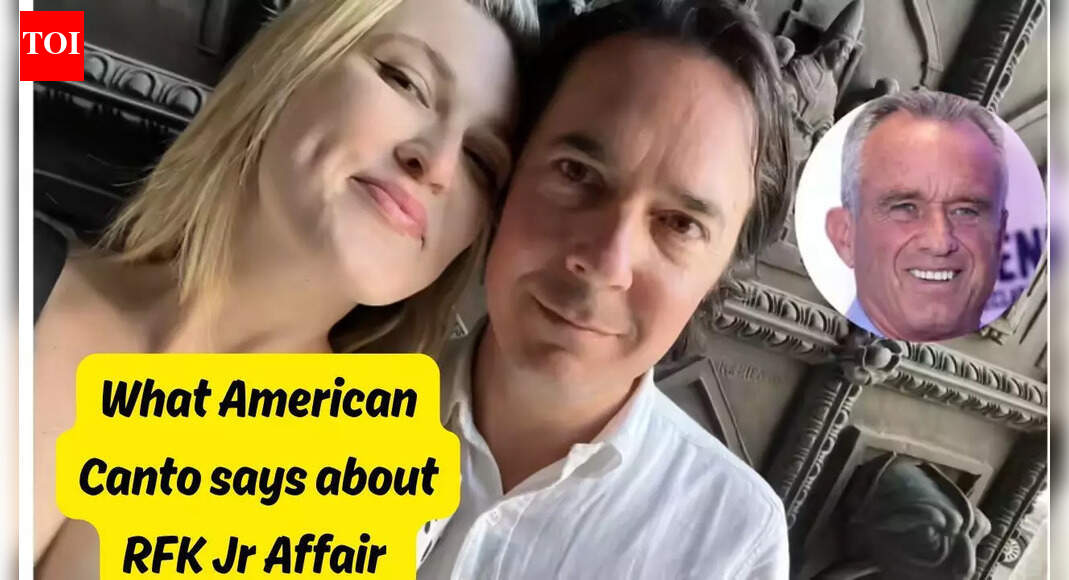

Olivia Nuzzi did not set out to become the main character of American politics. For most of the past decade she was the sharp-eyed narrator hovering at the edge of the frame, first at The Daily Beast and then as Washington correspondent for New York magazine, turning the Trump era into a running tragicomedy of ego, chaos and petty feuds. She made other people look ridiculous. She made institutions look hollow. She made the machinery of power feel like a dark farce. Then, in 2024–25, the neat division between “the reporter” and “the story” collapsed. Her love life, once a private subplot, detonated into the centre of a tabloid-political-media vortex, and her own memoir, American Canto, neither clarified nor contained the blast.
The RFK Jr relationship that collapsed the boundary
The axis of the scandal is her relationship with Robert F. Kennedy Jr., who by 2025 had become Donald Trump’s Health and Human Services Secretary. While covering his 2024 presidential bid, Nuzzi developed what was publicly described as a “personal relationship” with him. She had already written about his campaign and later published a widely read piece on Joe Biden’s fitness for office, so when the relationship became public it instantly raised questions about objectivity and conflict of interest. Kennedy publicly denied that there had been an affair, saying they met only professionally, but Nuzzi’s own account has always been more emotionally charged and less straightforward. In American Canto, she refers to him only as “the Politician”, yet anyone even casually following American news knows who she means. Reviewers have noted that she writes about him in lavishly romantic terms, dwelling on his mind, his “darkness”, his body, his voice, in an almost gothic mode. She sketches scenes of private conversations, flirtations and emotional entanglement, while insisting in earlier statements that the relationship was never physically consummated. Those reading her closely have described these passages as romantic reveries that offer very little concrete insight into a man who now controls a huge federal bureaucracy. As the book tells it, the agreed public “spin” when the scandal broke was that it had only been a flirtation, but she also recalls Kennedy suggesting that if it were “just sex” he could weather the fallout, dangling the possibility that what really happened was both more and less than an ordinary affair.
The fallout and the fiancé who walked away

Who are Olivia Nuzzi and Cheryl Hines and how are they linked to a sexting scandal and Robert F. Kennedy Jr.? Pic Credit: X/@ishitanair18
What is not in dispute is the fallout. After she disclosed the relationship, New York magazine put her on leave, and the two eventually parted ways. Around the same time, her fiancé, political journalist Ryan Lizza, ended their engagement. In later legal filings Nuzzi accused Lizza of threatening to leak personal material about her, hacking her devices and orchestrating a campaign of humiliation against her, before withdrawing the request for a protective order a few weeks later. He, for his part, would eventually launch a Substack series about the whole saga, casting doubt on her description of the RFK Jr. relationship and surfacing other alleged entanglements from her past.
The allegations that expanded the cast
It is Lizza who expands the cast list. In his posts he claims that, while they were together, Nuzzi also had a sexual relationship with former South Carolina governor Mark Sanford, a one-time Trump critic and would-be primary challenger whom she had profiled years earlier for New York. Nuzzi has not confirmed this, and her lawyer has said that American Canto describes the only instance in her career in which she had an improper relationship with someone she was covering. Lizza further alleges that she behaved less like a reporter and more like a Kennedy campaign operative, sharing opposition research and helping kill negative stories. She has rejected those claims as harassment. Viewed from his angle, her love life is not just messy, it is professionally compromising.
The tabloids turn it into a spectacle
Outside that triangle, the tabloids have gleefully piled on. One New York column framed the whole thing as the best soap opera of the year, complete with accusations that she’d had a sugar-daddy arrangement with former MSNBC host Keith Olbermann and a broader pattern of gravitating toward older, powerful men in politics and media. In this telling, Nuzzi is less a tragic heroine than a recurring character in a long-running drama about ambition, access and disastrous taste in men.
American Canto: the memoir that tried to explain everything

It is into this maelstrom that American Canto arrives. The book was heavily trailed as her big reckoning, a literary attempt to explain not just her own implosion but the warping of American reality during the Trump years from the vantage point of someone sucked into the distortion field. Instead, it has landed with strikingly unified scorn. The New Yorker called it disjointed and evasive, more impressionistic mood-piece than memoir. The New York Times found it structurally baffling and self-serious. A Washington critic went further, describing it as “aggressively awful” and scolding Nuzzi for refusing the basic memoirist’s duty to make herself look foolish rather than glamorous. Others have argued that the book reads like a “tell-nothing memoir”, written too soon and too defensively, more like a bargaining chip to salvage a post-scandal career than a reckoning with what actually happened.
The reviews that reshaped the narrative
Over and over, reviewers land on the same flaws. The book refuses chronology. It swaps narrative for vibes. It frames her involvement with Kennedy in cosmic or astrological language and relocates the drama to fire-lit California hills, all while skating over specifics of who did what and when. At its most strained, the prose feels like Joan Didion cosplay: the woman in sunglasses behind a steering wheel, Southern California apocalypses, invocations of a centre that cannot hold, but with the temperature turned up so high it tips into melodrama. A more sympathetic commentator in a left-leaning magazine, while acknowledging the trauma and family history Nuzzi sketches, still concludes that she violated every obvious ethical line and is far too seasoned a reporter to be indulged as naïve.
A pattern emerges across her personal and professional worlds
Fold these readings back into the plot and a clearer pattern emerges. Professionally, Nuzzi spent years thriving on proximity to powerful men: Trump, his aides, would-be insurgents like Sanford, finally Kennedy. Personally, according to both her own book and her loudest critics, she kept forming intense, sometimes romantic attachments to the same kinds of figures. Her romantic history, at least as it appears in public, repeatedly intersects with people she is also professionally incentivised to scrutinise. At one level, this is not unusual; politics is a small, incestuous world. At another, it is the core of the scandal, because once those attachments slide into secrecy, denial and blurred roles, they undermine the trust on which her work was built.
The mythmaking instinct
The irony is that Nuzzi understands performance as well as anyone. Her early life included child acting and a short-lived pop persona called “Livvy”; she has long seen herself as a character as much as a byline. In American Canto, she leans all the way into that: the exile in Malibu writing about a country and a heart on fire, the self-conscious literary heroine driving through the smoke of her own choices. What the book rarely does is drop the pose. There is very little plain regret, very little simple admission of having been used, manipulated or reckless. More often, the text drifts into symbols and omens, insisting that what happened to her is really about the nature of American reality, or the cruelty of the internet, or the fate of love in a broken country.
Why the world cared
This is why the story has gripped so many people far beyond the usual media-gossip crowd. It is not just about sex or texts or a messy breakup. It sits at the point where journalism, power and personal need collide. Here is a reporter who built a career on exposing the absurdities of American politics and then allowed herself to be drawn into the orbit of one of its more unhinged dynasties. Here is a woman who clearly has talent and drive, whose early work won awards and big-platform jobs, now being told by an army of critics that her big literary swing is juiceless, egotistical and almost unreadable. And here is a media ecosystem that is simultaneously appalled by her ethical breaches and thrilled to have such a richly complicated character to pick apart.
The journalist who wandered into the machinery
Strip away the noise and what remains is a fairly stark trajectory. Olivia Nuzzi was the chronicler of chaos who, for a time, thought she could stand inside the blast radius and keep taking notes. The relationship with RFK Jr. cracked that illusion. The breakup with Ryan Lizza turned a private implosion into a multi-platform feud. The allegations about Mark Sanford and others thickened the plot. American Canto was supposed to be the explanation, but instead it confirmed what the gossip already suggested: that she is still, even now, half inside the story, trying to rewrite it in real time.
A Gonzo journalist
Not a villain, not a martyr, and not particularly repentant, she sits somewhere more interesting: a journalist who got so close to the machinery she covered that it finally pulled her in and spat her out, leaving her to do the only thing she knows how to do. She walked through hell and took notes. The question for readers is whether they see those notes as revelation, excuse, or just another layer of the performance. Go to Source