
Lauren Turner and
Ian Youngs,Culture reporter

 EPA
EPAThe Eurovision Song Contest is changing its rules around voting and promotion in the wake of controversy about Israel’s result at this year’s competition.
Some countries raised concerns after Israel topped the public vote at the contest in May, finishing second overall after the jury votes were taken into consideration.
Fans will be able to cast 10 votes each, down from 20, and juries will return for the semi-finals.
Organisers will also ban contestants and broadcasters from taking part in promotional campaigns by third parties including governments. Last year, there were reports that an Israeli government agency paid for adverts and used state social media accounts to encourage people to vote for its entry.
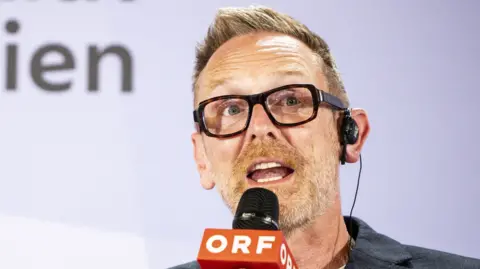
Eurovision director Martin Green said there had been “a lot of feedback from members and our fans” following the 2025 show, saying they wanted Eurovision to “have a good look at our rules”.
“There was a little fear that we’re seeing some undue promotion particularly by third parties, perhaps governments, that are out of proportion of the rest of the natural promotion that you should see in the show,” he said.
He stressed he was “not going to single any one participating broadcaster out” but that the changes had been triggered by a number of promotional campaigns over recent years – especially by third parties – that were “out of kilter” with the spirit of the annual contest.
 Getty Images
The presence of Israel at Eurovision has faced opposition from some participating countries because of the war in Gaza.
Spain, Ireland, Slovenia, Iceland and the Netherlands have all said they would consider boycotting next year’s contest if Israel takes part.
While Green did not address Israel’s participation directly, he said he hoped the measures would “give people reassurance that the contest remains an impartial and neutral space”.
In a statement, he added: “We are taking clear and decisive steps to ensure the contest remains a celebration of music and unity. The contest should remain a neutral space and must not be instrumentalised.”
The new rules:
- They will “discourage disproportionate promotion campaigns… particularly when undertaken or supported by third parties, including governments or governmental agencies”. Organisers said broadcasters and artists would not be permitted to “actively engage in, facilitate or contribute to promotional campaigns by third parties that could influence the voting outcome”.
- The number of votes that can be cast by members of the public will be cut from 20 to 10 per person, which Green said would mean people could still spread their votes “amongst many acts”. After this year’s contest, a Flemish MP said allowing 20 votes was “a system that encourages manipulation”.
- Juries, currently only used for the grand final, are being brought back for the semi-final stage to “make sure we’re assuring that quality, that diversity of music”, Green said, “as well as respecting what the public want”.
- Organisers will improve technical monitoring to “detect and prevent fraudulent or co-ordinated voting activity, and strengthen monitoring of suspicious patterns”.
Boycott threat
A vote on Israel’s participation had been due to take place in November, but the European Broadcasting Union, organisers of the annual contest, cancelled it due to “recent developments in the Middle East”, including the ceasefire in Gaza.
It said at the time that Israel’s participation would instead be discussed at an in-person meeting in December, but it is not yet clear if a vote will still take place.
Green said broadcasters and their artists participate, not governments, and it was important to “keep the geopolitics off of the stage”.
Austrian national broadcaster ORF, which will host the contest in 2026, has previously urged countries not to boycott the contest next year in Vienna.
Asked if the vote would still be happening, Green said: “We very much hope this package of measures gives our members the reassurance they need to ensure Eurovision remains a neutral and impartial space.”
Israel came second in the most recent Eurovision Song Contest in May, with its singer Yuval Raphael receiving the largest combined public vote.
However, the addition of jury votes led to Austria’s JJ being declared the winner for his song Wasted Love.
 Reuters
The final of the 70th Eurovision Song Contest will be held on 16 May. The semi-finals will be held earlier that week at the same venue, the Wiener Stadthalle.
It will be the third time Vienna has hosted the annual show, most recently held there in 2015.
In the UK, Eurovision is broadcast by the BBC.