
The Virtual Telescope Project 2.0
Comet C/2025 K1 (ATLAS) has become a major point of interest for astronomers following a series of rapid changes observed in recent weeks. First detected in May 2025, the comet moved steadily towards its perihelion in early October, then began displaying fluctuations in brightness and visible shape that hinted at underlying instability. Researchers have continued to track these developments closely, as they offer insights into how newly arriving long-period comets behave when exposed to strong solar radiation and gravitational forces. The behaviour of C/2025 K1 is scientifically significant because it provides a real-time view of cometary response during intense heating, helping refine models of how such bodies evolve as they pass through the inner solar system.
How the comet approached the Sun and why its path drew attention
The approach of C/2025 K1 towards the Sun drew immediate interest because of its relatively steep trajectory and the volatile-rich composition typical of long-period comets. Its perihelion on 8 October 2025 placed it roughly 0.334 astronomical units from the Sun, a distance close enough for rapid sublimation of ices to occur. As the nucleus warmed, gas and dust streamed outward, forming a coma and tail that became increasingly dynamic. Observers noticed early variations in its brightness, which suggested irregular activity across the surface. These changes hinted at internal structures that might be weaker than previously assumed, making the comet more vulnerable to disruption. The combination of proximity to the Sun, intensified heating and rapid rotation created a complex environment that scientists continued to monitor as the comet moved outward again.During this period, astronomers tracked how the comet’s material responded to repeated cycles of heating and cooling. Jets of escaping gas appeared to shift direction over time, which indicated uneven sublimation across the nucleus. For a dynamically new comet that had likely spent thousands of years in the outermost regions of the solar system, exposure to such conditions for the first time would have been particularly challenging. These observations laid the groundwork for predictions that the nucleus might not remain stable during the remainder of its solar passage.
What recent images reveal about the fragmentation and structural failure
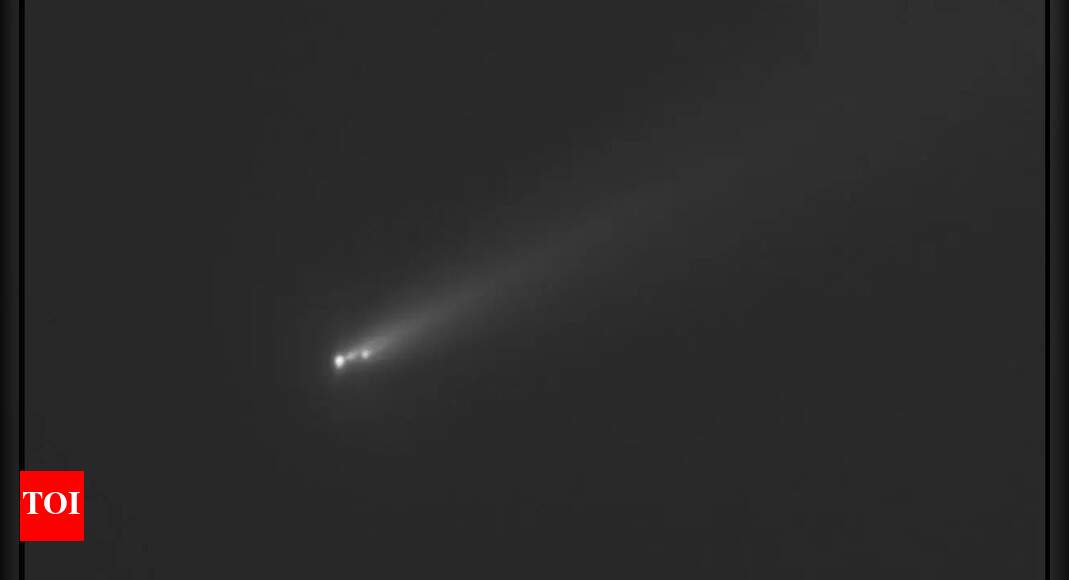
A major development occurred in mid-November, when new images showed that C/2025 K1 had begun to break apart. The Virtual Telescope Project reported that on 12 November, the comet displayed at least two main fragments, with a third appearing close to the sunward direction. By 13 November, their animation constructed from sequential exposures revealed measurable movement between the fragments, confirming that the nucleus had separated into distinct components. This separation grew more obvious over the next twenty-four hours, with the fragments slowly drifting apart and shedding diffuse dust.The fragmentation is likely the result of internal gas pressure combined with structural weakness deep within the nucleus. As gases expanded beneath the surface, they may have formed cavities that eventually ruptured when thermal stress exceeded the nucleus’s strength. The comet’s close solar approach would have intensified these effects by accelerating sublimation at a rate the structure could not withstand. Once the surface began to crack, the release of built-up gas would have contributed to the rapid spread of the debris cloud surrounding the fragments.Fragmentation events such as this are not uncommon in long-period comets, but each instance provides new data on how these bodies respond to extreme environments. The visible spread of fragments indicates that the original nucleus may have been loosely bound, composed of porous material that separated easily when stress increased. Such findings allow researchers to refine current views on what kinds of comets are most susceptible to disintegration during their first major encounter with solar heating.
Where the comet fragments are now and what sky-watchers can expect to see
The remains of C/2025 K1 are currently located within the constellation Leo, with an estimated magnitude near 9.9, making the fragments suitable for observation only through telescopes or strong binoculars. Their faintness is partly due to the dispersal of brightness across multiple pieces instead of a single concentrated nucleus. As the fragments continue to drift, the comet’s typical morphology becomes less defined, leaving observers with a gently diffuse glow rather than a sharp head and clear tail. The closest approach to Earth is expected around 25 November 2025, at a distance of approximately 0.40 astronomical units, which is close enough for continued monitoring but not enough to significantly enhance brightness.Observers seeking to view the remnants are encouraged to look during early morning hours, shortly before dawn. Conditions such as minimal light pollution and favourable moon phase will influence visibility. The debris field may grow increasingly diffuse as the fragments lose material, especially if smaller pieces evaporate entirely. For many sky-watchers, the interest now lies less in the comet’s brightness and more in its evolving shape, as the separation of fragments provides an unusual opportunity to watch a disintegrating comet over successive days.
What the fragmentation reveals about comet survival and long-period behaviour
The disintegration of C/2025 K1 offers valuable insights into the behaviour of long-period comets encountering the inner solar system for the first time. Many such comets are believed to be fragile, with loosely packed ices and dust held together by minimal cohesion. As they move closer to the Sun, thermal stress generates internal fractures that can trigger sudden failure. The rapid breakup of C/2025 K1 supports this idea by demonstrating how quickly structural integrity can decline once sublimation becomes intense. Scientists studying the fragments aim to understand the pattern of the breakup, including the distribution of gases, dust and smaller particles.By examining the evolving cloud around the fragments, researchers can gain evidence about the internal composition of the nucleus before it separated. The event aligns with past cases of first-pass comets disintegrating shortly after perihelion, suggesting that many bodies arriving from distant reservoirs such as the Oort Cloud may only survive a single solar passage. These findings help refine long-term models of comet evolution and improve forecasts of how similar objects might behave during future visits to the inner solar system.Also Read | How 39,000-year-old ancient RNA from a mammoth found in Siberia reveals its biology Go to Source