
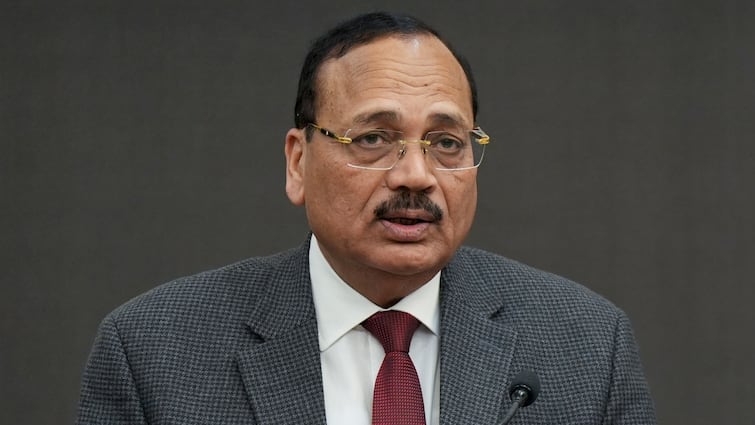


Chief Justice of India B. R. Gavai on Monday officially forwarded the name of Justice Surya Kant to the Union Government for appointment as the next Chief Justice of India (CJI). Justice Kant is set to assume office on or shortly after November 24, and will serve until his retirement on February 9, 2027.
Justice Kant hails from Hisar district, Haryana, born February 10, 1962. He was elevated to the Supreme Court of India on May 24, 2019. Prior to that, he served as a judge of the Punjab & Haryana High Court and as Chief Justice of the Himachal Pradesh High Court, among other appointments.
Here are a few key judgements by Justice Surya Kant:
Key Judgements By Justice Surya Kant
Justice Surya Kant has in recent years delivered a number of high-impact rulings that illustrate his evolving jurisprudence on constitutional rights, environmental protection, land acquisition and access to justice.
1. Arbitration Agreements & Stamp Act (2023)
In Babanrao Rajaram Pund v. Samarth Builders & Developers (2022 9 SCC 691 under the Arbitration and Conciliation Act 1996 and the Indian Stamp Act 1899, Justice Kant authored or co-authored a judgment in which the Court held that an unstamped or under-stamped arbitration agreement is inadmissible in evidence under Section 35 of the Stamp Act.
However, the defect was held to be curable and the agreement was not automatically rendered void or unenforceable. This creates clarity for parties in arbitration and avoids automatic invalidation of agreements with stamping defects.
2. Right to Life & Environmental Protection
In ‘Jitendra Singh v. Ministry of Environment (2020 20 SCC 581)’, Justice Kant held that village ponds are “public utilities meant for common use” and that extinguishing them can violate the fundamental right under Article 21 of the Constitution because of the impact on potable water and community resources.
Justice Surya Kant authored or co-authored this reasoning. The ruling reflects his view that the law must evolve to protect the environment as part of human dignity.
3. Criminal Law & Victim’s Participation
In Jagjeet Singh v. Ashish Mishra (2022 9 SCC 321), the bench held that a “victim” under the Code of Criminal Procedure has the right to be heard from investigation stage onwards—not only after trial commences. Justice Surya Kant emphasised the participatory rights of victims in criminal justice
4. Land Acquisition and Compensation
Justice Kant authoured a decision in which he affirmed the “belting” method of land valuation for acquisition compensation, which involves dividing land into zones based on proximity to major infrastructure (for example, a highway) and awarding a proximity premium accordingly.
He emphasised the need to rely on recent comparable sales and to avoid distress sales as benchmarks. The ruling strengthens protections for land-owners whose property is acquired for infrastructure. It also emphasised fairness in compensation by recognising enhanced value arising from better connectivity.
5. Access to Justice and Invisible Victims
In his speeches and judgements, Justice Kant has voiced concern about the accessibility of the justice system, especially for socio-economically disadvantaged persons. He said the “doors of the temples of justice” remain “too narrow” for many citizens.
He also encouraged courts and lawyers to recognise the “invisible” victims of adjudication—persons who may not be party to the litigation but are directly impacted by its outcome.
Emphasising that true constitutional guardianship lies in restraint and transparency, he cautioned that judicial overreach, even if well-intended, could upset the balance of powers among branches of government.
6. Free Speech and Democratic Role of Courts
Justice Kant has stressed that courts interpret the law not as a “cold command” but as a living instrument of justice. He has explicitly reaffirmed that freedom of speech is part of the right to a dignified life, especially for journalists and media organisations, subject to constitutionally permissible restrictions.