
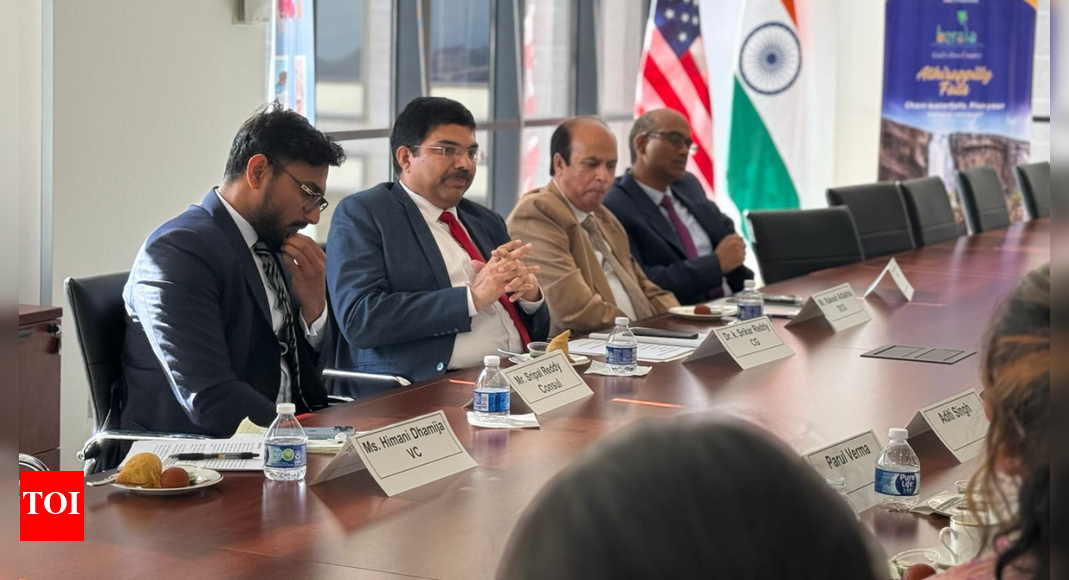


On a mild Friday afternoon in San Francisco, a group of Stanford Graduate School of Business students walked up the sandstone steps of the Consulate General of India. The building sits a few blocks off Market Street (half formal, half faded), like an old diplomat who’s seen enough decades to know that marble doesn’t have to shine to mean something.Inside, they were greeted by Dr. K. Srikar Reddy, the Consul General, and his team — Deputy Consul General Shri Rakesh Adlakha, Mr. Abhishek Kumar Sharma (Consul, Commerce), Mr. Chittyreddy Sripal (Consul, Head of Chancery, Political & Technical), Ms. Himani Dhamija (Vice Consul, Passport & Education), and Ms. Poonam Singh (Executive Assistant, Education). They smiled broadly and motioned the delegates into a conference room lined with framed photographs of Indian skylines, satellites, and prime ministers.The meeting was simply a conversation between young people trying to understand India’s economic transformation and the diplomats who interpret that transformation to the world.Most of the students had just returned from the Stanford GSB’s Global Study Trip (GST) to India, a ten-day immersion across Delhi and Mumbai on the theme Growth and Innovation. They had spent their days in conference rooms, boardrooms, and occasionally the backseat of buses caught in Delhi traffic, trying to piece together a country in motion.
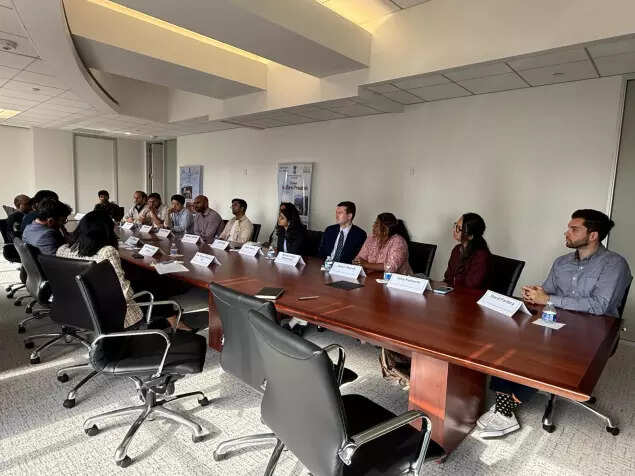
When they gathered that afternoon in San Francisco, the trip was still fresh in their minds.Dr. Reddy began the session with a polite critique. “I read your article,” he said, referring to the students’ reflection piece from the trip, and talked of Bangalore and Hyderabad, where he said, “you would have also seen cities where innovation is happening: global capability centers, manufacturing hubs, deep-tech startups.”He spoke with the composure of someone who has spent decades explaining India’s uneven map to visiting delegations: how Tamil Nadu leads in automobiles, Gujarat in manufacturing, Telangana in technology, and how India’s economic story is really a mosaic of state stories stitched together. “Some regions are growing in double digits,” he said. “The national average is six or seven percent, but that hides the truth, that some states are racing ahead while others are still rooted in agriculture.”The students around the table reflected the same diversity that India itself often contains. Some were of Indian origin; others weren’t. A few had grown up in Seoul, Singapore, or Texas, and for many, the trip was their first real encounter with India.A first-year student who had lived across Asia said he joined the trip because “it felt like a missing piece.” Another student who grew up in Korea spoke about the parallels between South Korea’s family-run conglomerates and India’s business dynasties. “In both countries,” he said, “you see this mix of tradition and ambition: family companies evolving into modern enterprises. But now, tech is changing the pattern.”Dr. Reddy agreed, but added a distinction. “The service sector, especially IT and design, is driving much of the growth now,” he said. “Eighteen percent of India’s value added comes from digital industries. We are moving from call centers to research centers. Every global company you can name has engineers in Bangalore.”That statement caught the group’s attention. Most had heard of India as the “back office of the world.” Few had considered it the “design office” too.The discussion soon moved to technology. Parul, an electrical engineer who had worked in Bangalore’s AI scene before coming to Stanford, asked about the government’s plan to build a semiconductor ecosystem. Dr. Reddy responded: “Twenty percent of the world’s chip design already happens in India,” he said. “Now we are building capacity for manufacturing, starting with 28 nanometers and above. Micron is setting up its facility. Tata Electronics is partnering with a Taiwanese firm. By 2030, we want to grow electronics manufacturing to $500 billion, with semiconductors contributing about $110 billion.”Then came a question from a student, William Whittenbury, who had an aerospace background. He had worked at a company involved in sending India’s astronauts to the International Space Station. “India’s space program has been so self-reliant,” he said. “Do you see room for international collaboration?”Dr. Reddy nodded. “Absolutely,” he said. “Our collaboration with NASA is strong. The NASA-ISRO Synthetic Aperture Radar satellite was launched jointly in July. We’re working together on Earth observation and human space programs. India wants to be a reliable partner, not just for ourselves but for the world.”A week later, he mentioned, the Consulate would host an event on India-U.S. space cooperation.The tone shifted from macroeconomics to something more personal. A student who grew up in the U.S. but was of Indian origin asked about the growing number of people like him: professionals who wanted to build careers that straddled both countries.Dr. Reddy leaned back. “That is already happening,” he said. “Our bilateral trade in goods and services crossed $212 billion last year. We want to double it by 2030. The United States is our largest economic partner. As India grows, talent will flow both ways. For the next 25 years, our demographic advantage will be unmatched: average age 29.”He noted that over 2.5 million Indians graduate annually in STEM fields. “That’s why so many companies are setting up Global Capability Centers. They’re not just offshoring. They’re innovating.”Toward the end, one student who had built startups in both countries compared the experience of raising capital in India versus Silicon Valley. “It’s much easier here,” he said. “In India, even with great talent, the funding ecosystem still feels cautious.”Dr. Reddy acknowledged the challenge. “Some states like Karnataka and Telangana are creating funds-of-funds,” he said. “They’re investing directly into venture capital firms to expand local capital pools. And Indian financial institutions, banks, pension funds etc, are slowly opening up to the VC asset class. It will take time, but it’s changing.”He mentioned that WestBridge Capital, a Bay Area firm, now invests 80 percent of its portfolio in India. “There’s growing confidence,” he said.Outside, the San Francisco light had softened into the late afternoon. The students drifted toward the curb, still chatting about semiconductor fabs and startup policies, about Delhi’s chaos and Mumbai’s charm. This meeting was, in the truest sense, an exchange of ideas, of stories, of curiosity.Much of the visit had been made possible by Ms. Poonam Singh, a long-time part of the Indian Consulate, who had coordinated the logistics behind the scenes, confirming schedules, clearing security, and ensuring everything ran seamlessly. The students were deeply grateful to the entire Consulate team (Dr K Srikar Reddy, Shri Rakesh Adlakha, Mr Abhishek Kumar Sharma, Mr Chittyreddy Sripal, and Ms Himani Dhamija) for their warmth and hospitality.For a few hours, between the glass towers of California and the ambitions of a rising India, the room had held two worlds in quiet conversation. Go to Source