
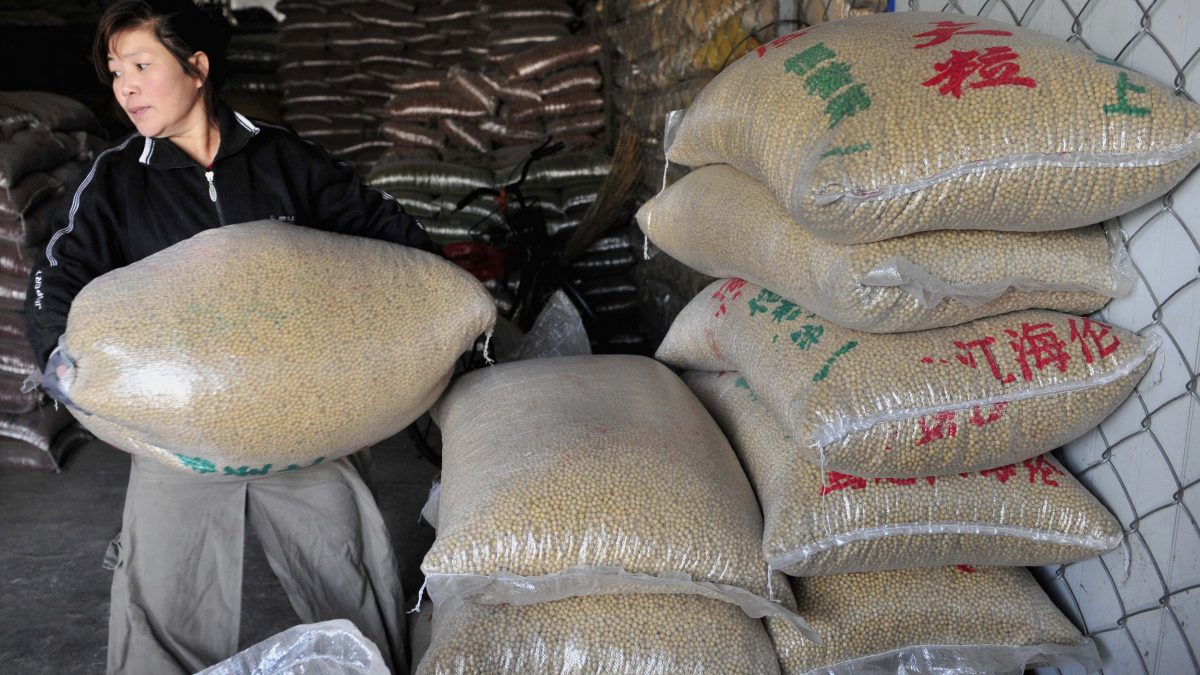
 "Argentina wins US-China trade war with a bn bailout and soaring soyabean sale")

The ongoing trade war between the US and China has thrown up an unexpected winner: Argentina.
In a geopolitical triangle that few predicted, the United States has extended a $20 billion bailout to Argentina, China has redirected its soybean purchases away from American farmers and Argentine exporters have seized the opportunity to capture a key share of the world’s largest soybean market.
This alignment has left US farmers fuming, the Trump administration internally divided and China with greater leverage in its confrontation with Washington.
China shuns American soybeans
Soybeans sit at the heart of the US-China trade dispute.
For decades, American growers supplied China, the world’s top soybean consumer, with tens of millions of tonnes each year. That flow has been cut off.
Since May, Chinese importers have ceased all purchases of US soybeans, retaliating against tariffs imposed by Washington. As a result, American exports to their single largest customer have evaporated creating a glut at home and plunging prices on the Chicago Board of Trade.
This vacuum has been filled by South America.
Brazil, already a dominant supplier to China, booked 12 million tonnes of soybeans for shipment in late 2025. Now, Argentina has moved aggressively into the same space aided by favourable government policies and a timely surge in Chinese demand.
Milei seizes China opportunity
In mid-September, President Javier Milei’s government temporarily suspended export taxes on soybeans, corn, wheat, and their by-products. Levies as high as 26 percent on raw soybeans and 24.5 percent on soybean oil and meal were suddenly cut to zero. The result was a flood of declared sales.
Within just two days, Argentina booked nearly $7 billion in grain exports, more than half of which were soybeans bound for China (South China Morning Post, 2025).
The tax holiday coincided with a landmark deal in New York, where US President Donald Trump promised Buenos Aires a $20 billion financial package.
Designed to stabilise the peso and shore up reserves, the bailout was also intended to curb Argentina’s economic reliance on Beijing.
But the immediate effect was least to say paradoxical. Argentine soybeans, suddenly cheaper and tax-free, became the prime choice for Chinese buyers seeking to sidestep US suppliers.
Chinese pays, Argentina sells
The response from Beijing was swift. Within days, around 40 cargos—2.66 million tonnes of soybeans—were booked for shipment in November and December, with most of the volume headed directly to Chinese ports. These sales represented more than half of China’s near-term demand and pushed Argentina’s soybean export orders to a seven-year high.
China has obviously shown intent to avoid US supplies. Last year, China imported 105 million tonnes of soybeans, including 22 million from the US. But this season, Chinese traders have indicated they may rely almost entirely on South America until Brazil’s next harvest arrives in early 2026.
For Argentina, the shift translates into billions of dollars in new revenue, while for Washington, it represents both a political and economic setback.
And American farmers fume
The bailout has triggered anger among US farmers, who see themselves as collateral damage in the geopolitical struggle.
The American Soybean Association (ASA) has openly criticised Washington’s decision, warning that the $20 billion lifeline to Buenos Aires effectively subsidises a competitor while US producers are left with falling prices and shrinking markets.
Soybean futures in Chicago have already slid to $10.10 per bushel, pressured by Argentina’s sudden export surge and the absence of Chinese buyers. Harvest season in the Midwest has compounded the problem, as silos fill with unsold crops and buyers remain scarce.
Farmers in key states like Iowa, Indiana, and Minnesota—longstanding Republican constituencies—have expressed alarm that federal subsidies cannot replace the long-term demand from China.
Friction in Trump camp China levers
The fallout has not been limited to rural America. Divisions within the Trump administration have deepened in recent weeks, as images circulated of Treasury Secretary Scott Bessent reading a text message at the UN General Assembly.
The message, reportedly forwarded by Agriculture Secretary Brooke Rollins, lamented that the US had bailed out Argentina only for Buenos Aires to remove export tariffs, reducing prices for China at a time when US farmers would normally be selling.
The text warned bluntly: “This gives China more leverage on us.”
The leak highlighted tensions within the administration, where some officials see the bailout as a strategic move to limit Chinese influence in South America, while others view it as a direct blow to US farmers.
China and America fight, Argentina wins
The dynamic is clear.
China’s boycott of US soybeans has not only hurt American producers but has allowed Argentina to strengthen its ties with Beijing despite Washington’s financial intervention.
While the bailout was tied to conditions such as dismantling Argentina’s $18 billion currency swap line with China, the immediate reality is that Chinese buyers are filling their silos with Argentine grain, not American.
For Beijing, the strategy is doubly effective. By turning towards Argentina, it secures essential supplies while driving a wedge between Washington and its farm lobby.
For Buenos Aires, the surge in soybean exports provides a much-needed infusion of foreign currency and market confidence. And for American farmers, it represents another season of frustration and economic pain.
Double gain for Argentina
The unusual alignment of financial aid from Washington and soaring sales to Beijing has placed Argentina in a uniquely advantageous position.
It is simultaneously receiving US dollars to stabilise its economy and Chinese yuan to boost its trade flows. For Milei, the outcome is a vindication of his gamble to suspend export taxes and leverage international tensions to Argentina’s benefit.
For US farmers, however, the developments highlight the vulnerability of agriculture to geopolitical conflict. Without access to China’s massive demand, American producers face oversupply, declining prices and growing political pressure on the Trump administration ahead of the 2026 midterms.
In the balance of the trade war, Argentina has emerged as the unlikely winner—boosted by US money, Chinese demand and a global market reshaped by conflict between the world’s two largest economies.
End of Article
 "‘Rumours’: Taliban reject reports of internet ban in Afghanistan, call it fibre-optic disruptions")
 "What’s Delhi’s plan to not be on world’s most polluted list this winter?")
&description=Argentina+wins+US-China+trade+war+with+a+%2420+bn+bailout+and+soaring+soyabean+sale)