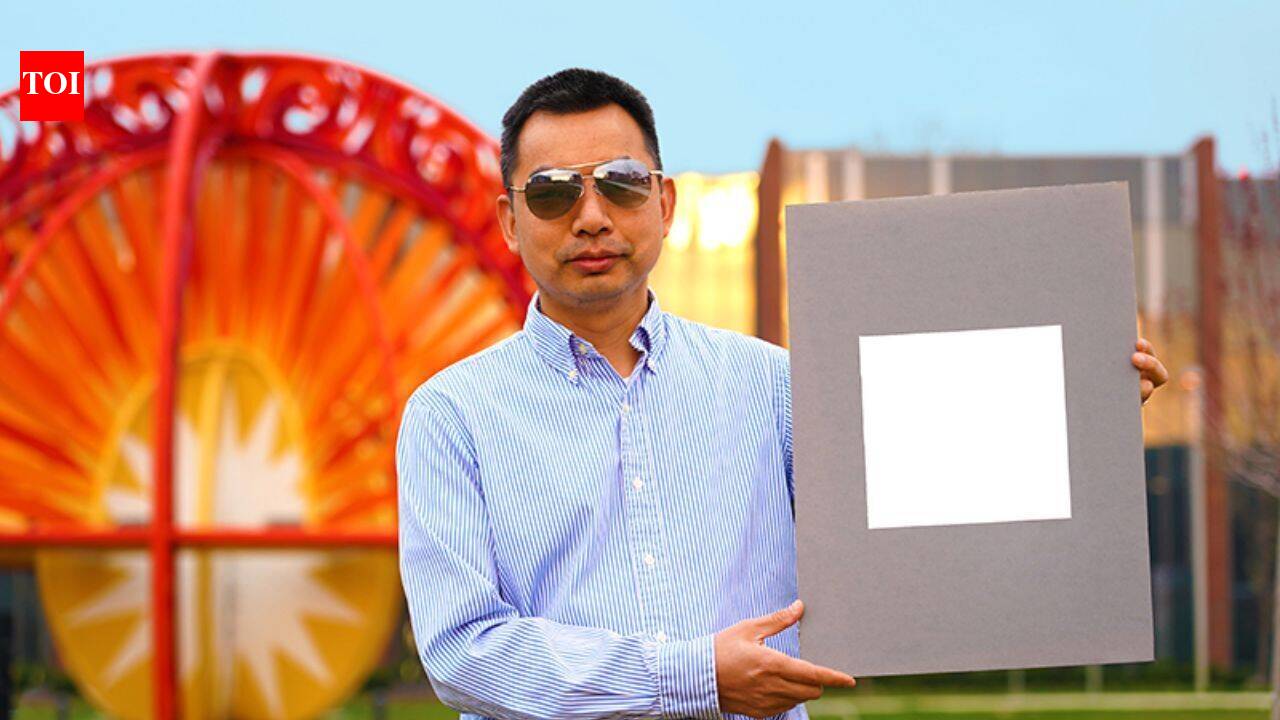


PC: Purdue University
Keeping buildings cool has become an increasingly difficult challenge as temperatures rise and air conditioning demand continues to grow. While cooling systems provide comfort, they also consume large amounts of electricity, adding to energy costs and greenhouse gas emissions. That has encouraged scientists to look for alternatives that work with nature rather than against it. One promising approach is to prevent buildings from heating up in the first place by reflecting as much sunlight as possible.A team of engineers at Purdue University believes it has taken a significant step in that direction after developing an exceptionally reflective white paint designed to cool surfaces naturally, even under direct sunlight.
How the world’s whitest paint reduces heat build-up
The new coating was created to bounce away nearly all of the Sun’s incoming energy instead of allowing it to be absorbed by roofs and walls. Reportedly, laboratory measurements showed that the paint reflects around 98.1% of sunlight, placing it beyond the performance of conventional white exterior paints and even ahead of the team’s earlier experimental version.That difference may appear small at first glance, but when spread across the roof of a building exposed to strong sunlight throughout the day, the improvement becomes meaningful. Standard white paints usually absorb enough solar energy that they still warm up. Even specialist “cool roof” products generally reflect between 80 and 90% of sunlight, meaning surfaces remain warmer than the surrounding air.The research published in the journal ACS Applied Materials & Interfaces, titled ‘Ultrawhite BaSO4 Paints and Films for Remarkable Daytime Subambient Radiative Cooling’ where the team described the paint as one of the highest-performing single-layer radiative cooling coatings developed so far. By combining exceptionally high solar reflectance with strong infrared emission in a paint that can be applied using familiar methods, the work offers a practical example of how materials engineering could help buildings stay cooler using less energy.
What makes the world’s whitest paint so white
Achieving such a high level of reflectivity required more than simply adding extra white pigment.The research team selected barium sulfate as the primary material after comparing a wide range of naturally white substances. The compound is already familiar in everyday products, including cosmetics and photographic paper, because of its bright appearance. Its optical properties also make it highly effective at scattering sunlight.Equally important was the size of the particles inside the paint. Rather than using particles of a uniform diameter, the engineers deliberately mixed many different sizes together. Since each particle interacts with different wavelengths of sunlight, combining a broad range allows more of the solar spectrum to be reflected back into the environment instead of being absorbed by the painted surface. Packing too many particles into the mixture could make the paint more likely to crack or peel once applied, so the researchers balanced reflectivity with long-term durability.
How this cooling paint lowers surface temperatures
Outdoor testing showed that the paint could lower surface temperatures beyond what passive shade or conventional coatings normally achieve.During daytime measurements under strong sunshine, coated samples stayed roughly 4.5°C below the surrounding air temperature. After sunset, when radiative cooling became even more effective, surfaces were measured at around 10.5°C cooler than the ambient air.The effect was also observed during colder weather. In one winter test, despite air temperatures of approximately 6°C, the painted sample still maintained a considerably lower surface temperature.According to the researchers, covering a roof area of roughly 1,000 square feet with the coating could provide a cooling effect equivalent to about 10 kilowatts under favourable conditions. That figure exceeds the cooling capacity of many residential central air conditioning systems, although real-world performance would depend on local climate, roof design and weather conditions.
Years of experimentation behind a simple-looking finish
Although the finished product resembles ordinary white paint, reaching this point took years of trial and error.The Purdue group spent around six years investigating materials suitable for passive radiative cooling. More than 100 candidate substances were considered before narrowing the list to a handful worthy of detailed testing. Each promising material went through dozens of formulation changes as the team searched for the right balance between optical performance, reliability and ease of manufacture.An earlier version of the project relied on calcium carbonate, a material commonly found in rocks and seashells. That paint already demonstrated strong cooling performance, but switching to barium sulfate allowed the researchers to improve sunlight reflection even further without abandoning a manufacturing process that remains compatible with commercial paint production.
More than laboratory research
The work was intended with practical use in mind rather than remaining a purely academic exercise.The team says the formulation can be produced using techniques already familiar to the paint industry, making future commercial development more realistic. Tests also suggested that the coating can withstand outdoor exposure in a way comparable with existing architectural paints.Patent applications covering the formulation have been submitted through Purdue University’s technology commercialisation office. The research itself was supported by the Cooling Technologies Research Center at Purdue University and the US Air Force Office of Scientific Research.
A possible role in reducing building energy demand
Passive cooling has attracted growing attention because it reduces heat without consuming electricity. Instead of relying on compressors, refrigerants or powered ventilation, radiative cooling materials allow buildings to shed heat naturally while reflecting incoming solar radiation.If coatings like Purdue’s can be produced at scale and remain durable over many years, they could reduce cooling demand for homes, offices, warehouses and industrial buildings in warm climates. They are unlikely to replace air conditioning entirely in every setting, particularly during periods of extreme heat or high humidity, but they could reduce the amount of mechanical cooling needed. Go to Source