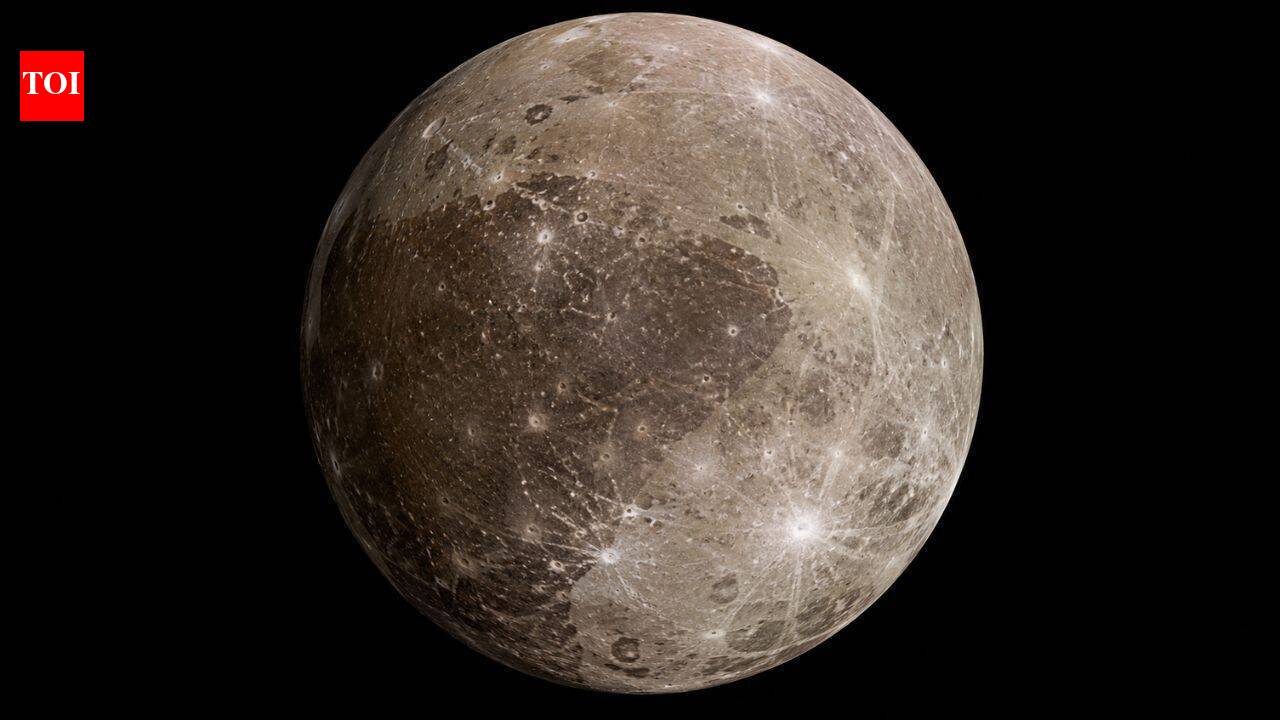

Image AI generated
When people think about moons, they usually picture small rocky companions circling much larger planets. Ganymede does not fit that picture. It travels around Jupiter, yet it is larger than Mercury, holds signs of an immense hidden ocean, and even possesses its own magnetic field. Those are characteristics more often associated with planets than their satellites. It remains officially classified as Jupiter’s biggest moon, though its size and internal complexity make it one of the most unusual worlds in the Solar System. According to Nasa, Ganymede is the largest moon known, exceeding both Mercury and Pluto in size while displaying features rarely seen beyond planets themselves.
What makes Ganymede one of the most planet-like moons in the Solar System
At first glance, Ganymede’s title as a moon seems misleading. Its diameter measures around 5,260 kilometres, making it larger than Mercury despite containing less mass because much of its interior consists of ice rather than dense rock and metal. It circles Jupiter roughly every seven Earth days while remaining locked in place, always presenting the same face to the giant planet.That combination raises an interesting contrast. If Ganymede orbited the Sun directly instead of Jupiter, many people would probably think of it as another planet. Instead, its orbit determines its classification, even though its physical properties rival those of planetary bodies. As per Nasa, Ganymede belongs to the four large Galilean moons discovered by Galileo Galilei in 1610, a finding that helped overturn the long-held belief that everything revolved around Earth.
Ganymede’s hidden ocean may contain more water than all of Earth’s oceans
The surface of Ganymede appears frozen and ancient, marked by bright grooves, darker cratered terrain and vast stretches of ice. Beneath that shell, however, scientists believe there may be an enormous reservoir of liquid water.Observations from the Hubble Space Telescope indicate that Ganymede likely contains an underground saltwater ocean buried beneath an icy crust roughly 150 kilometres thick. The hidden ocean itself could reach about 100 kilometres in depth, leading scientists to estimate that it may contain more water than exists across all of Earth’s surface oceans combined.The possibility of so much liquid water has kept Ganymede firmly on the list of worlds that deserve closer study. Computer models have also suggested that water may come into contact with rock deep below the ice, an interaction considered important when scientists assess whether an environment might support simple forms of life.How Ganymede’s magnetic field reveals clues about its hidden ocean
Perhaps the feature that most separates Ganymede from ordinary moons is invisible.
Ganymede remains the only moon in the Solar System known to have its own intrinsic magnetic field, first detected by the Galileo spacecraft in 1996. That magnetic field creates shimmering auroras around the moon’s poles while sitting inside Jupiter’s much larger magnetic environment. Scientists have even used the subtle movement of those auroras to investigate what lies beneath Ganymede’s icy surface, providing additional evidence for its buried ocean.The moon also has a remarkably layered interior consisting of an iron core, a rocky mantle and an extensive shell of ice. Juno has identified mineral salts and organic compounds on the surface, observations that may help researchers better understand the composition of the deep ocean hidden below.
Why Ganymede remains one of the most extraordinary moons in the Solar System
Ganymede still carries the label of a moon because it orbits Jupiter, yet nearly everything else about it stretches that definition. Its planetary dimensions, vast internal ocean, layered structure and self-generated magnetic field make it unlike any other natural satellite known.Spacecraft continue to reveal new details rather than simple answers. Nasa’s Juno mission is still examining Jupiter and its major moons, helping scientists piece together how giant planets and their companions formed billions of years ago. Ganymede may never be reclassified as a planet, but it already stands as one of the Solar System’s most planet-like moons, reminding researchers that celestial worlds do not always fit neatly into familiar categories. Go to Source