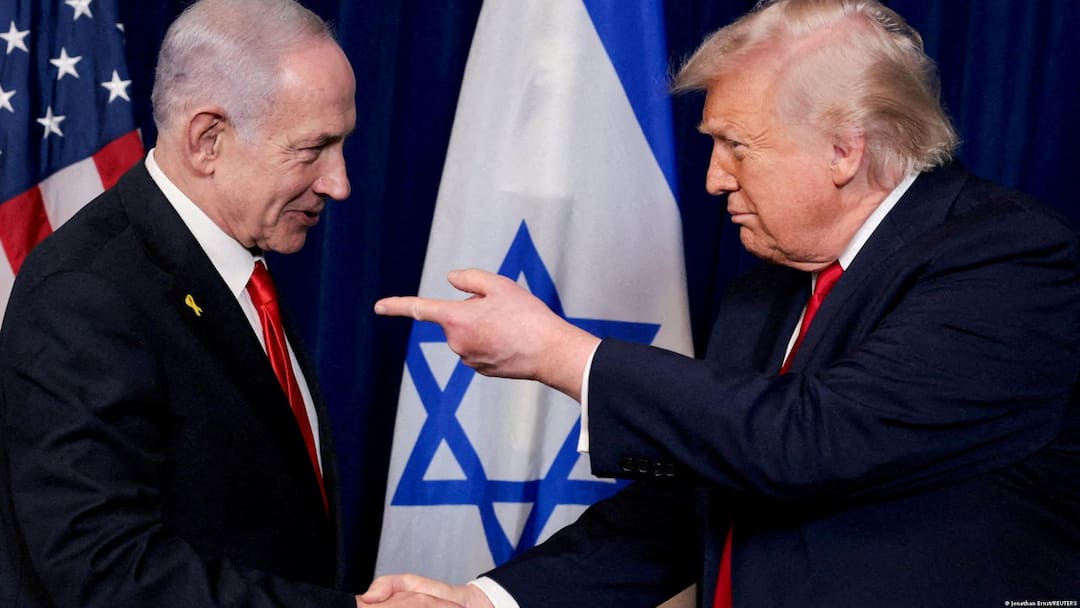

- Trump meets Netanyahu and Zelenskyy amid escalating conflicts.
- Iran executes two protesters; war support declines in US.
- Israel intercepts drone; US sets Israel-Lebanon talks.
- Benjamin Netanyahu arrives in Washington
- Israeli PM set to meet President Trump for the first time since the start of the Iran war
- Trump to also meet with Ukraine’s Volodymyr Zelenskyy
- Iran executes two men in relation to January protests
- US sets date for next Israel-Lebanon talks
Iran executes two men in relation to January protests
The Iranian judiciary announced on Tuesday that two men convicted of acts of violence during anti-government protests in January had been hanged.
“The death sentences of Abolfazl Sepahi and Amir-Hossein Safari were carried out this morning,” the judiciary’s Mizan Online portal said.
It said the pair had been found guilty of “attacking police officers with machetes and knives, tying them to road signs, pulling them on the ground, dousing them with gasoline, and setting them on fire.”
Other charges, according to Mizan, included “moharebeh [waging war against God] by drawing weapons and creating fear and terror” and “corruption on earth for committing acts that severely disrupted public order and security in the country.”
The Mehr news agency reported that the executions took place in “a square in the city of Malekshahr” in the central Isfahan province, in the presence of members of the public.
Two other men were hanged on similar charges in Isfahan province on July 19.
In December 2025, a protest movement initially sparked by the high cost of living in Iran rapidly evolved into widespread anti-government demonstrations that peaked on January 8 and 9.
Iranian authorities reported more than 3,000 deaths, attributing the violence to “terrorist acts” which they claimed were orchestrated by the United States and Israel, while rights groups based abroad maintain that security forces fired on protesters.
According to Amnesty International, Iran conducts the second most judicial executions of any country, after China.
ALSO READ | ‘How To Kill Melania Trump’: Report Claims Chilling Iranian Propaganda Video Targets First Lady, Barron
Zelenskyy to meet Trump as Ukraine, Iran conflicts overlap
Ukrainian President Volodymyr Zelenskyy is also expected to meet US President Donald Trump in Washington on Tuesday, emphasizing the increasing overlaps between the ongoing Russian invasion of Ukraine and the US war against Iran.
The meeting comes after Ukraine reportedly carried out long-range strikes against Iranian-linked vessels in the Caspian Sea over the weekend, which Zelenskyy claimed had been carrying military cargo linked to Iran.
Tehran confirmed that one of its ships had exploded in the attack, killing a sailor and injuring several others, with Iranian Foreign Ministry spokesperson Esmaeil Baghaei warning that Ukraine’s actions amounted to a “dangerous act of adventurism.”
The common denominator in both conflicts, according to Kyiv, is Russia, which is separated from northern Iran by only a short sea route bypassing Azerbaijan in the Caspian Sea, or by a 250-kilometer (155-mile) strip of Azeri territory over land.
Earlier this month, Zelenskyy claimed that Moscow has been providing Tehran with satellite imagery of US bases in the Gulf region.
President Trump has played down the impact of any potential Russian assistance for Iran, telling reporters on Air Force One on Monday: “I don’t think they’ve been doing it, certainly not at a high level. And if they have, it has been very un-impactful.”
Other overlapping issues linking the wars in Ukraine and Iran include the stretching of US munitions stockpiles available for each theater and the cutting-edge Ukrainian experience in drone warfare, which Kyiv has been sharing with the US.
US support for Iran war in decline — survey
Popular support for the United States’ war with Iran has fallen to its lowest since the start of the conflict five months ago, according to a new survey conducted by the Reuters news agency and the Ipsos polling institute.
According to the poll, carried out over the weekend and published on Monday, only one third of US citizens remain supportive of their country’s military operations.
Meanwhile, 69% are of the opinion that US President Donald Trump has failed to adequately explain the goals of the intervention.
A government spokeswoman told Reuters that the White House doesn’t attach any meaning to the poll and that President Trump doesn’t make decisions based on fluctuating survey results.
She insisted that the most important objective in the war against Iran remains the degradation of Tehran’s ability to produce a nuclear weapon.
18 US service personnel have been killed during operations so far, in addition to thousands of people in Iran and Lebanon, despite Trump promising during his 2024 election campaign to keep the United States out of foreign wars.
The survey put general public support for Trump at 37%.
Israel intercepts drone near Jordanian border
The Israeli air force said on Tuesday morning that it had intercepted a drone close to the border with Jordan — although it provided no information regarding the potential provenance of the weapon.
According to the air force, the drone did not enter Israeli airspace.
The operation came following the interception of two further drones near the Jordanian border on Monday, the provenance of which also remains unclear.
In addition to Israeland the Israeli-occupied West Bank, Jordan also shares borders with Syria, Iraq and Saudi Arabia, giving it a geographically important position amid several regional conflicts. The United States also maintains a military presence on Jordanian air force bases.
Although Israel took joint part in the initial offensive against Iran back in February, it has not participated in the most recent round of strikes.
US confirms next round of Israel-Lebanon talks
The US State Department confirmed on Monday that the next round of talks between Israel and Lebanon would begin in Rome next week on August 4.
“In Rome, technical groups will focus on advancing the full implementation of the framework agreement,” a State Department official told the French AFP news agency.
The Israel-Lebanon framework deal calls for an end to hostilities, the disarmament of militant group Hezbollah, the deployment of Lebanese military troops in the south of the country, and for Israeli forces to gradually withdraw from Lebanon in two so-called “pilot zones.”
The official said the agenda would include “resolving all outstanding border issues,” among other things.
“The experience of the initial zones will help us perfect pilot-zone implementation so it can expand in a phased manner,” the official added.
Despite the framework agreement, Lebanon has reported intermittent Israeli strikes and artillery shelling on the south of the country in recent days.
Netanyahu lands in Washington to meet with Trump
Israeli Prime Minister Benjamin Netanyahu arrived in Washington on Tuesday to meet with US President Donald Trump .
It will be Netanyahu’s first visit to the White House since the US and Israel attacked Iran in late February, triggering the ongoing war.
“This is a great privilege, but it is also a great responsibility,” Netanyahu said before departing Israel on Monday.
“We will discuss all the issues on the agenda, first and foremost Iran. Naturally, our goal is to safeguard our security and also to expand the circle of peace around us,” he added.
The trip comes as Trump increasingly expresses frustration toward Netanyahu over hostilities in the Middle East, referring to him in one interview as a “difficult guy.”
ALSO READ | OPINION | Japan’s AI Diplomacy: A New Path To Technological Sovereignty
Welcome to our coverage
Welcome to our coverage of the US-Israeli war against Iran.
Israeli Prime Minister Benjamin Netanyahu is set to discuss the conflict today with US President Donald Trump in Washington. The two leaders have publicly disagreed throughout the course of the war, with Trump in recent weeks expressing frustration with Netanyahu’s actions in the Middle East.
Meanwhile, arrangements are being made for the next round of direct Israeli-Lebanese talks early next month, according to Washington.
(Disclaimer: This report first appeared on Deutsche Welle, and has been republished on ABP Live as part of a special arrangement. Apart from the headline, no changes have been made in the report by ABP Live.)