
- Freedom fighters, including Gandhi, used fasts for rights.
- Post-independence fasts shaped states, policies, and anti-corruption movements.
- Recent fasts address human rights, environment, and current governance issues.
Hunger strikes have played a defining role in India’s political and social history, emerging as a powerful form of non-violent resistance across generations. From the freedom struggle against British rule to contemporary campaigns over governance, human rights and environmental protection, fasting has often compelled authorities to respond to public demands.
While some protests resulted in landmark policy decisions, others ended in tragedy, leaving behind a lasting impact on India’s democratic and social landscape.
Freedom Fighters Used Fasting To Challenge Colonial Rule
One of the earliest and most significant hunger strikes took place in June 1929 inside Lahore Central Jail. Freedom fighters Bhagat Singh, Batukeshwar Dutt and Jatindra Nath Das launched a fast to protest the discriminatory treatment of Indian political prisoners by the British administration.
The prisoners demanded equal treatment with European inmates, including better food, improved living conditions, access to books and an end to forced labour. The protest continued for 116 days, becoming one of the longest hunger strikes of its time.
The movement took a tragic turn when Jatindra Nath Das died on September 13, 1929, after fasting for 63 days. His death sparked nationwide outrage and increased pressure on the British government, which later introduced improvements in prison conditions.
Mahatma Gandhi also transformed fasting into a moral and political instrument. In 1932, he began a fast while imprisoned to oppose separate electorates for Dalits, eventually leading to an alternative political arrangement. The following year, in 1933, Gandhi observed a 21-day fast for “self-purification,” focusing on the eradication of untouchability and advocating equal access to temples, schools and public facilities for Dalits.
ALSO READ: ‘Will Continue Fasting’: Sonam Wangchuk After CJP Protesters Clash With Police
Fasts That Reshaped India’s Political Landscape
Several hunger strikes in independent India directly influenced political developments and government policy.
Among the most significant was Potti Sriramulu‘s fast unto death in 1952. Seeking a separate state for Telugu-speaking people, the Gandhian activist began his protest on October 19 and died 58 days later on December 15. Widespread public protests following his death prompted Prime Minister Jawaharlal Nehru’s government to create Andhra State on October 1, 1953. The movement also laid the foundation for the States Reorganisation Act, 1956, which reorganised states along linguistic lines.
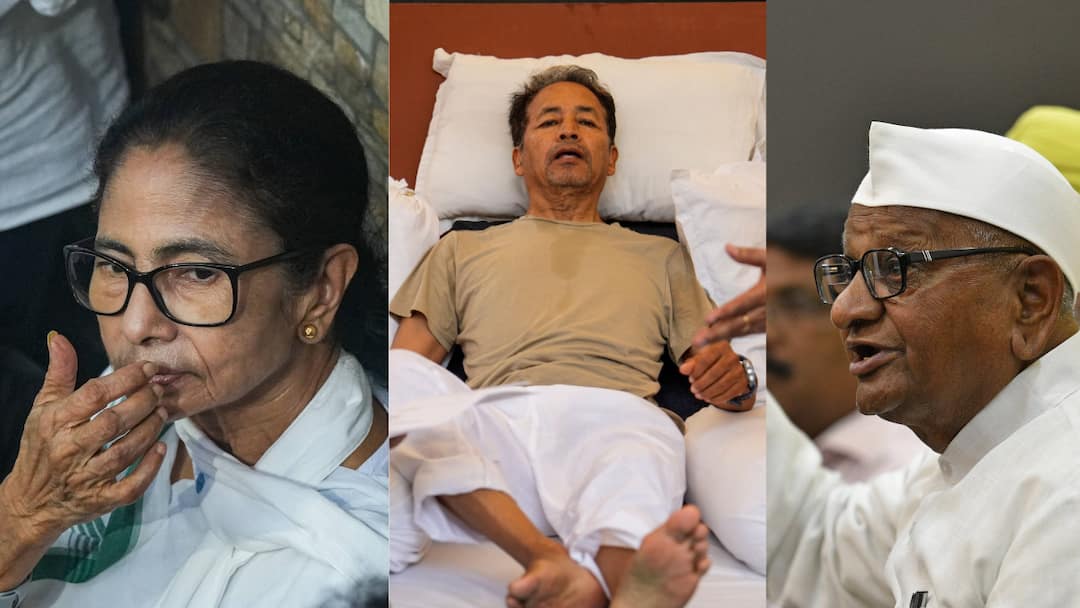
More than five decades later, Mamata Banerjee undertook a 26-day hunger strike in 2006 against the acquisition of farmland in Singur for the Tata Nano project. As her health deteriorated, intervention from then-President APJ Abdul Kalam and Prime Minister Manmohan Singh led to the end of her fast after she received written assurances from the Centre. The protest became a defining moment in West Bengal politics and strengthened her position ahead of her victory in the 2011 Assembly elections.
Anna Hazare‘s 12-day fast in 2011 also became one of independent India’s most influential public protests. His campaign demanding a stronger Lokpal law against corruption triggered nationwide demonstrations and intensified pressure on Parliament to pursue anti-corruption reforms.
Human Rights And Environmental Movements Embraced Hunger Strikes
Hunger strikes have also become a prominent tool in campaigns for human rights and environmental conservation.
Irom Sharmila, popularly known as the “Iron Lady of Manipur,” began her fast on November 5, 2000, after the Malom massacre, in which security forces allegedly killed 10 civilians. She demanded the repeal of the Armed Forces (Special Powers) Act (AFSPA), continuing her protest for nearly 16 years despite repeated arrests and force-feeding through a nasal tube while in custody. She ended her fast on August 9, 2016, by tasting honey, concluding what is widely regarded as one of the world’s longest hunger strikes.
Environmental concerns have similarly inspired prolonged fasts. Swami Nigamananda died in 2011 after fasting for 115 days while protesting illegal sand mining along the Ganga near Haridwar. Seven years later, environmentalist G.D. Agarwal, also known as Swami Gyan Swaroop Sanand, died after a 111-day fast demanding stronger measures to preserve the river’s uninterrupted flow.
Sonam Wangchuk’s Protest Continues
The latest addition to this long history is engineer and education reformer Sonam Wangchuk, who has been on a hunger strike for more than 20 days in 2026.
His ongoing protest seeks the resignation of Union Education Minister Dharmendra Pradhan over the NEET-UG paper leak controversy and other alleged examination irregularities. Wangchuk’s fast has once again brought national attention to the role of hunger strikes as a means of expressing dissent and influencing public debate in India.