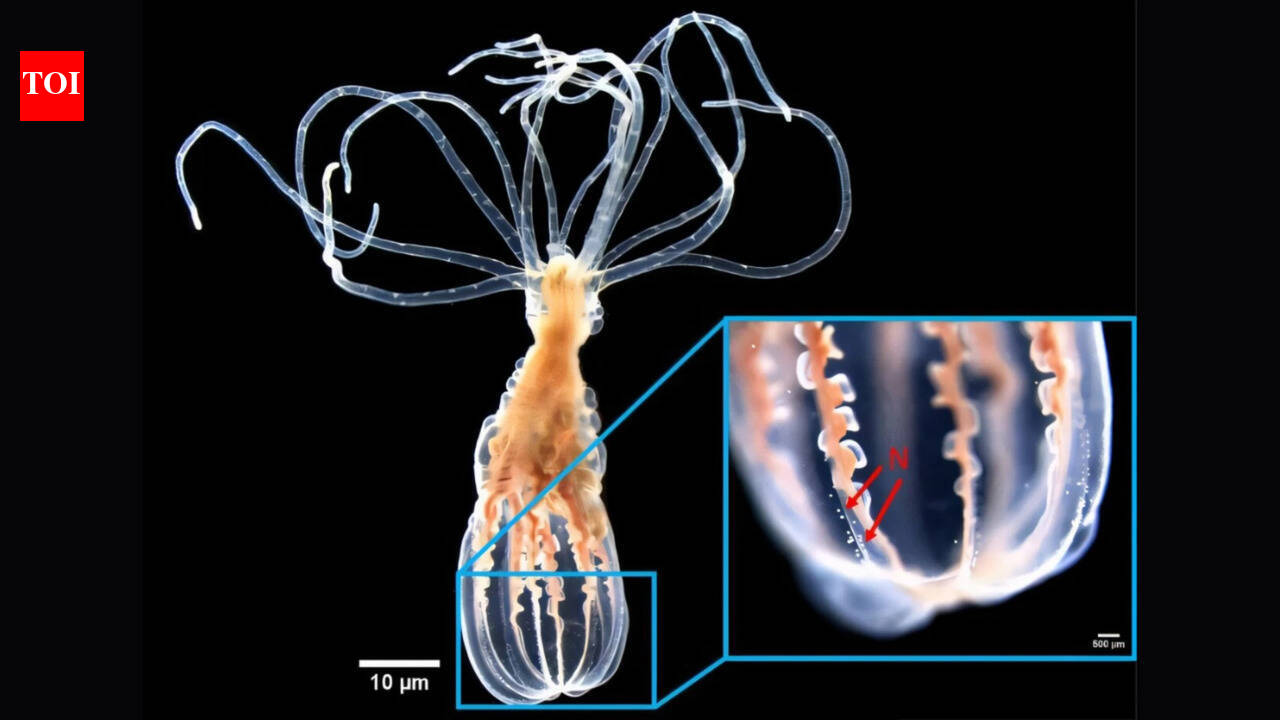

The sea anemone Nematostella vectensis. In the enlarged section, the nematosomes—which are key to the immune system of these invertebrates—are highlighted. (Credit: HHU/Nida Kaya)
A simple sea anemone (a small plant with white, red, blue or purple flowers that are shaped like cups and have dark centres) can distinguish helpful bacteria from harmful invaders despite lacking antibodies or immune memory cells. This challenges long-held assumptions about how early animal life defends itself.Researchers from Heinrich Heine University Düsseldorf and Kiel University discovered that the starlet sea anemone (Nematostella vectensis) uses specialized mobile cell structures to selectively swallow and destroy non-native bacteria while leaving its own beneficial microbiome intact.The findings, published in Nature Communications, prove that the targeted identification of microscopic life developed hundreds of millions of years earlier in evolutionary history than scientists previously believed.
Beyond the adaptive immune system
For decades, biological textbooks taught that simple invertebrates possessed only a basic, non-specific innate immune system. According to this traditional view, targeted discrimination required the complex adaptive immune system of vertebrates, which relies on specialized antibodies and memory cells trained through exposure to pathogens over a lifetime.The new study demonstrates that this evolutionary model is outdated. The team focused on nematosomes, which are motile, multicellular bodies moving inside the sea anemone’s internal cavity. These structures develop from special tissues called mesenteries and contain both stinging cells and immune-like cells capable of phagocytosis….. which is the process of engulfing and digesting bacteria.Experiments showed that nematosomes actively hunt, engulf, and break down foreign bacteria that enter the creature. At the same time, these cell clusters ignore the resident bacteria that naturally belong to the sea anemone, preserving the delicate microbial balance needed for the host animal to survive.
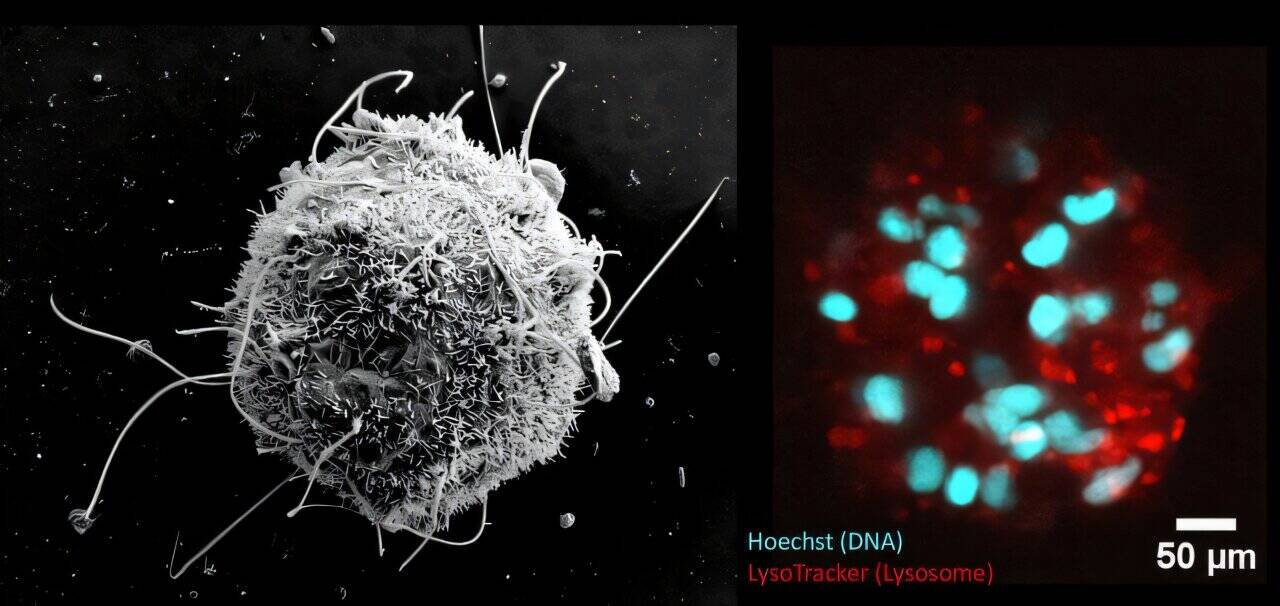
Images of a nematosome taken using a scanning electron microscope (left) and a confocal microscope (right). Credit: HHU/Nida Kaya
Disabling the genetic switch
To understand how nematosomes identify different types of bacteria, the researchers turned to gene editing. They identified a core gene called cJun that appears to regulate nematosome activity.Using CRISPR/Cas tools, the team switched off the cJun gene in a group of sea anemones. The modified animals produced far fewer nematosomes and completely lost their capacity to tell foreign bacteria apart from their own natural microbiome. As a direct result, the altered sea anemones suffered from internal microbial imbalances and became far more vulnerable to fatal bacterial infections.The gene also controls the destruction of bacteria after they are swallowed. Normally, nematosomes break down harmful microbes inside lysosomes, small compartments filled with digestive enzymes. Without cJun, this breakdown process failed, allowing bacteria to survive inside the cells instead of being destroyed.Dr Nida Kaya, lead author of the study who conducted the research for her doctoral thesis, highlighted the broader implications for immunobiology.“Our findings show that the targeted identification of microorganisms is not a privilege restricted to the adaptive immune system,” Dr Kaya said. “Rather, even invertebrates already possess sophisticated mechanisms for supporting beneficial microorganisms and selectively controlling potentially harmful bacteria.”
Ancient foundations of immune memory
The research was conducted through the Collaborative Research Centre 1182, an interdisciplinary network supported by the German Research Foundation that investigates how multicellular organisms form functional units with specific microbial communities.Cnidarians, the group that includes sea anemones, jellyfish, and corals, split from the evolutionary line leading to humans more than 600 million years ago. Studying Nematostella vectensis provides a rare glimpse into the earliest defence mechanisms in animal evolution.Beyond explaining daily microbial management, the discovery opens up new avenues for exploring how simple organisms remember past threats. Invertebrates frequently respond more effectively to a pathogen after an initial exposure, even though they lack traditional memory cells—a phenomenon known as “trained immunity” or innate immune memory.Because nematosomes can distinguish between closely related bacterial strains under the control of the cJun gene, researchers plan to use them as a practical model to map the exact signaling pathways behind innate memory.Professor Dr Sebastian Fraune, head of the research team at the Heinrich Heine University Institute of Zoology and Organismic Interactions, noted that these primitive pathways reveal basic principles preserved across animal evolution.“The ability to identify microorganisms on a selective basis is thus likely to be significantly older than assumed to date and already developed early on in the evolution of these animals,” Professor Fraune said. “The so-called immunological memory of invertebrates is particularly interesting in this context. Once they have encountered certain pathogens, they seem to be able to respond more quickly or effectively to repeated contact, even without an adaptive immune system.”
Maternal transfer of living immune guards
Beyond protecting adult animals, nematosomes serve an unexpected generational role by transferring immune defenses directly from parent to offspring.When female starlet sea anemones spawn, they release their eggs packaged within a thick, protective jelly mass. Embedded inside this gelatinous matrix are hundreds of active nematosomes transferred directly from the mother’s body cavity.Because developing embryos lack their own functional tissues, they are particularly vulnerable to environmental bacteria and microscopic egg predators. By supplying these free-swimming immune clusters alongside her eggs, the mother provides an external defensive shield.The active nematosomes patrol the surrounding jelly layer, neutralizing potential bacterial threats before the young hatch into swimming larvae. This maternal transfer shows that early animals developed ways to pass non-antibody immune protection down through generations long before complex adaptive immunity appeared. Go to Source