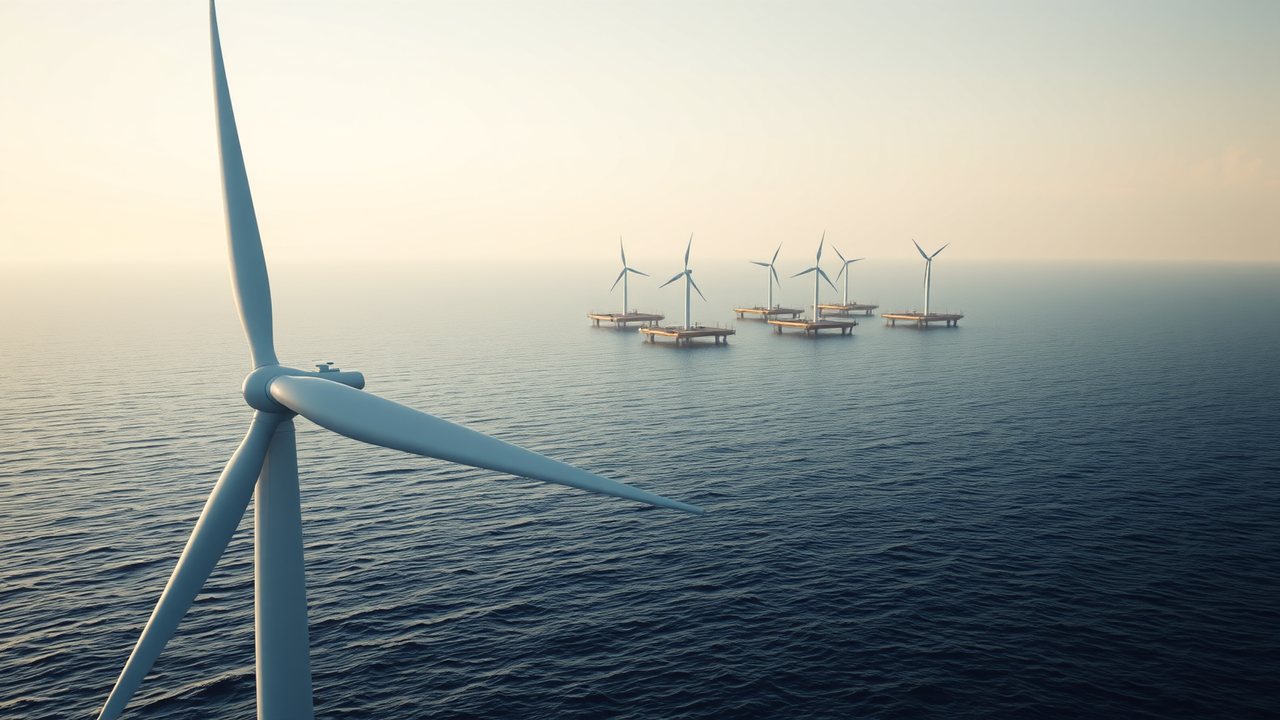

Japan is an island nation with plenty of wind and a whole lot of ocean, but building wind turbines out at sea has never been simple for the country. Most coastal waters around Japan drop off steeply into deep water within just a few kilometres of shore, which rules out the fixed, seabed-mounted turbines used in shallower parts of Europe. So instead, Japan has been developing turbines that float on the surface, held in place by mooring lines rather than concrete foundations sunk into the seabed. This year marked the country’s first real step into commercial floating wind, and Tokyo has already announced plans for something ten times bigger, a project that would eventually place the equivalent of a nuclear power plant out in the open ocean.
Why floating turbines make sense for Japan
Unlike countries with wide, shallow continental shelves, Japan’s coastline plunges quickly into deep water, and floating turbines can be installed in water depths of up to 300 metres, something a traditional fixed foundation simply cannot handle. Rather than drilling into the seabed, these structures use large buoyant platforms secured with mooring lines and anchors, letting turbines sit safely on the surface even far out to sea. Japan’s total offshore wind potential is estimated at around 9,000 terawatt-hours a year, more than nine times the country’s projected electricity demand by 2050, and a large share of that potential exists specifically in deeper waters where only floating technology will actually work.
Japan’s first commercial floating wind farm goes live
Japan officially entered commercial floating wind territory on January 5, 2026, when the Goto Floating Wind Farm off Nagasaki Prefecture began commercial operations. Located roughly 7 kilometres off Fukue Island, in water depths of about 130 to 140 metres, the project uses eight Hitachi turbines mounted on a hybrid spar-type floater, a design featuring a steel upper section and a concrete lower section. According to reporting by The Maritime Executive, Goto represents the world’s first commercial use of this particular hybrid floater design, and the project took nearly a decade of planning and construction to reach this point.
Why the Goto project matters beyond its size
Goto is a relatively modest project in terms of output, but its real significance lies in proving that floating wind technology can actually work at a commercial scale in Japanese waters, not just as a small-scale demonstration. The consortium behind the project includes Toda Corporation, which designed and built the floater, along with major energy players like ENEOS, Osaka Gas, INPEX and two of Japan’s regional electric utilities. Getting this kind of commercial project running is seen as a critical step toward Japan’s broader target of reaching 10 gigawatts of offshore wind capacity by 2030, with floating turbines specifically expected to contribute 15 gigawatts toward a wider 45-gigawatt offshore wind goal by 2040.
Tokyo’s plan for the world’s largest floating wind farm
While Goto proved the concept, Tokyo has much bigger ambitions. The Tokyo Metropolitan Government is developing plans for a floating wind farm off the Izu Islands, a chain of volcanic islands south of Tokyo Bay, targeting at least 1 gigawatt of capacity, roughly ten times larger than the current largest floating wind farm operating in Norway. According to Windtech International, the Tokyo Metropolitan Government is set to begin seabed surveys from April 2026 to assess site conditions ahead of a potential commissioning timeframe around fiscal year 2035.
How this project would power both islands and the capital
The plan focuses on waters near five island communities in the Izu chain, Oshima, Niijima, Kozushima, Miyake and Hachijo, chosen partly for their naturally strong and steady winds. Electricity generated offshore would travel to shore through high-voltage subsea cables, feeding both the remote island communities and the mainland grid supplying Tokyo. If it reaches its 1 gigawatt target, officials estimate the project could supply electricity to roughly 850,000 households, all from turbines floating far out at sea rather than a single power plant on land.
The real challenges standing in the way
Ambitious as it sounds, this project still has a long way to go before construction even begins. The Izu region is currently classified only as a preparation zone, the earliest stage in Japan’s offshore wind development process, and analysts have questioned whether the 2035 target is realistic given that offshore wind projects typically take well over a decade to move from planning to actual operation. Cost is another sticking point, since rising material prices and a weaker yen have already pushed at least one major Japanese company to pull out of large wind projects elsewhere in the country, leaving private investors somewhat cautious about committing to offshore projects with long payback periods.
What this means for Japan’s energy future
Whether or not Tokyo’s Izu Islands project hits its 2035 target, Japan’s push into floating offshore wind marks a genuine shift in how the country plans to generate clean energy. With limited shallow coastal waters but enormous deep-sea potential, floating turbines offer Japan one of its few realistic paths toward serious offshore wind capacity, and every megawatt generated this way chips away at the country’s heavy reliance on imported fuel. Projects like Goto and the planned Izu Islands wind farm represent Japan’s attempt to turn its geography, normally seen as a limitation for offshore wind, into a genuine long-term energy advantage. Go to Source