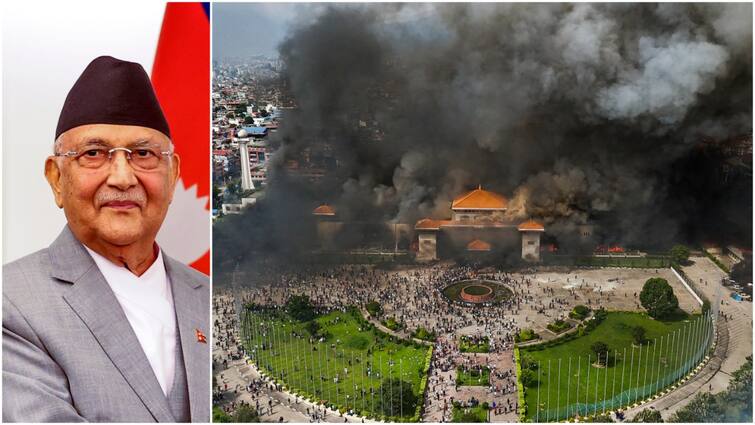

Gen-Z protesters in Nepal are continuing their mass demonstrations even after Prime Minister KP Sharma Oli’s resignation. This highlights a deep-rooted frustration with entrenched corruption, inequality, and generational disconnect from the country’s political elites and their children, dubbed ‘Nepo kids’.
Roots Of Unrest
The immediate spark for the protests was the government’s sudden decision in early September 2025 to ban 26 major social media platforms, including Facebook, YouTube, and X, following viral campaigns that exposed nepotism and the ostentatious lifestyles of politicians’ children — widely referred to as ‘Nepo Kids’.
This move struck a particularly raw nerve for Nepal’s overwhelmingly young population, where Gen-Z (median age 25) depends on social media for information, activism, and social life.
In Nepal, social media isn’t just entertainment—it’s a lifeline. The country has one of South Asia’s highest user rates per capita. When the government abruptly blocked major apps, citing registration issues with the information ministry, critics saw it as an attempt to silence anti-corruption campaigns spreading online.
- Social media bans were seen not just as censorship but as a direct attack on the means by which Nepal’s youth communicate and mobilise.
- The protests quickly morphed into a broader movement against systemic political corruption, deepening economic inequality, and the lack of accountability for Nepal’s wealthiest and most powerful families.
- Violent clashes with the police, including the use of live ammunition against crowds, resulted in at least 19–22 deaths and hundreds injured, further inflaming demands for justice and reform.
Why Protests Continue After Oli’s Fall
Despite KP Sharma Oli’s resignation, demonstrators have not dispersed, seeing his exit as “just one face” of a broader, “corrupt” system.
- Many protesters want a complete overhaul, not just a change in leadership. They’re demanding new elections, accountability for protest deaths, and the prosecution of officials involved in corruption and repression.
- There is widespread cynicism that the country’s next government could be similarly compromised, as most major parties have participated in patronage politics and “dynastic privilege”.
- The arrest or resignation of a few top leaders is viewed as insufficient since the broader structures of privilege and impunity remain intact.
What Do Protesters Want Now?
The protesters’ agenda is sweeping, with reforms that could redefine Nepal’s political system. Their key demands include:
- Dissolution of the current House of Representatives, citing loss of public trust.
- Amendment or rewriting of the Constitution with active involvement of citizens, youth, and experts.
- Fresh elections after an interim period, ensuring free, fair, and direct public participation.
- “Justice” for those killed during the protests; declaring them ‘martyrs’.
- Directly elected executive leadership replacing the current structure.
- A full investigation into assets allegedly looted by corrupt politicians over the past three decades, with illegal wealth to be seized by the state.
- Sweeping reforms in five key sectors for institutional reforms: education, health, justice, security, and communications.
What’s Next for Nepal?
Nepal now faces a period of acute political uncertainty. Here’s what is compounding the situation:
Parliament is deeply fractured, with the ruling coalition in disarray and opposition parties lacking a clear majority or consensus for forming a new government.
The army has been deployed to restore order, curfews remain in effect in several cities, and the political elite appears isolated from the youth-led movement’s demands.
New reformist leaders such as Kathmandu’s popular mayor, Balendra Shah (“Balen”), have gained prominence among protesters, but bridging the gap between grassroots activism and stable national governance poses major challenges.
The risk of further unrest is high if the next government is perceived as a continuation of the old order, or if security forces respond with renewed force rather than reform.