
- India’s East policy faces trade deficits, slow FTA reviews.
- Australia’s ECTA shows modest export growth, large trade deficit.
- ASEAN trade deal review delays worsen India’s widening deficit.
Prime Minister Narendra Modi’s three-nation tour to Indonesia, Australia and New Zealand, closely following the visit of Japan’s Prime Minister Takaichi Sanae, reinforces New Delhi’s decisive shift, since 2014, from just Looking East to a proactive engagement with countries in ASEAN and elsewhere in the region. But it is also proving to be a tough act to follow.
Even as collaboration on industrial development, the financial sector, critical minerals and energy deepens between India and its trade partners in the East, large trade deficits keep India’s trade balance skewed. FTAs are caught between long waits for reviews or reviews which simply do not start, limiting India’s benefits.
Australia: ECTA Yet To Deliver Its Full Potential
In the case of Australia, India and Canberra are better positioned with a deepening partnership anchored by the India-Australia Economic Cooperation and Trade Agreement (ECTA), which completed four years in April 2026.
The deal, however, has yet to reap the dividends of a full-blown FTA, as somewhat indicated by Prime Minister Narendra Modi and his Australian counterpart Anthony Albanese in the MEA’s Joint Statement, which reaffirms their commitment to progressing towards an ambitious, balanced and mutually beneficial Comprehensive Economic Cooperation Agreement (CECA).
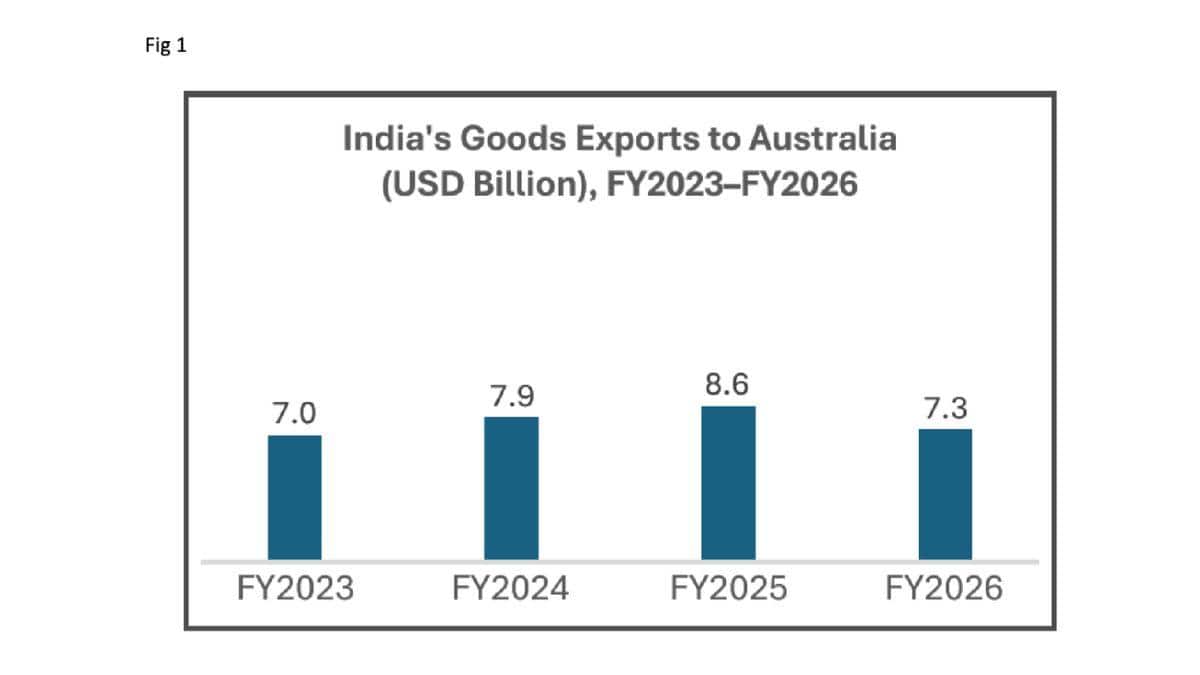
Clearly, the ECTA has yet to unlock the full potential of the economic relationship. (See Fig 1)
Sharp Trade Mismatch
Four years after the ECTA came into force, India’s exports to Australia rose modestly from $7.0 billion in FY2023 to $7.9 billion in FY2024, $8.6 billion in FY2025 and $7.3 billion in FY2026, at only 1.6 per cent CAGR, according to Rubix Data Sciences.
“The relatively subdued export growth indicates limited expansion in export penetration so far under the ECTA framework,” states the Rubix report.
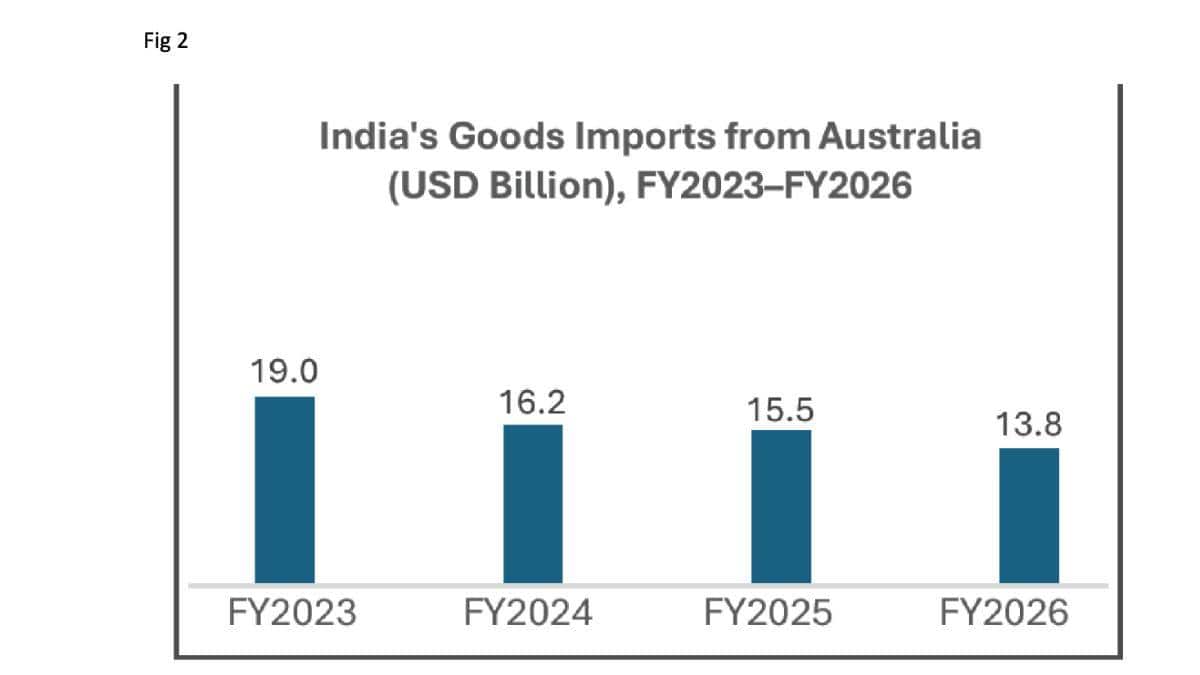
On the other hand, India’s imports from Australia have consistently remained higher than exports, at $19.0 billion in FY2023, $16.2 billion in FY2024, $15.5 billion in FY2025 and $13.8 billion in FY2026. However, there has also been a decline, with the data showing a CAGR of 10 per cent.
Overall, India-Australia bilateral goods trade declined from $26.0 billion to $21.1 billion in FY2026. (See Fig 2)
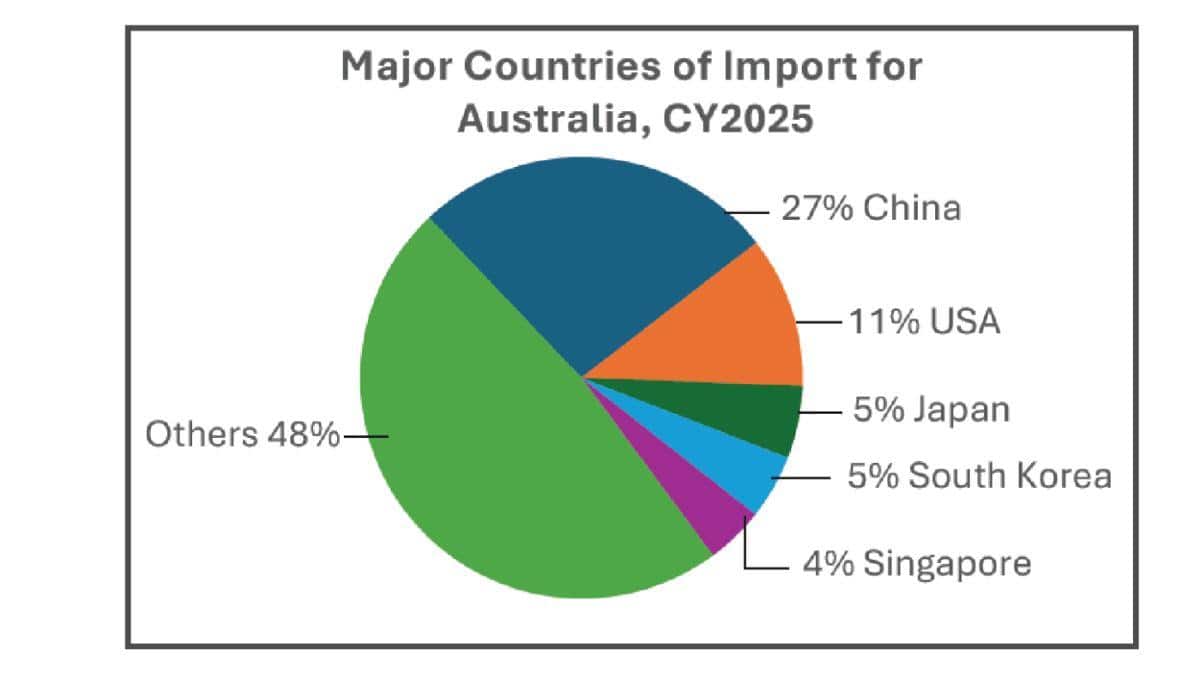
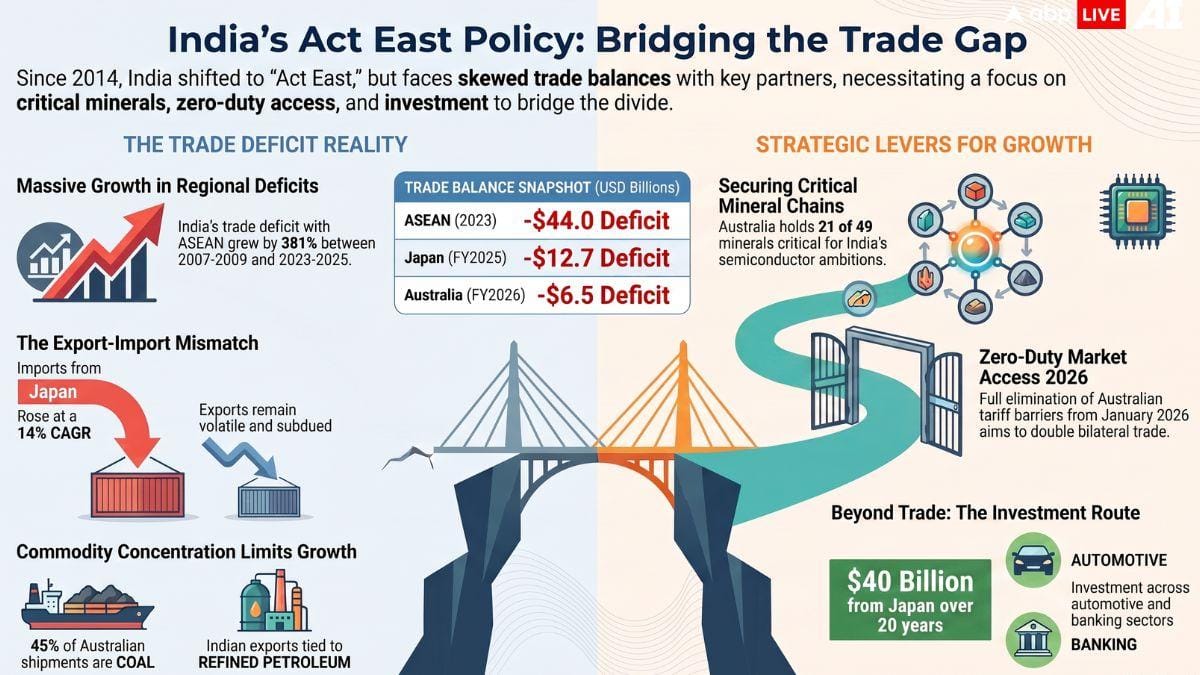
India continues to have a deficit in merchandise trade with Australia, largely due to coal imports, which dominated shipments to India with a 45 per cent share in FY2026.
Another problem is that India’s exports to Australia remain heavily concentrated in refined petroleum products, though their share has declined from 42 per cent in FY2023 to 37 per cent in FY2026.
Growth and the broadening of India’s export basket under the ECTA framework have been slow but steady in higher-value and emerging categories such as pharmaceuticals, gold jewellery, industrial machinery and passenger vehicles, according to Rubix data.
Also Read : Should You Let AI Manage Your Money? The Pros And Cons Of Financial Automation
Tushar Bhaskar, President, Rubix Data Sciences, feels that what most conversations about India-Australia trade miss is the minerals dependency running through it.
“Australia holds 21 of the 49 minerals India has flagged as critical, at a time when India’s clean energy and semiconductor ambitions need exactly that kind of supply security. We feel that is a bigger long-term story than the trade deficit numbers,” says Bhaskar.
In that context, the outcome on India-Australia collaboration for the development of secure critical minerals supply chains, including through coordinated investment, regulatory alignment, and recycling and recovery, is a significant bilateral development. (See Fig 3)
In the long term, industry is optimistic that the zero-duty market access for all Indian exports into Australia from 1 January 2026 will enhance India’s competitiveness through the elimination of remaining tariff barriers and expand price advantages across the entire export basket in the Australian market.
The implementation of the ECTA has the potential to double bilateral trade in goods and services to $45 billion in five years, according to an estimate by the Confederation of Indian Industry (CII).
ASEAN Deal Review Drags
Though India and Indonesia, a key member of the ASEAN grouping with which India has had the ASEAN-India Trade in Goods Agreement (AITIGA) since 2010, have a lot at stake in an upgrade of the pact towards unleashing the full potential of trade and commerce, the review remains a work in progress.
While both Modi and President Prabowo Subianto have expressed mutual interest in the timely re-evaluation of the AITIGA for a balanced, mutually beneficial and facilitative trade environment, as per the MEA’s Joint Statement, a timeline for completing the AITIGA review remains elusive. (See Fig 4)
The case for an expeditious AITIGA review has never been stronger, with the “deeper bilateral trade engagement” proposed by the two leaders resting significantly on correcting India’s widening trade deficit with ASEAN, which will also help boost India’s merchandise shipments to Indonesia, the largest country in the 10-member grouping by land area, population and nominal GDP.
Established in 2009 and implemented between 2010 and 2011, the first review of the agreement was expected by 2025, as agreed by both regions to tackle the growing trade asymmetry.
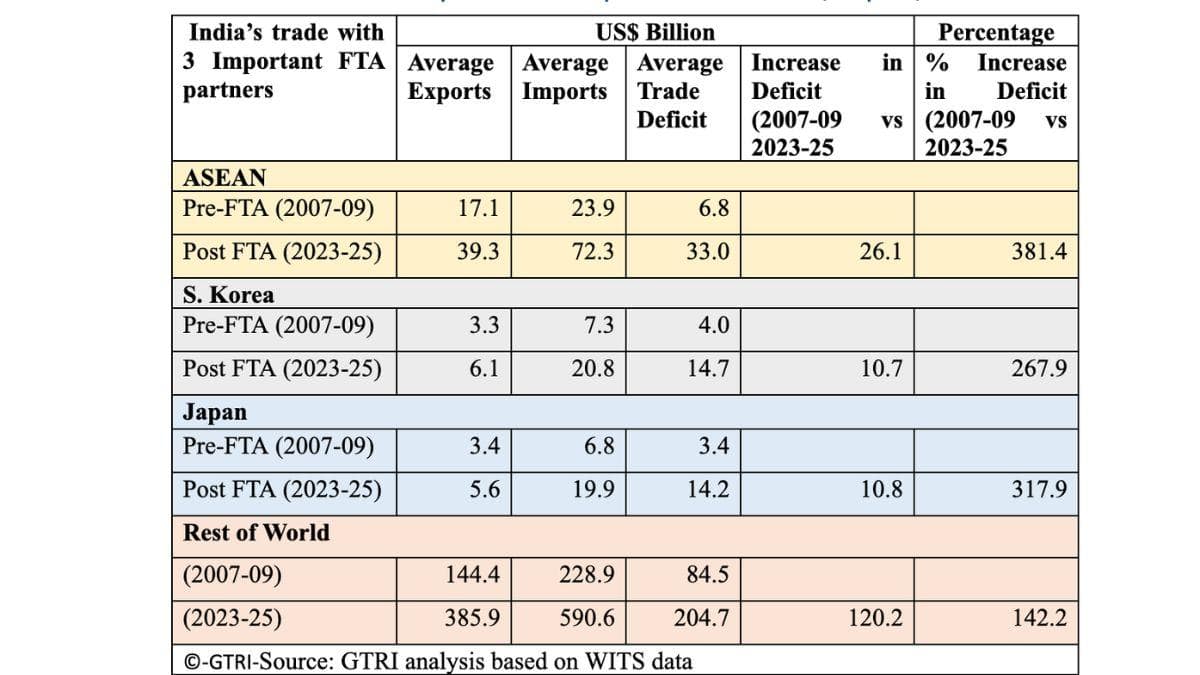
“Between 2007-09, before the FTAs took effect, and 2023-25, India’s trade deficit with ASEAN grew by 381 per cent and with Japan by 318 per cent. India’s trade deficit with the rest of the world increased by 142 per cent,” informs Ajay Srivastava, founder, Global Trade Research Initiative.
According to other industry data, between FY2009 and FY2023, India’s imports from ASEAN surged by 234.4 per cent, while its exports to the bloc increased by only 130.4 per cent.
India’s trade deficit with ASEAN widened from $7.5 billion in 2011 to approximately $44 billion in 2023.
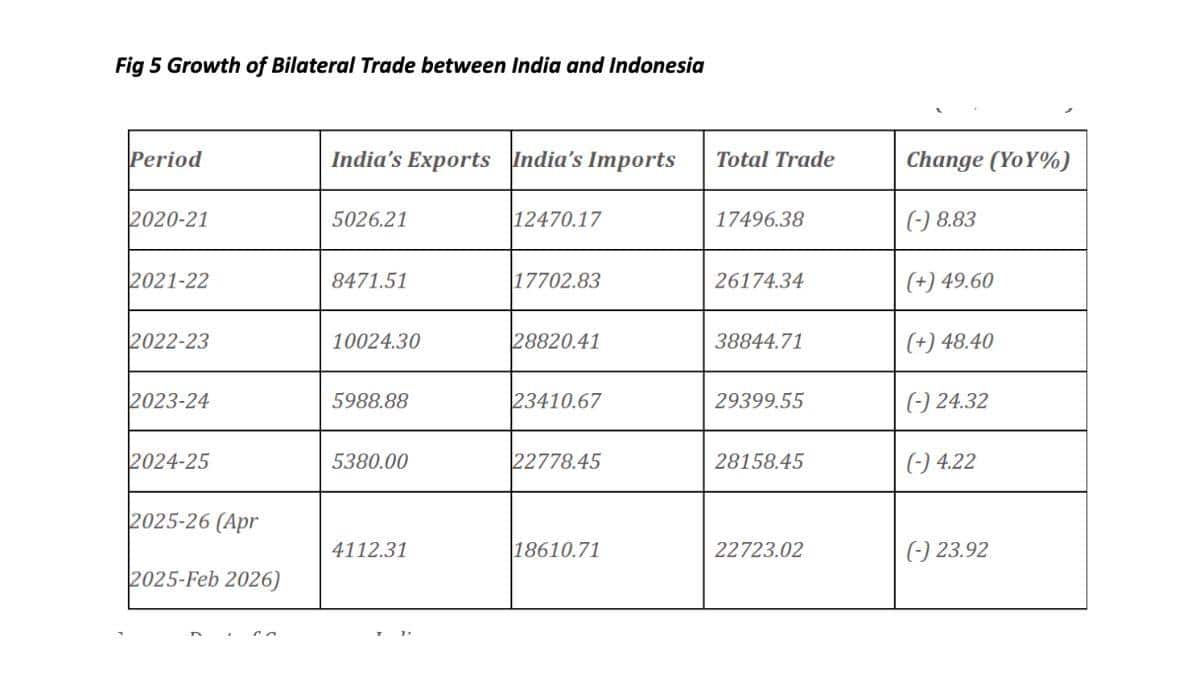
Over the years, on the bilateral front, Indonesia may have emerged as India’s second-largest trade partner in the ASEAN region and India as Indonesia’s third-largest export destination in 2025. However, beyond the hype, bilateral goods trade has, in fact, declined from $38.8 billion in FY2023 to $24.8 billion in FY2026, registering a negative 14 per cent compounded annual growth rate (CAGR), driven mainly by falling exports, recorded at $4.5 billion, and moderation in imports to $20.3 billion, according to Rubix Data Sciences.
India’s trade deficit has narrowed to $15.8 billion, though it remains substantial. (See Fig 5)
There are two things that an AITIGA review can help address.
Indian exports, ranging from petroleum products, automobiles, pharmaceuticals and engineering goods, face non-tariff barriers in ASEAN markets, including stringent standards, regulatory hurdles and delays in customs procedures, which have collectively curbed India’s export potential.
Second, Indian SMEs also have to compete with ASEAN’s more integrated production networks and efficient logistics infrastructure.
“Besides, with most of India’s FTA partners already open economies with low tariffs, ASEAN countries are increasingly becoming manufacturing hubs for supplying the Indian market and Indonesia is among the countries where Chinese companies have invested heavily,” points out Srivastava.
India-Japan CEPA
It is not only the AITIGA whose re-evaluation has dragged on, but also the Comprehensive Economic Partnership Agreement (CEPA) between India and Japan, which came up during the recent visit of Prime Minister Takaichi Sanae.
India and Japan have concurred on accelerating the review of the implementation, as well as the full and effective utilisation of the CEPA, to make it more forward-looking, according to the MEA’s Joint Statement.
Japan is a key pillar of India’s Act East Policy, but more than 15 years have passed since the two countries signed the CEPA, which came into force on 1 August 2011.
Over the years, as the MEA’s bilateral brief points out, 94 per cent of the items traded between India and Japan in 2011 saw tariff reductions by 2021, facilitated by a stable framework under the CEPA that ensured tariff certainty, regulatory predictability and an environment for deeper collaboration between India and Japan. (See Fig 6)
Despite these complementarities, there has been little movement on the CEPA, even though the two sides have underlined the need to correct various trade asymmetries and India has a strong need to diversify and strengthen exports.
Rajiv Kher, former Commerce Secretary, calls Japan a very intricate market driven largely by a few factors.
“Japan has a very high quality product consciousness and a strong cultural barrier, manifested also in the art of doing business, which itself in Japan is very complicated. In Japan you have to establish long-term relationships and the Japanese decision-making process is very time-consuming because they would very gradually make an assessment of their potential partner and, once they are convinced over a couple of years, only then do they loosen out and the business starts,” Kher told ABP Live.
Also Read : Using E20 Petrol? Govt Says You May Get Less Mileage, But There’s A Catch
Beyond Trade Figures
Then there are minor things like data.
“The bilateral trade data reconciliation itself is an issue. Many a time, the trading partner under a CEPA or FTA shows one set of data which is higher or lower for its trade; hence, reconciliation itself is an issue.
Another factor in the case of Japan is that Japan came through an investment technology route. Japan has invested very heavily in India, to the tune of approximately $40-40 billion in the last 20 years across banking, automobiles and the technology investment route.
The point is that you can’t look at the success of an agreement merely by how much exports and imports you have done. You have to look at the level of investment the agreement has facilitated,” reasons Kher.
India’s trade with Japan has increasingly come to be characterised by a volatile export curve, says a Rubix Data Sciences insight.
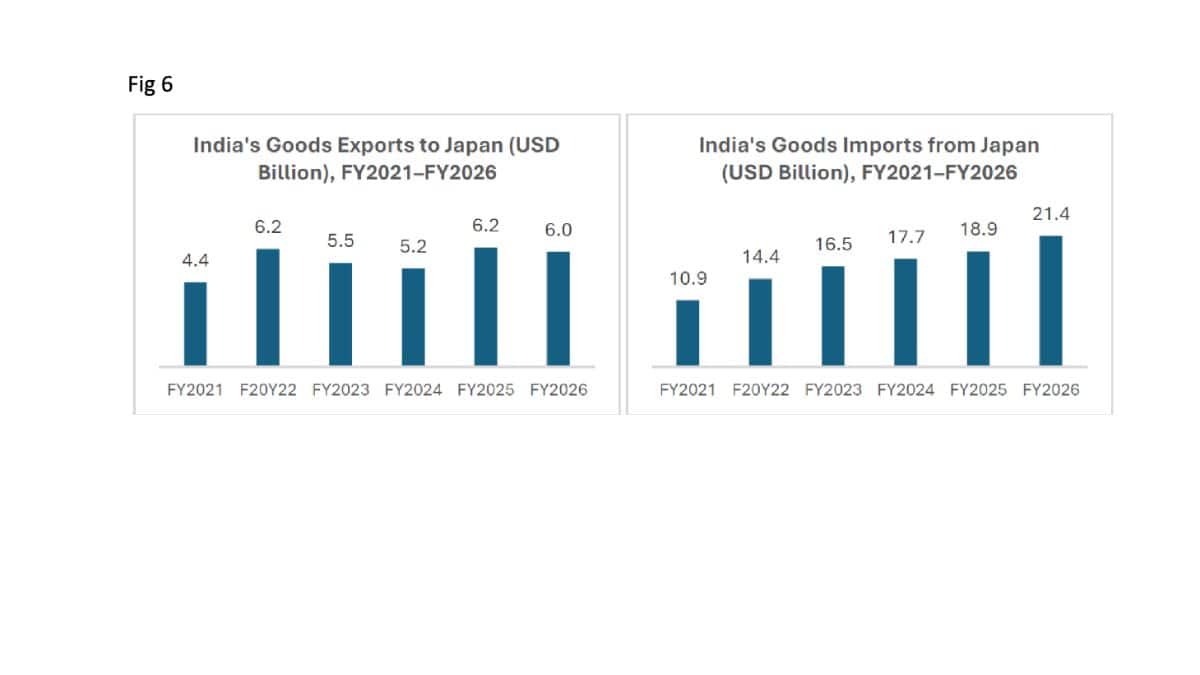
According to other sources, India’s total trade with Japan in FY2020-21 was $15.33 billion, with imports of $10.9 billion and exports of $4.43 billion.
The surging import trajectory saw India’s goods shipments from Japan rise from $10.9 billion in FY2021 to $18.9 billion in FY2025, registering a robust 14 per cent CAGR and significantly outpacing export growth.
India’s trade deficit with Japan widened from $6.5 billion in FY2021 to $12.7 billion in FY2025, growing by more than two times, driven by faster growth in imports than exports.
By FY2025-26, of the two countries’ bilateral trade of $27.48 billion, Japanese imports stood at $21.44 billion, while India’s exports were $6.04 billion, according to Government data.
According to Rubix, India is way down in Japan’s pecking order of trade partners at the 14th position, with a total bilateral trade share of 1.75 per cent, while Japan ranks 10th among India’s trade partners, with a 2.26 per cent share.
Nagesh Kumar, Director, Institute for Studies in Industrial Development (ISID), observes in his study, Harnessing India-Japan Economic Partnership for Supply Chain Resilience, that despite deepening political engagement and institutional mechanisms, including the CEPA, the India–Japan economic partnership has failed to realise its well-recognised potential.
This is especially so in sectors such as textiles, pharmaceuticals, agriculture and services. (See Fig 7)

Diversifying India’s Export Basket
Kumar calls for an urgent need to diversify the products that India exports, especially labour-intensive products such as textiles and garments, leather goods and footwear, processed foods, gems and jewellery, furniture and toys, among others, which Japan imports in very large quantities from China but only minimally from India.
Japan imports apparel worth around $30 billion per year, nearly 60 per cent of which comes from China, 15 per cent from Vietnam, 5 per cent from Bangladesh and 5 per cent from Cambodia. India’s share is less than 1 per cent of Japan’s apparel imports, Kumar points out.
The ISID Director urges a review of the CEPA in consultation with businesses in both countries to identify problem areas and the non-tariff and process-oriented barriers that Indian exporters face in exporting labour-intensive goods, such as textiles, garments and processed foods, to Japan. He also recommends capacity building, especially for MSMEs, to help them comply with those standards.
Also Read : India-UK Trade Deal: Import Duty On UK Cars Cut, Here’s What Changes From July 15